If we are curious,

We can enrich our lives because we can purposefully seek meaning, instead of finding solace in empty superficiality.

Relationships can be stronger because each uplifts the other through their passions.

Organizations can work with more intention, go deeper, and become more innovative and impactful.

Cities can have more engaged and concerned citizens who can make things happen with creative solutions.

Countries can have leaders that are more informed and make better decisions for those they are serving.

The world can sustain itself for future generations.


In a conversation with Gretchen Rubin, author of The Happiness Project, we exchanged ideas about the senses, particularly about smell. She mentioned a book she was reading called The Scent of Desire by Rachel Herz. A part of it discussed olfaction as a way for human beings to choose mates and how the birth control pill may be a culprit for divorce.

The Scent of Desire by Rachel Herz

Research suggests that birth control affects women’s taste in men. It’s all in the MHCs, or major histocompatibility complexes, hidden in the scent of men. Studies show that females prefer men whose MHCs differ from their own, perhaps to increase chances of  survival—the resulting offspring will then bear more diverse MHC profiles.

But being on the pill creates a preferential shift towards men with similar MHCs. Relationship troubles can then start when the woman gets off the pill; she begins to be attracted to MHC-dissimilar men and is less attracted to the MHC-similar guy she’s with.

In simpler terms, being on the pill can make you attracted to Mr. Wrong, and you realize it when you get off the pill.

(Read more at Psychogical Science.)

One of the best things I learned since moving back to Manila is The Mind Museum.

The Mind Museum at Taguig. Image via The Mind Museum’s Facebook page

It was a great day to reconnect with the city, and it was an even better surprise when I discover that one of my former capoeira classmates now works there as an exhibit manager.

The building itself is a gorgeous piece of architecture led by Ed Calma (featured in the December 2011 / January 2012 issue of Fast Company). It is a significant addition to the commercial, artistic, and residential landscape of Fort Bonifacio.

There are five galleries in two floors spread over 5,000 square-meters:

  1. The Story of the Universe: Its Beginning and Majesty
  2. The Story of the Earth: Its Story Across the Breadth of Time
  3. The Story of Life: The Exuberant Varieties of Life
  4. The Story of the Atom: The Strange World of the Very Small
  5. The Story of Technology: The Showcase of Human Ingenuity
It’s such a great example of interactivity in a science museum. The major theme is nature in scale. Visitors can go through a human brain, see a skeleton of a T-rex up close, and come across scientific concepts by experiencing them. It has been open since March, but already has gained visits from locals and tourists alike.
Maribel Garcia, curator, emphasized the importance of scientific correctness and emotionally grabbing the viewers—an opinion that   I share, and one that triggered this “science meets art” trajectory in my life.
Visit The Mind Museum site.

Image via Penning Perfumes

What happens when you mix olfaction and poetry? In this brilliant proejct, Penning Perfumes explores the intersection between these two seemingly unrelated worlds. It is the brainchild of “olfactress” (don’t you just love that word?) Odette Toilette and poet/editor Claire Trevien. Poets pen new pieces of work in response to mystery fragrances while perfumers create new fragrances based on poems.

(More via The Guardian. HT @brainpicker)

Returning to a city after many years is both pleasurable and vexing.

You are both resident and stranger. The shapes, sounds, and smells have both changed and remained the same.

My three major “homes” so far—Manila, New York, and Barcelona—are all port cities. In both historic and modern times, they have been the site of international trade, cultural intermixing, and political upheavals. Their faces dissolve and stabilize with the ebb and flow of both tide and time.

I am reminded of Cities of You, a beautiful project by Brian Foo, a web developer and “joy evangelist” whom I first encountered online when he submitted a sketch for DrawHappy.

Cities of You is a project that envisions people as imaginary places. It was inspired by Italo Calvino’s Invisible Cities. Each artwork represents a person and also a relationship. Brian writes:

“I travel through each city and describe their special properties—how the buildings are built, how the people live, its history, culture, and reputation. As the project progresses, I revisit some cities, describing how they evolve over time or enter unexplored parts of the cities. The intended result is to be able to imagine relationships as dynamic spaces in which one can visit, walk through, and explore.”

I enthusiastically backed his Kickstarter project, which surpassed his initial goal of $2,000 and raised $11,000. The project is the publication of the first 41 cities he designed. His book is a gorgeous labor of love, alive with drawings, paintings, and prose. An overwhelming response from his supporters also led him to upgrade all the rewards, including a lifetime of gifts. (Yes, you read that right. I and 140 other backers are looking forward to receiving annual presents for the rest of our lives.)

Cities of You, volume 1. Image by Brain Foo via his Kickstarter project page

A couple of weeks ago,  Brian drew me as a city, too. Voila, I’m City #44! It’s quite an honor. Even though we haven’t known each other for very long, I think he nailed it:

“If you walk through the city of Orynnaci, the buildings are tall, bare, and ordinary. However, if you stare at a building, look away, then look back again, the building may change. Or sometimes, a building can disappear, or merge with another one. As a tourist, you may begin to recognize past cities you have visited if you stare long enough. Some buildings lose their form entirely. Walk down Main Street and you will see most citizens standing still with their head tilted back, tracing shapes with an outstretched arm. On the face of city hall, three words are inscribed in Latin, loosely translating to ‘Imagination, Perception, Metaphor’.” —Brian Foo

City #44: Orynnaci
24 x 18″, Gouache and Colored Pencil on Paper
Image and Text copyright by Brian Foo

Visit the project’s site here.

A farewell illustration I made for my taekwondo school, because I’m a sentimental crybaby.

Three days away from New York. I need to kick something.

Rewind to last Friday. I always spend part of my last day in a country in my taekwondo school. Call me strange, but for me having the final words from my masters is almost like being blessed by Buddha.*

*Sort of. Give me a break; it’s hard to keep moving.

Taekwondo is the bedrock of all my beliefs, perhaps even beyond art, science, writing, and design. It is the one thing that has remained consistent in all the years of traveling and starting over, and as such, is the one thing that has never failed to give me a sense of stability and groundedness. It has been a way not to just let off steam and counter depression, but also to channel all my energy into something that is positive. It will always be my second home.

It is the closest thing I have to a religion. I could probably do without drawing, writing, or tinkering around for a few days, but I go stir-crazy if I can’t train. I’ve trained everywhere—old buildings, white sand beaches, the streets. Even in graduate school, I missed out on most of the design talks because I would always be in the dojang every night. (Was that a confession? Oops.)

It’s an addiction whose seed was planted early. I started doing this when I was thirteen, but I only took it really seriously in the past eight years when I started moving a lot. I got my black belt after fifteen years—quite a while, but starting anew is a side effect of a nomadic lifestyle. The fact that I do this has always surprised people; surely someone who hugs and squeals as much as I do couldn’t possibly be doing something so…tough. I suppose it’s what has given me the confidence to be as open and happy; it’s quite comforting to know that I can take care of myself in potentially dangerous situations. Or at the very least, I know I won’t die without putting up a fight.

Mirrors and masters

Martial arts has always mirrored my life, including all the professions I’ve ever touched. Consider design. Long before designers came up with things like “gamification” or ways of incentivizing and motivating people, martial arts have always used a belt system to “promote” you from one level to the next. Everything from the uniforms, to how the belt is tied, to structure and hierarchy, is designed, way before we ever earned badges or became mayor of something.

Training in Asia, Europe, and America has given me some insights on how differently people see martial arts, and by extension, their personal worldview. Students in Asia are always the youngest I encounter; it’s something ingrained in them (us) from very early on. In Barcelona, it was a mix of young athletes who are set on competing, as well as older ones who’ve done it for years but just want to keep training for the love of it. In New York, it’s always the most eclectic bunch, which is probably why I learn so much about life from watching students progress.

Escapism

For the most part, I find people who either want to try something new or do what I have come to define as “escapist training” – they want to transcend the usual daily grind. Occasionally, I encounter those who find their careers unsatisfactory, or have rocky relationships that they want to think about. They find the urge to kick the crap out of something to let out the frustrations of the day. I kind of like this application of martial arts; while we can’t actually go to war (unless you’re in the military or security or related professions), we can at least use it to fight our personal battles.

At its core, martial arts have little to do with the BS of the world. You either do the kick or you don’t. I see it as a method of reflection or problem solving— all the questions in your mind can be translated into movement, similar to how I’ve felt in dance. I’ve come to appreciate how it turns into a thermometer of a sort; how I feel during the day becomes so obvious and manifest by how well or poorly I train.

Bullies and therapists

It’s so incredibly beautiful the way I’ve seen people who are not competitive athletes apply this in their lives. I’ve observed kids who were bullied become more confident and sure of themselves, and adults who have made serious life decisions because of what they’ve realized through the sport.

Once, I encountered a pint-sized five-year-old who greeted me at the door after a belt test, jumping up and down and proudly holding the pieces of a board he just broke. And I wonder, what if all kids could do that and grow up believing they can do anything, that everything can be as simple as breaking a board with your foot?

Once, I helped teach a woman who sobbed every time I touched her wrist when teaching her self-defense. She told me that she once came from an abusive marriage, and all the grabbing reminded her of those awful times. Another woman came to me and said that because of training, she felt like wakes up with a lot more purpose. Always when I hear these stories, I’ve thought that some of the techniques should be a requirement for everyone, no matter what age you are.

Perhaps on a more sheepish note, most of my masters have been my therapists of a sort. I am almost embarrassed, but not quite, to say that I have cried on the shoulders of a lot of black belts over the years (because, you know, they have no choice but to listen), and now that I actually am one, it’s a testament to how titles really don’t matter. I suppose I have traumatized many a stoic traditional instructor (who I bet was laughing hysterically inside) who have had to put up with me over the years.

Some things I’ve learned so far

The belt doesn’t matter. Seriously. I see blue belts kicking the butts of black belts all the time. (From what I’ve observed, blue—the fifth color in most belt systems—is the time when I see people getting good. They’re now familiar with the foreign terms and have gotten used to testing and are committed to getting their black belts.) It’s kind of how it doesn’t matter what one’s degree is. The belt is just the thing that holds up your pants. And on that note…

Getting a black belt doesn’t mean much if you get lazy and stop. It’s like getting a degree and then not using it. Don’t get me wrong; It takes years of hard work to earn one, but I’ve always seen it as a lifelong commitment. When I finally “graduated,” I was relieved I didn’t have to start over again when I went to another school, but it wasn’t like the belt gave me superpowers. Training went on; the only difference was that I had to hold the kick pads sometimes. And it’s a lot more embarrassing if you forget things.

How you do taekwondo is how you do everything.

For BB

Is it possible to ever say goodbye to New York City?

The past two weeks, I have been gaining weight from all the brunches, lunches, dinners, coffees, mid-lunches, desserts and other invented rituals as I say “So long!” to New York once again.

This is the sixth time I am leaving a country, so by now, I know the drill. Moving to another country is quite different from moving to another state; it involves immigration papers, customs, another currency, language, and time zone. Life has gotten simpler the more this happens to me. Two years’ worth of stuff have been packed in three boxes and shipped. I don’t accumulate much anymore.

We all have our quirks. For me, it’s saying goodbye—it’s important to say goodbye! It marks the passing of time, of “properly” saying thank you for being a part of my life, whether voluntarily or otherwise. I have had rituals that were very traditional (dining out), adventurous (climbing a mountain and hiding a pepper plant in a castle for my friends to hunt for), and nonexistent (I once just left without notice). All have had different results. For this time, I think I prefer the simple ritual of having a conversation—the last one I will have with them face-to-face for a while.

It’s not just about the ritual, because it’s always good to get together with friends. Each move represents a switch, violently or not, of career directions and personalities. I’ve been a research scientist, a human rights something-or-other, a journalist and an editor, an artist and a poet, and an interaction designer. I’m quite curious (and clueless) as to what will happen to me on this leg of the journey now. And because of the chronic change, usually when I say farewell it does mean the end for most of the people I have known, who will likely never have a reason to reconnect with me ever again, who may at one point shake their heads, wonder, and go back to the anchored desks of their (relatively) stable and mortgaged lives. Sometimes, goodbyes are heartstoppingly lonely.

But they also have their entertaining side. Just what is it with farewells that makes people say the juiciest things to me? I’m quite positive I would never have heard a lot of these “confessionals” otherwise. It’s no wonder that travelers turn into storytellers in one form or another; one by one, the people I leave behind keep spilling their guts out without me having to prompt them. Amidst all the Thai lunches, American breakfasts, Japanese dinners, and English teas, I have been privy to the hidden lives of friends and colleagues alike. The secret identities, the love affairs, the hidden longings are all revealed to me like a discontinuous soap opera or graphic novel. It’s almost like they think of me as a bottle in which they can keep a message, to be tossed into choppy waters and never to be seen again, except maybe for the stranger who will pick it up on the other side of the ocean. Perhaps then I can whisper that secret, and create a legend out of that piece of gossip. Sometimes, I think they want me to.

The stories I have collected over time remain with me, long after the memory of the place has all but vanished. Sometimes, stories are all that I carry.

To say goodbye means to die a little inside, because I feel that I am leaving a part of myself behind in all the people I have met and cared about. And so once more I feel a bit lighter, a bit rootless, a little sad, but indescribably happy that the two years have meant oh so very much.

Is it possible to ever say goodbye to New York City? Nah, I’m sure I’ll see you all very soon.

For everyone I have met in NYC on this round. 

Last May 10th, my class and I finally marched (!) on stage, culminating two years of graduate work here at the MFA program in Interaction Design at the School of Visual Arts.

Our commencement speaker was the incomparable Laurie Anderson, experimental musician, composer, performance artist, and inventor, among other hats she wears. During her speech, she recounted her time as NASA’s first artist-in-residence and recalled how she was also the last one, after a politician sought to amend a bill making sure no such thing happened in the future. Anderson suggested that really, we should create artist-in-residence positions in institutions such as NASA, Congress, and other such places, which generated applause and laughter from the audience.

Laurie Anderson. Image via The Guardian.

It’s strange to be listening about art when I spent two years studying to be a designer. I have always questioned my artistic leanings, especially coming from a scientific background. I am and will always be immensely grateful for my geeky past (and who am I kidding, present), although from my experience in that world, to want to be in the arts was almost tantamount to self-banishment.  Thinking about the past six years out of undergrad—all the cancer lab rotations at Memorial Sloan-Kettering, art school in Spain, the Poetry Brothel in Barcelona—and frankly, I have to ask myself whether I actually have found what I’m looking for in a design program. And to a large extent, I did in interaction design. I always thought it was a way to humanize the sciences and the arts, which thankfully doesn’t always have to translate to something on screen. Two years in a design program have found me to be stubbornly conceptual, not because I wanted to upset my class but because that’s what I came to graduate school for. I think that if I do work for a company, I will probably spend all my waking hours designing apps and websites, and I have all the time in the world to do that.

So what is the use of an artist? After being immersed in interaction design for two years, I think that IxD shares an important thing with the arts—empathy. To be an artist, at least for me, requires me to place myself in different shoes and absorb various identities. The same is true as an interaction designer. Perhaps one thing that has been enormously helpful to be a practicing artist is the familiarity of actually inhabiting a character instead of simply watching people from afar, taking down notes.

To be an artist is to challenge the norm. While it’s wonderful to design apps and websites, it’s not the first thing I turn to when trying to give form to a project. Ironically, I do not own a smartphone, which will probably give most interaction designers a heart attack. No smartphone? What do you do when figuring out a bill, trying to find a place, or bored in a subway? Well, I try to do the algebra by hand, I talk to strangers a lot, and I write and doodle in a sketchbook constantly. It’s not a perfect system but it is a cheaper and more entertaining one. I think that we are more than our gadgets, and I think that an artistic practice allows one to experiment not just with what is, but what could be.

But more importantly, at least for me, artists are always questioning the self. Art will never lose its relevance, particularly in a time that is rife with uncertainty, though as I get older, I think each year in human history is tumultuous and unstable. On a personal scale, art allows for the exploration of selfhood in a manner that is less contained. I suppose that’s why I keep hearing of the banker who finally turned to painting, or the lawyer who is now a musician. As a scientist (I’m still wondering if I can call myself this), there are certain terminologies and protocols I have had to use for the scientific institution to understand where I am coming from. As an interaction designer, I do feel sometimes limited (although “limited” isn’t always a bad thing) by the words I have to use (hello, “user”) and the media by which I practice (wireframes and sticky notes). As an artist, I am moored to no such arbitrary islands; I can easily experiment with musical instruments as much as kitchen appliances and be equally at home with both of them

But enough with all this labeling. As I leave the comforts of school—though my classmates and my teachers alike are betting I’ll go for a PhD eventually—I would like to embrace the hyphen the comes when saying that one is a writer-artist-interaction designer-etc. I sometimes cringe when I’m only referred to as one of these, because to seemingly pledge allegiance to one field may appear as though one is relinquishing all her other interests. And wouldn’t that be such a shame.

Laurie Anderson with a pillow speaker in her mouth

But back to the red landscape of graduation at Radio City Music Hall and the blinding strobe lights. My favorite part of Anderson’s speech was the finale, when she stuffed a pillow speaker in her mouth and proceeded to sing to us for quite a long period of time with a sound that resembled Darth Vader’s voice, waking up even those who were dozing off. Afterwards, the school gave her an honorary doctorate. Lady, I just adore you.

Speaking at my first TEDx conference was a challenge. It was not just because it was a great platform for ideas, but because of the timing, design, and execution needed to pull off four interactive talks in one day.

TEDxNewHaven: The Art and Science of Happiness. Photo by Chris Randall

The theme for TEDxNewHaven was The Art and Science of Happiness. My goal for the talks was two-fold: to engage the audience in something interactive in the course of the day, and to enable them to view their senses as tools by which to achieve happiness. To achieve these, I had to produce 200 “sense kits” that contained physical, non-digital formats of my projects: HugPrints, Rorsketch, Smellbound, and EatPoetry.

Round One. Photo by Liz Danzico

First Talk: Touch

My first talk was about using our sense of touch. I presented HugPrints, my project where I am attempting to hug everyone in the world and getting visual feedback through a specially designed thermochromic vest. I asked volunteers to come up the stage to hug me.

Hugging on stage. Don’t you just love it? Photo by Chris Randall

Afterwards, I asked the rest of the audience to pull out the HugPrints cards in their sense kits, which contained hugging instructions so they can hug each other (if they wished).

Are you getting enough hugs a day? Photo by Chris Randall

Second Talk: Sight

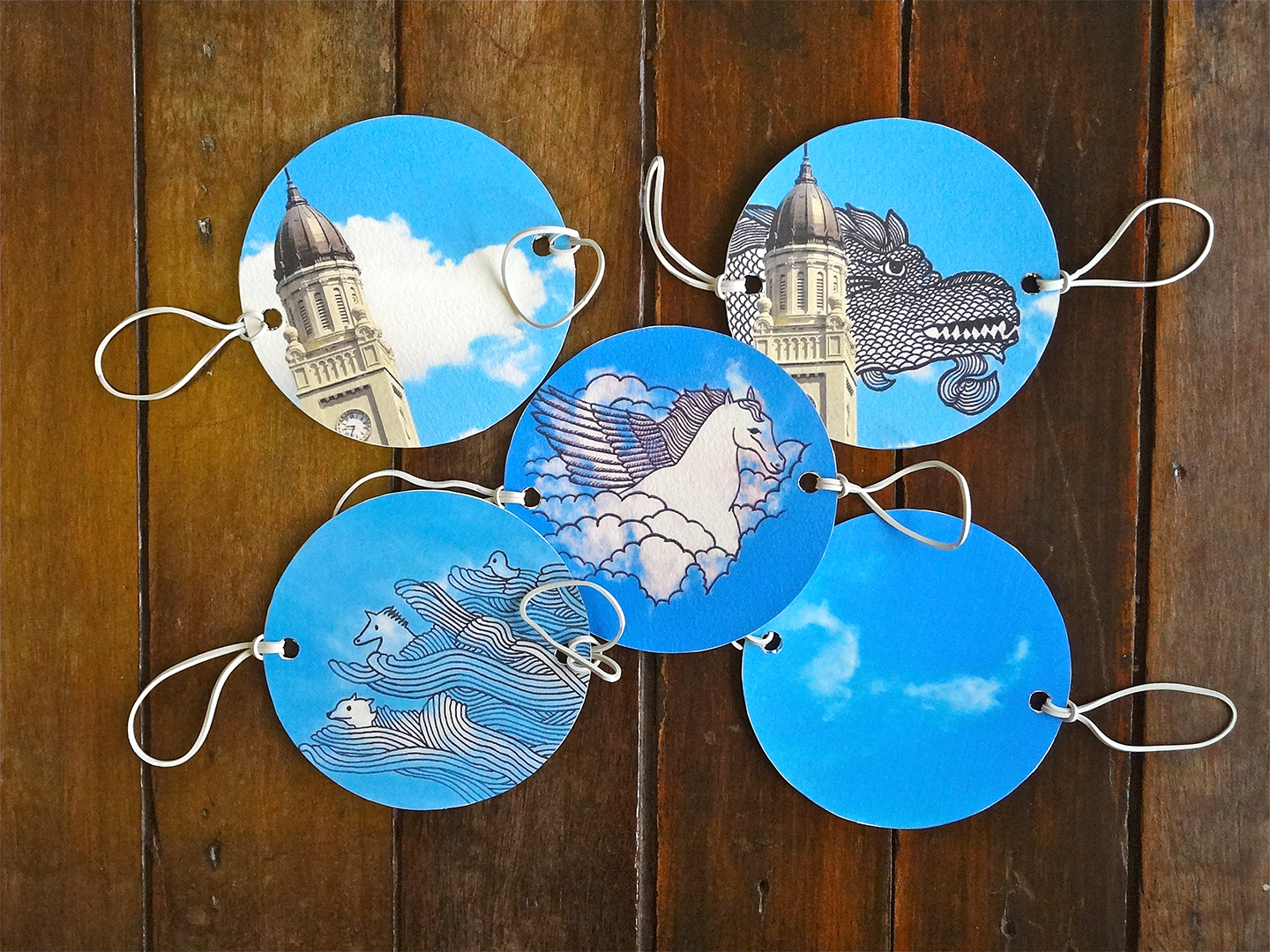
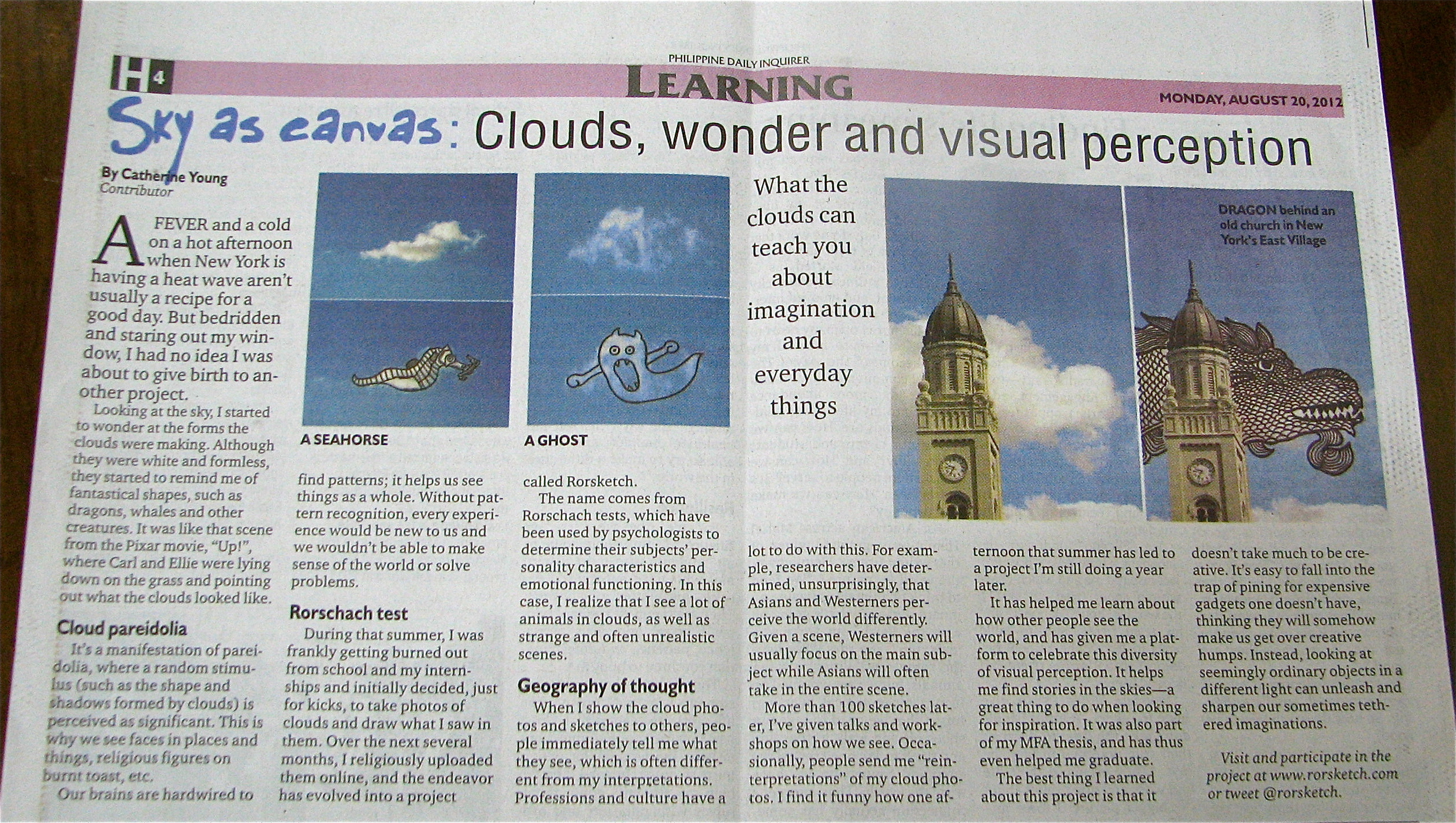
For the second talk, I explained Rorsketch and first engaged the audience in a guessing game of what clouds looked like and then revealed what drawings I made. After doing this project for a while, I wasn’t surprised about how some people were calling out the same things, while other clouds had very different interpretations.

You know what my favorite Pixar movie is! Photo by Ruoxi Yu.

Yes, it’s a dragon! Photo by Chris Randall

I then asked the audience to pull out the blue Rorsketch cards and the Sharpies in their kits, and they drew their own interpretations on the clouds printed on their cards. To encourage them to draw, I did a live drawing session on a big cloud on stage.

Drawing on a cloud. The cloud I sketched on was taken by Nikki Sylianteng. Photo by Liz Danzico

One of my fellow speakers, Nima Tshering, sent me his cloud drawing. (Thanks, Nima!)

A fairy grandma with a baby by Nima Tshering

Third Talk: Smell, Hearing and Taste

I explained two projects for this post-lunch session: Smellbound and EatPoetry. First, I explained the connection between smell and memory and had the audience remove the Smellbound postcard which contained a printed smell. I showed them the book I made, An Olfactory Memoir of Three Cities. Afterwards, I read them After Apple-Picking by Robert Frost while they ate the apple lollipop inside their kits.

“Now please remove another envelope from your kits…” Photo by Chris Randall

Fourth Talk: Happiness and the Senses

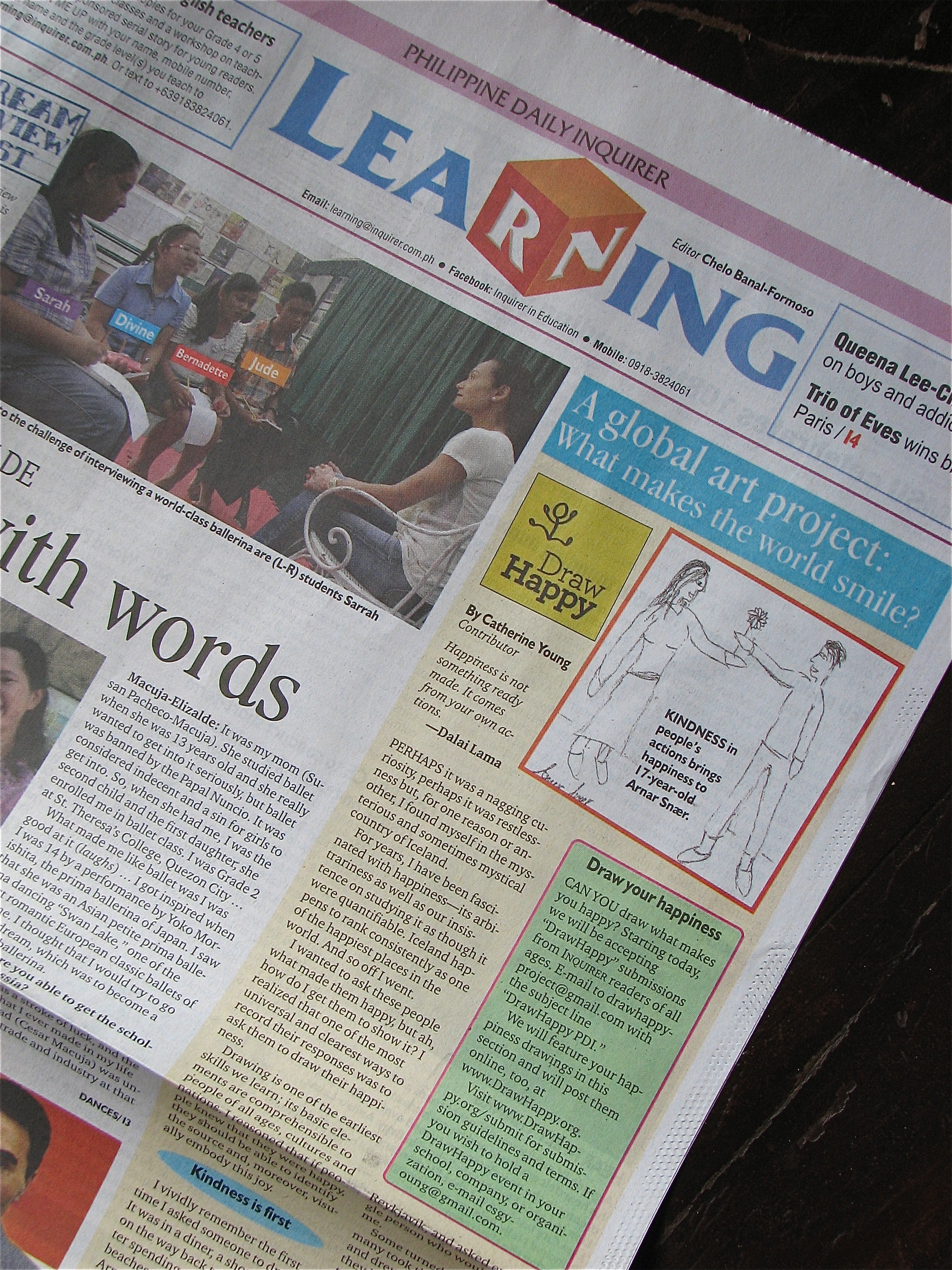
For my fourth talk at the end of the conference, I summarized how we can use our senses to be happy. The key points were that we are all equipped with these tools; i.e. we all had the capacity to hug our loved ones, to interpret a cloud, to smell a memory, and to connect poetry with food, and that if we paid more attention to the world around us, it would promote our feelings of well-being and optimism. I also explained my own explorations with happiness by showing submissions from DrawHappy, as well as what I’ve learned from the project so far.

Photo by Liz Danzico

What Worked, and What I Would Do Differently Next Time

All the sleepless nights making sure all 200 kits had the right contents were definitely called for. So much craft and attention were given to every single detail—each postcard had to be sealed in an envelope so people can only view them as instructed, the envelopes had to match the main color of each project’s logo for easy recall, each postcard had to be branded and oriented in a specific direction, each kit had to contain envelopes in a particular order and needed both a Sharpie and a lollipop. Anything less would have taken away from the experience or would have confused people. Doing something onstage so that people can mirror my actions was also important, and getting all the props together also was something I had to keep in mind in addition to the actual slides.

I’ve also been onstage on different occasions and it was interesting to feel these variegations of audience contact. When performing for the Poetry Brothel in Barcelona, I had to inhabit a certain character and, depending on the piece we were doing, had to maintain a certain mystique. When doing poetry readings just as myself, there was a bit of conversation with the audience when I talk about the process of writing, but during the reading of the actual poem, it was just myself and the text. I felt this while reading the Frost poem to the TEDx crowd—the entire hall was dead silent in contrast to all the other times I was up there. (That was quite fun, actually.) But doing a talk that involved not just a Keynote presentation but an actual creative activity was another world altogether—it’s difficult to assess if everyone was enjoying the activity, although what was great about having a particularly open audience such as this one was that they weren’t afraid of trying new things.

For the next time I do something of this nature, I would have a card that had explicit instructions not to use the objects inside the kit unless asked. Although I anticipated this by making sure the envelopes were sealed, I did catch at least one person eating their candy before lunch. (We were running a bit late, and I suppose he was hungry.) One thing about having a sealed and long candy stick was that it affords a long eating session; they wouldn’t have finished it to begin with and they could just put the candy back in the plastic and in the kit. Hard candy was definitely the way to go.

Also, I would have split the third talk (Smellbound and EatPoetry) into two and let each project have its own 10 minutes. Thus, I would have placed EatPoetry for the fourth talk and followed it with a short summary of the senses. When I went up for the last talk and said that “Ok, I’m not going to make you do anything now,” I could swear I felt the disappointment of some people. If the schedule allowed it, giving each project its own time in the spotlight would have allowed the audience to absorb the concept more fully, instead of rushing to the next project right away. I can’t wait until I develop these projects more and more, and see what I will ask people to do the next time.

Finally

I have to say, I love this format of getting the audience to actually do something creative in a talk, instead of me just standing there telling them about myself. Thanks again to the audience for being open to these ideas, my friends and colleagues for helping me pull this off, and to the wonderful team at TEDxNewHaven who worked tireless to make it all happen!

Thanks to Kate Russell and Liz Danzico, my plus two!

Last Saturday, I gave four talks at TEDxNewHaven: The Art and Science of Happiness, where I engaged the audience in my different interactive projects. The first goal was to get them to play throughout the day and the higher goal was to show them how paying more attention to the world promotes happiness. With the help of friends, I designed and produced 200 sense kits that contained objects that they interacted with at my instructions at different points of the conference.

The kit came in the form of a red box that matched the TEDx logo.

Each kit contained sealed envelopes with postcards containing postcards representing each project — HugPrints (a set of hugging instructions), Rorsketch (a cloud that can be drawn on), Smellbound (a piece of printed smell), and EatPoetry (text from Robert Frost’s After Apple-Picking), together with a mini-Sharpie (for Rorsketch) and a sealed kosher apple-flavored lollipop (for EatPoetry).

HugPrints cards, front and back:

Rorsketch cards, front and back:

Smellbound cards, front and back:

EatPoetry cards, front and back:

Here are all 200 of the kits (Two hundred! Madre mia. The TEDxNewHaven team were nice enough to have picked them up from the studio instead of me lugging all 200 to Connecticut.)

I would never have pulled this off without the help of these amazing people:

For graphic design guidance
Christine Aaron

For kit assembly
Kate Russell
Dan Fan
Desiree Go
Annika Yi-Wang

More about the actual conference and experience design in the next post.