Archive

Tag Archives: artscience

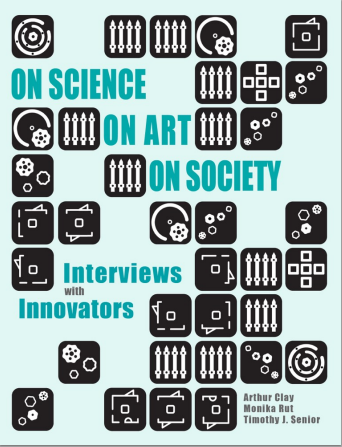
Digital Art Weeks International, whose exhibition “Hybrid Highlights” was held in Seoul last year, just published their free book, On Science, On Art, On Society: Interviews with Innovators”. Edited by Arthur Clay, Monika Rut, and Timothy J. Senior, it features a collection of twenty-five interviews from practitioners originating in diverse fields and opposing outwardly.

Divided into three separate chapters, the authors illustrate to the reader models of hybridity that can validate convergence as a method for nurturing innovation across disciplines. Readers interested in innovation and the processes that drive it, will find that each of the chapters of the book addresses a particular area of ​​knowledge and that each of the interviews offers its own perspective on the subject at hand as well as examples that could offer theory into practice.
Screen Shot 2015-07-25 at 3.22.09 PM

I was one of the interviewees in this interesting project. I’m in very cool and amazing company and it’s quite intimidating to be with them, such as Denisa Kera, Davide Angheleddu, Ruedi Stoop, etc. Download it here from iTunes now!
ClimateChangeCoutureLookbook

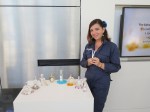
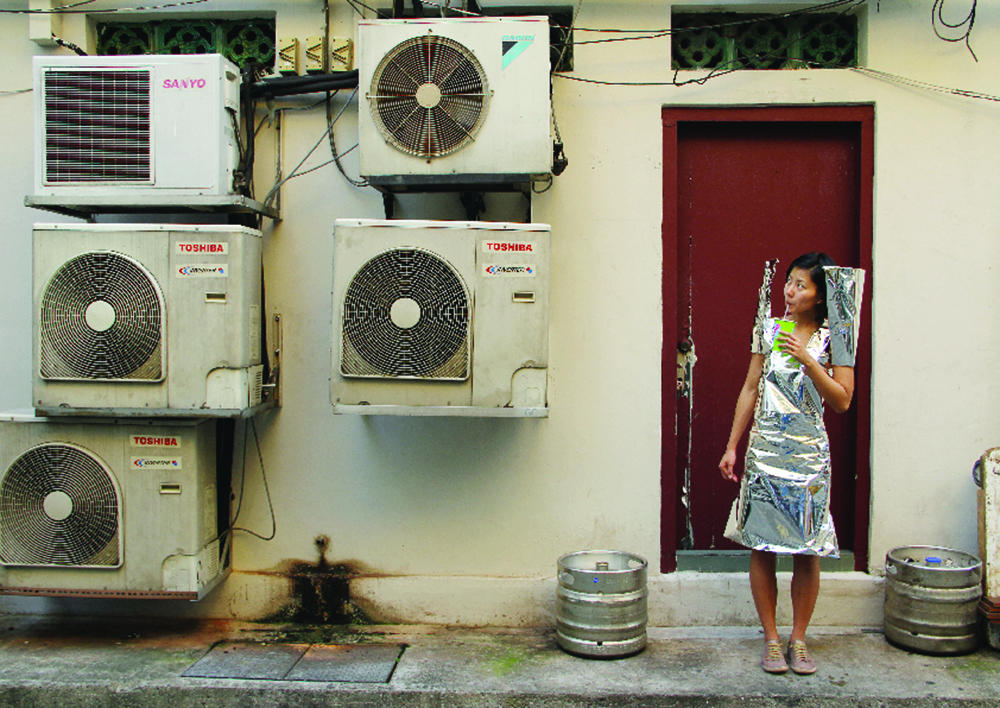
In my interview I talk about artscience collaborations, The Apocalypse Project, and climate change and cultural change. It also featured a photo from Climate Change Couture: Singapore (the Thermoreflector, modeled by Cheryl). Here is the interview, courtesy of DAW International:

Where Art & Science Coexist
An Interview with Catherine Young

Interviews with Innovators: As an artist, your work primarily explores human perception and its relationship to memory, creativity, and play. In a way, your story as an artist begins with studying molecular biology and biotechnology at the University of the Philippines. What inspired you to move into the arts, and what did you take with you from the sciences?

Catherine Young: I come from a family of artists and doctors. Although my grandfather was a photographer, my mom was a genetics professor so I grew up with a lot of Punnett Squares and DNA lessons. I love science and initially wanted to do only lab-based research, but I realized that I didn’t want to be just cooped up in the lab – there were so many other ways I wanted to pursue my ideas. I moved to New York City at 21 and just saw the endless possibilities available instead of the stifling path I had ahead of me. I moved (or more specifically, “ran away”) to Barcelona and rediscovered art, but also discovered for the first time how art and science could work together. From there I chose to study interaction design for my MFA in the US (which was a relatively new field at the time) because I felt it was a discipline where art and science could coex- ist and be effectively communicated to others.

IWI: You have worked in a variety of traditional forms including draw- ing and painting, but also with less-traditional media such as dirt or soil. What role has artistic and scientific practices played in helping you break away from traditional formats?

CY: When two things collide, new relationships can be formed. For exam- ple, visual art is usually composed of traditional fields such as painting or sculpture—works that the public shouldn’t touch else you destroy the work. But this doesn’t hold true with interactive pieces where the work has to be touched to be experienced. The convergence of art and science leads to new ways to offer stories for people to explore, and unique opportunities for empathy. Also, advancements in science along with new ways of expression in art are leading to greater diversity in the type of work that can be done. For instance, there’s been a relatively recent interest in art investigating smell because of research that shows that olfaction is linked to memory. So if I were an artist interested in memory, this sense is now a channel for me to investigate that theme. Science can inform art and vice versa; each enriches the other.

I don’t really look at my projects and say, “Ok, what is the ‘art’ and what is the ‘science’ here?” I start with the questions I want to explore, and then test those approaches that I feel will best communicate the ideas I want to share with people. My different experience of artistic and scien- tific fields has exposed me to a lot of different ways for investigating top- ics and then presenting them to a wider audience. Science for me involves a lot of data collection, something which I often do in my current work. Artistic methods help me explore the many ways in which I can show that work. Each exhibition of a project is also like an experiment to me, so my work continues as I check how people respond to it. Person- ally, I don’t think there’s much of a difference between art and science because both ask similar questions. However, there is a great difference in the professions of art and science because of the systems we have created to practice them, such as the galleries, the festivals, the labs, academia, industry, and so on.

IWI: “Disclosure of knowledge” or “lifting of the veil” is how you describe your Apocalypse Project. Here you are trying to physically animate an in- quiry made concerning environmental futures. Can you tell us about this research in general and what the process was that transformed an en- quiry into an artwork?

CY: I started The Apocalypse Project during my participation at the 2013 ArtScience Residency Program in partnership with ArtScience Museum at Marina Bay Sands, Tembusu College National University of Singapore, and the Singapore-ETH Zurich Future Cities Laboratory (FCL). I was talking to the scientists in FCL who were doing very interesting research on climate change and sustainability. But while their work was important, I saw a gap between their research and the public understanding of climate change.

In parallel to this, I was doing workshops with high school and college students in Singapore, asking them questions about what climate change looked like to them, what superpowers they wished they had to combat climate change, and what they would wear to a climate-change apocalypse. The last question resonated really well with the majority of the stu- dents, more so than my other questions. I realized that fashion is one thing that people can relate to – clothing is both a means of survival and a form of self-expression. This was the beginning of Climate Change Couture. I took the research of the FCL scientists and designed clothes and narratives that would fit a world that was uninhabitable, highlighting the problems that the research projects addressed. For the first collection, members of the FCL staff were the ones who modeled them and I think it was wonderful to see them outside the lab and being models.

IWI: Besides showing the actual objects themselves, how else have you tried to communicate the fact that climate change is real and “the heat is on” as they say?

CY: The projects are all about experience, so rather than just showing the clothes or the perfumes I developed, the visitors are invited to try on the clothes and smell the perfumes. In this way, they are able to place themselves in the story. I also hold public events, such as Future Feast at The Mind Museum in Manila where I got to collaborate with chefs to think about dishes of the future. It was a real feast with local musicians per- forming, scientists explaining topics about climate change, the chefs talking to people about why things like worm meat and sea vegetables could be future sources of nutrition, and included activities for the whole family. I think doing these inclusive and fun events reframes climate change from a doom-and-gloom political issue, meant to be discussed only by governments, to a human issue about creativity and resilience that everyone should act on.

IWI: Some of the garments that you have put on exhibition connect traditional design culture with what we might call “a fashion of necessity”. Does the inclusion of traditional elements make the message clearer that climate change and cultural change are synonymous?

CY: I think culture has always had to adapt to the environment. For example, the Barong Tagalog, which is a traditional dress for men in the Philip- pines, was designed to be lightweight because of the country’s tropical climate. I re-imagined it with a hoodie because of the unpredictable weather the country now has. When designing for a particular city, I like to research their traditional garments because the message resonates bet- ter with the audience if the visual imagery is familiar and they can relate to it. A lot of my projects deal with future loss, and so the audience has to imagine a world where some things are not available to satisfy the needs of their traditional practices.

IWI: Which of the methods used to carry over your message have been the most effective in motivating and empowering people to become co- creators of a more tangible future?

CY: I think it’s the fact that I do multiple projects, so I give people different ways to engage with environmental futures. If one doesn’t do it for them, another one might. Each project is also exhibited through multiple platforms and in multiple cities, and uses different types of media. Some people knew about the projects through the Internet, but for most peo- ple the work was more powerful when they saw and experienced them in person. From what I’ve observed, I think the work becomes most effec- tive when people are able to share their experience (and the memories that these projects evoke) with other people. This allows conversation about climate change go beyond the exhibition or the festival and into the people’s normal everyday lives. Another is that I target a wide audience. I’m particularly interested in the reactions of young children, because they have the most honest reactions. They will also bear the worst consequences of climate change, so I think they need to learn about it and how to take care of the environment as soon as possible.

IWI: Knowing that the research you have draw upon is the intellectual property of an institution with clear guidelines on representation, do you feel that there are any dangers of misrepresenting such research if presented through art objects and in a museum context?

CY: Yes, which is why I’m extremely careful about collaborations. There are a lot of conversations in the background, with me talking to my col- laborators (be it scientists, chefs, artists, students, companies, etc.) about what the project is, why I’m doing it, what possibilities could follow once we exhibit the work in public, as well as an opportunity to say no. I send out updates from time to time, and I update all my websites regu- larly so everyone knows what I’m up to. I’ve been on fellowships and grants for a long time, so I’m used to accountability and making sure eve- ryone is on the same page so that we’re all happy. For the information and images I have to send out to the press, or that I publish online, I always make sure everyone involved has reviewed it and has no issues with it. I think life is really short and there is no sense in prolonging suf- fering, so if I or the other person is unhappy, and all possible solutions have been exhausted, I probably will end the collaboration and just change the direction of the project.

That said, though, in my experience, if the finished project is successful – and I define “success” here as when a project gains an audience, when the message about climate change is effectively transmitted to another person, and when the collaboration was pleasant and we want to do it again – everybody wins: the artist, the collaborator, the space it was exhibited in, the audience who has had a positive experience. If the project fails at any point, such as if a blogger completely misinterprets it, it’s only me that has to bear it, and I try to rectify it by reaching out to the writer with more information and an invitation to get in touch. Either the writer updates his article or I’ll be working on another project to further make the point. The public events are, to me, critical, because I usually have attendants (I call them The Apocalypse Squad) who are trained to talk about the project and assist the audience if needed. The online presence of the projects is also important because that’s where I put all the information. I’ll get the occasional troll in the exhibition or on the Internet – usually climate change deniers – but I just ignore them.

Catherine Young is an artist, scientist, designer, explorer, and writer whose work primarily explores human perception and its relationships to memory, creativity, and play. Her work combines art and science to create stories, objects, and experiences that facilitate wonder and human connection. Her first solo exhibition was in a science museum. She re- ceived her degree in molecular biology and biotechnology from Manila, fine art education from Barcelona, and has an MFA in Interaction Design from the School of Visual Arts in New York as a Fulbright scholar. Previously, she was on residencies and fellowships in New York, Barcelona, Seoul, Singapore, and Manila.
DSC00689small

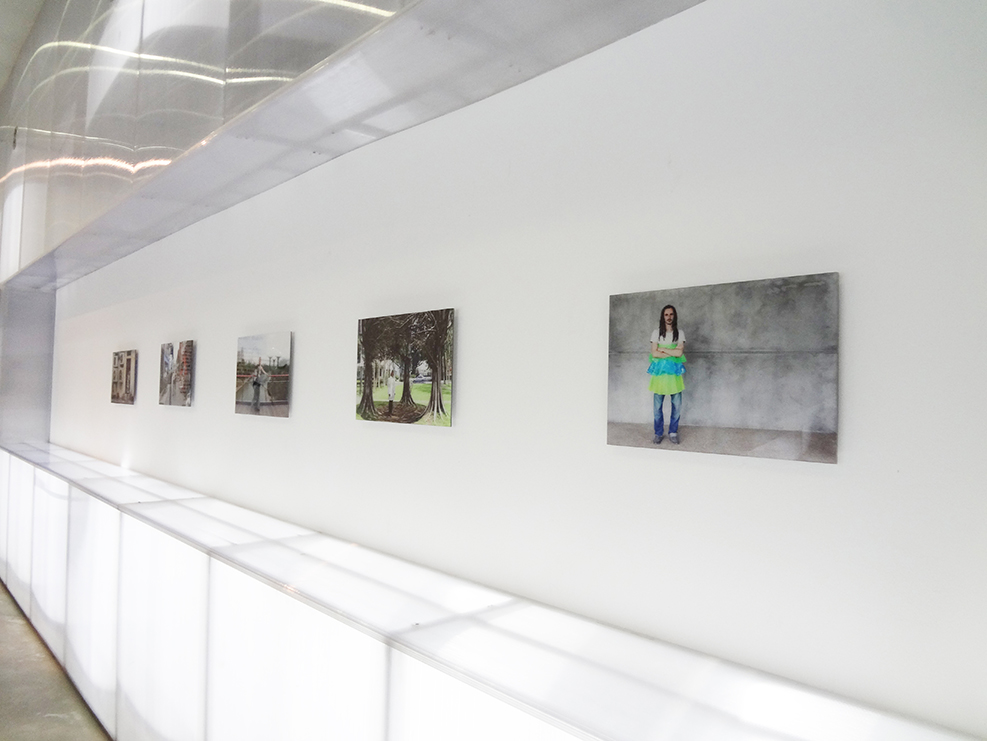
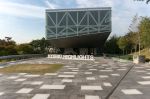
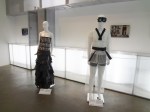
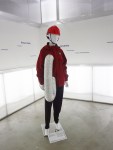
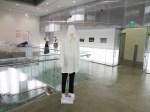
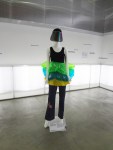
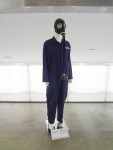
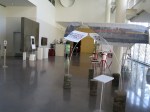
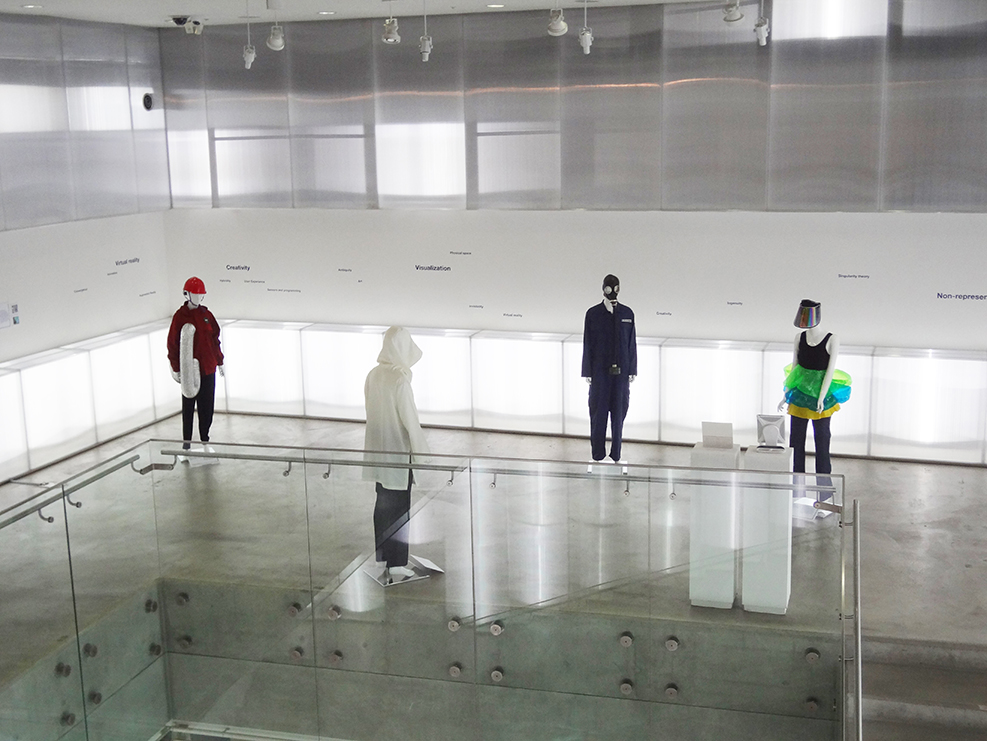
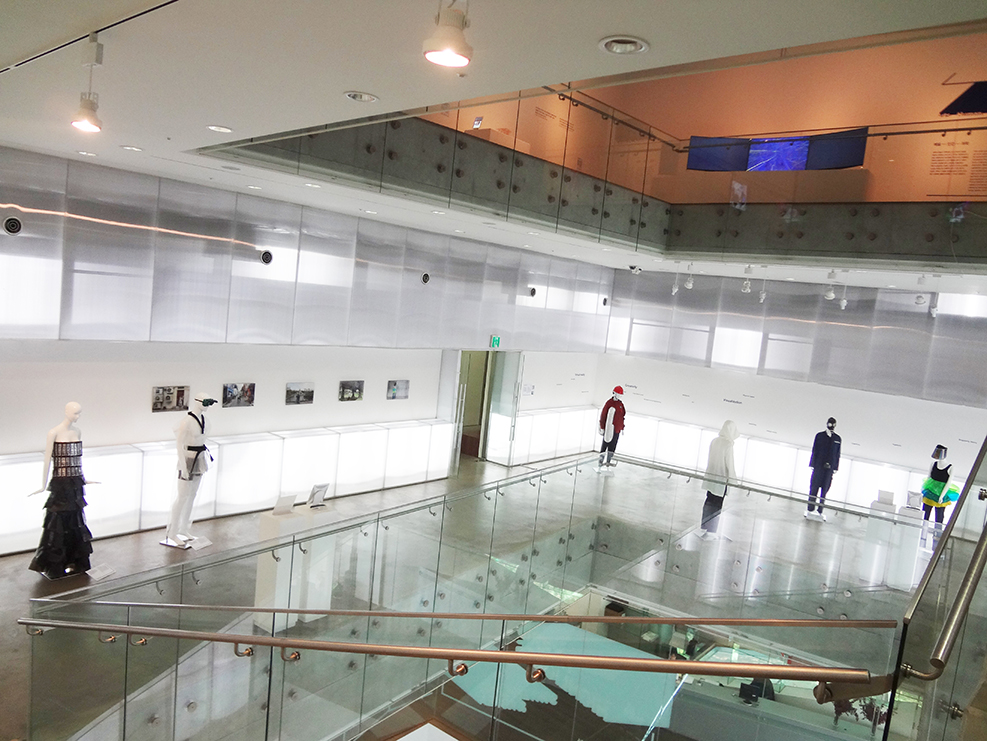
October 2014, Seoul—The Apocalypse Project’s Climate Change Couture is now on view at Seoul National University Museum of Art. My piece is on the second floor and features six garments from Climate Change Couture’s Singapore, Manila, and Seoul collections, as well as six photos from the Singapore collection.

DSC00686small

Curated by Arthur Clay, founder and artistic director of Digital Art Weeks International, and Jeungmin Noe, senior curator at Seoul National University Museum of Art, the exhibition blurs the boundaries between art and science and enlarges the possibilities of interdisciplinary collaborations.

DSC00701small

The exhibition runs until December.

Many thanks to Digital Art Weeks and SNU MoA

DSC00632small

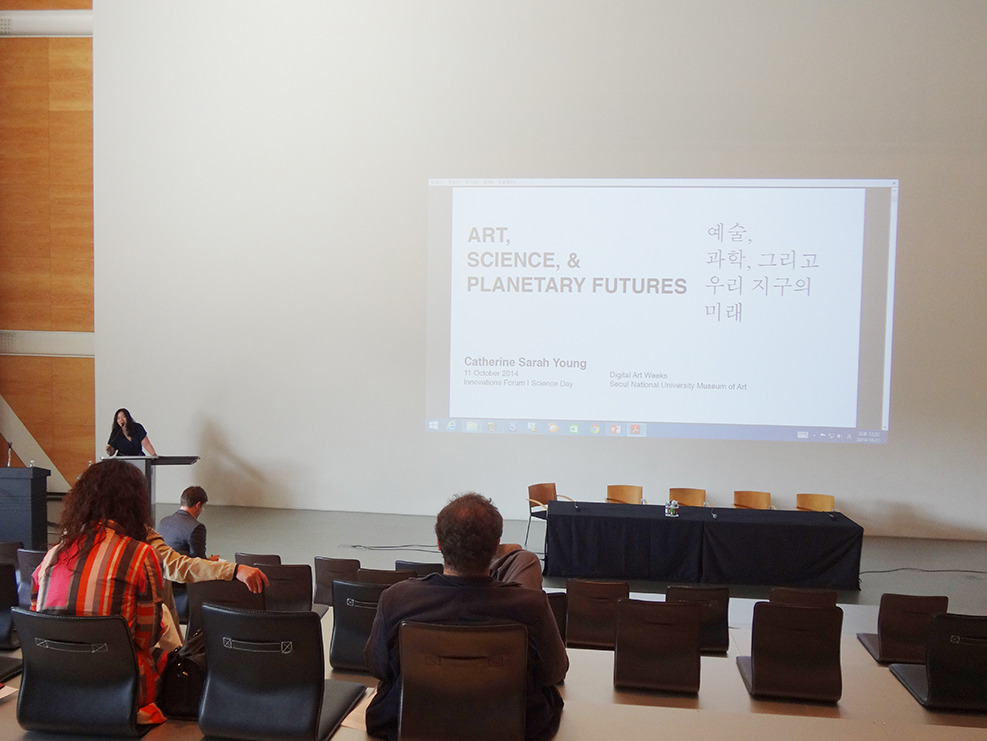
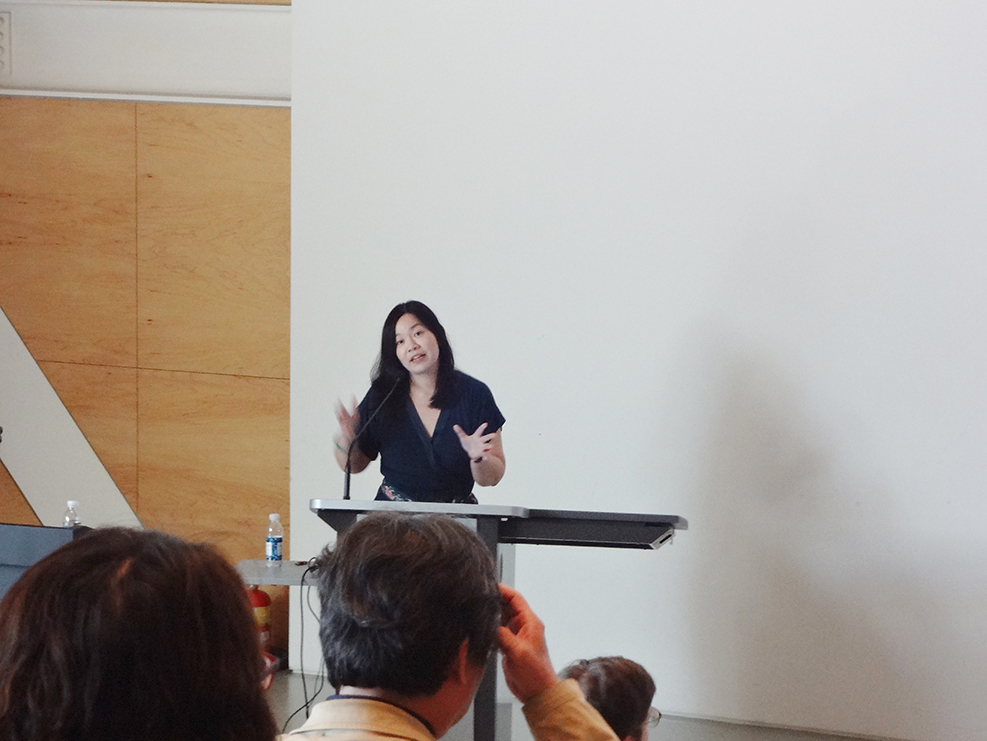
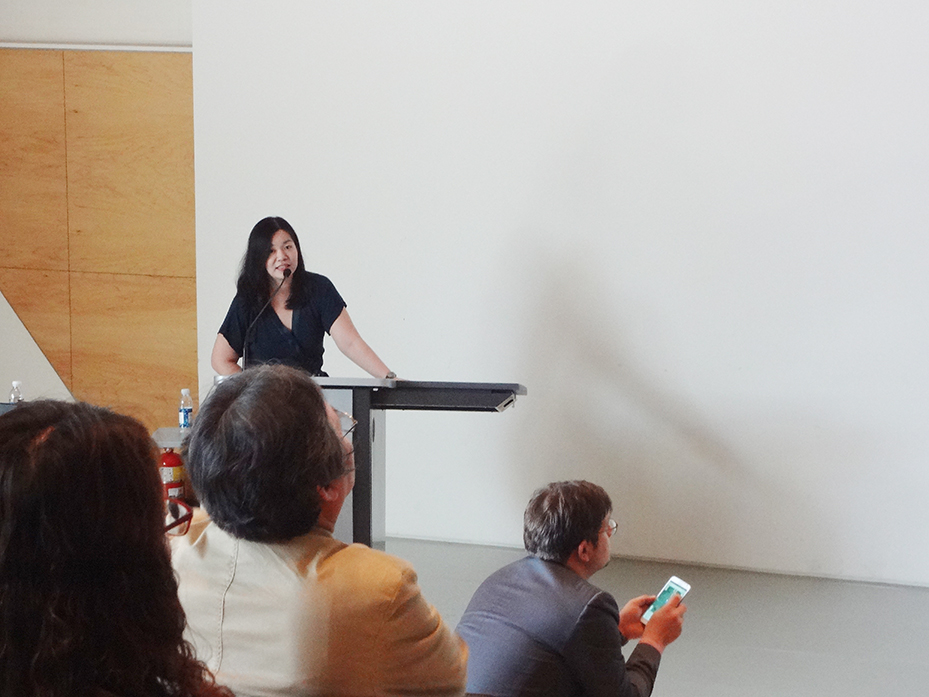
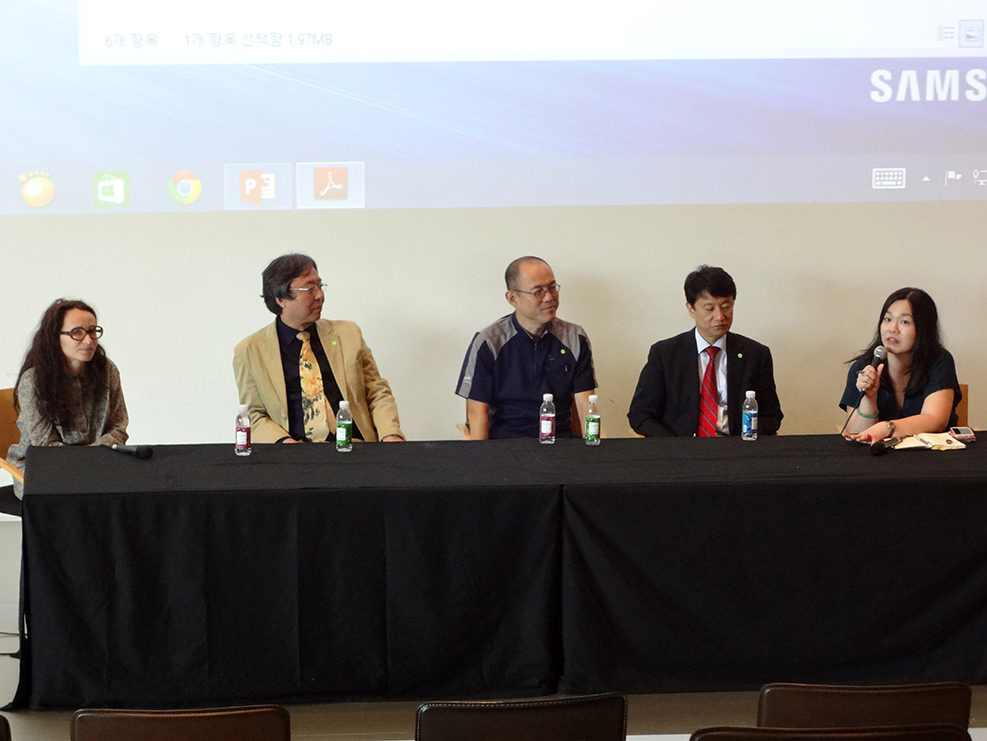
11 October 2014, Seoul—I was part of a panel on Science Day at the Innovation Forum of Digital Art Weeks held at Seoul National University Museum of Art. Dr. Denisa Kera of Swiss Hacketeria and National University of Singapore gave the keynote speech. My fellow panelists included Dr. Tae-Sub Chung of Yonsei Medical School, Dr. Min Suk Chung of Ajou University School of Medicine, and Dr. Tai Hyun Park of the Advanced Institute of Convergence Technology of Seoul National University. The panel was moderated by Dr. Sunghoon Kim, Director of the Integrated Bioscience and Biotechnology Institute at Seoul National University.

DSC00634small
The Innovation Forum is a three-day symposium spread out during Digital Art Weeks Seoul, which runs until December. Science Day explores common themes on the crossroads between Neuroscience and Aesthetics in the arts and Bioinformatics and Biohacking art movement, bringing in and raising questions about the creative process, scientific inquiry and realm of empirical aesthetics. The panel I was on, “Convergence in Arts and Sciences”, raised questions around convergence of science and art and how they have been inseparable.

DSC00637small2

I gave a talk on “Art, Science, and Planetary Futures”, chronicling my experiences in science and art through the different residencies and fellowships I’ve had in the world. I spoke about how art and science converged to give people new experiences, to empower audiences, and to break traditional formats. It was great to see familiar faces in the audience—from fellow alumni of the School of Visual Arts, the staff at the National Art Studio of Korea (now known as the MMCA Residency Changdong), and the Future Cities Laboratory. Even Denisa is a familiar face—she moderated our panel at ArtScience Museum in Marina Bay Sands last year. It was like going to a big family reunion. Thanks, guys!

DSC00658small

Thanks to DAW International for the invitation, SNU MoA for the lovely venue and staff, and Kate Kirkpatrick for the photos.


IMG_0017


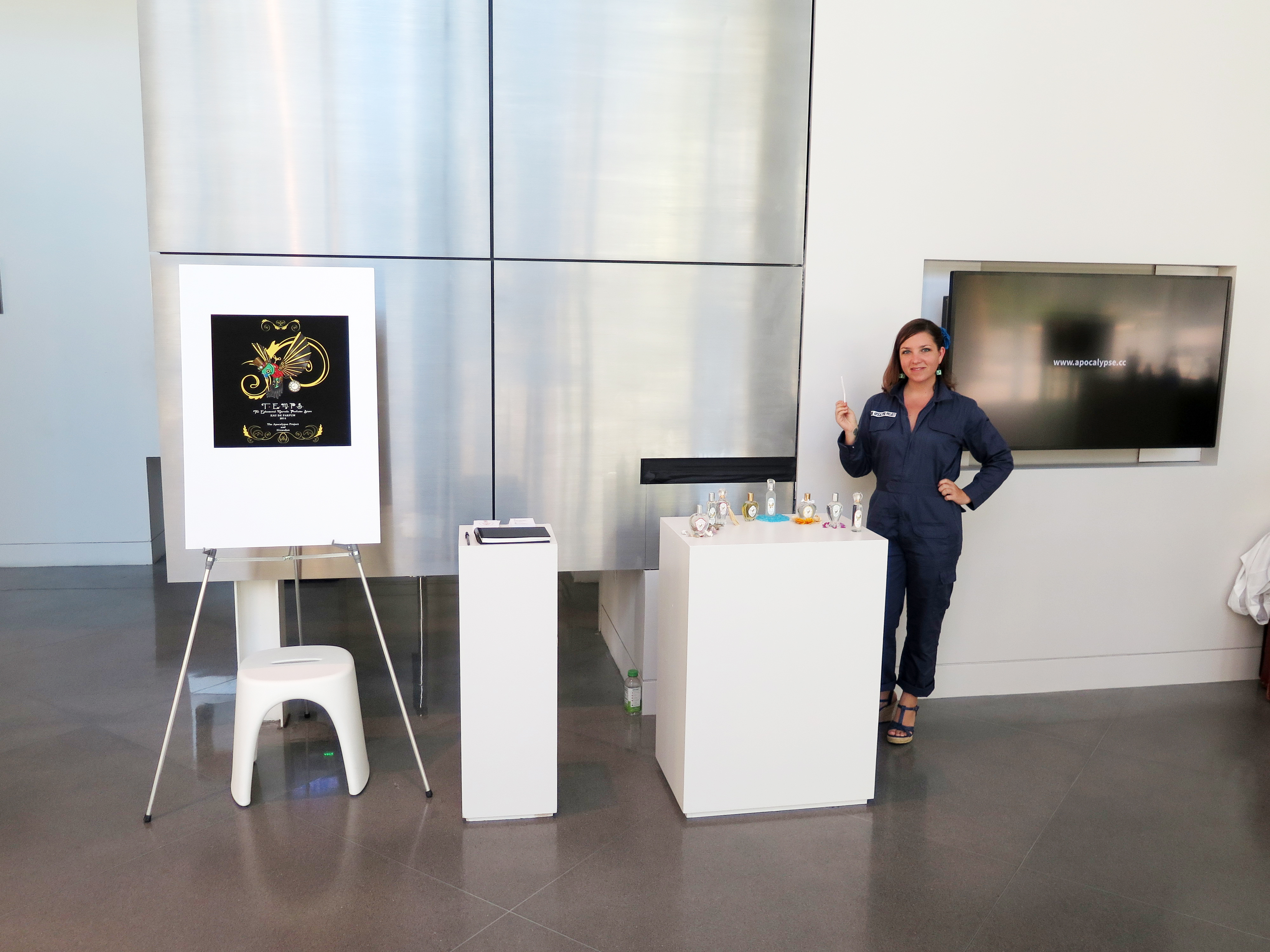
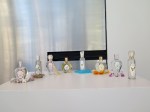
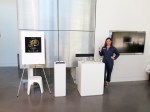
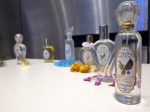
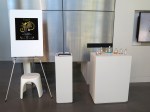
Here are some photos from The Ephemeral Marvels Perfume Store’s exhibit at the Open City / Art City Festival last October 4, co-organized the Institute for the Future and Yerba Buena Center for the Arts. Many thanks and huge congratulations to my friend Zoe Bezpalko (who also modeled one of the Climate Change Couture garments last year and is shown in the above photo wearing an Apocalypse Suit), for handling this single-handedly.

I’m here in Seoul for the moment for some exhibitions and a panel, so I’m very grateful for my friends and collaborators from all over the world who can take over when I cannot physically be there.

Photos courtesy of Zoe Bezpalko

The past year or so has seen me venturing into the mysterious field of “speculative design.” In The Apocalypse Project, I’m trying to see possible futures under climate change, which are generally not pretty visions of tomorrow.

There are lessons I’ve learned as well as experiences whose lessons I’m still trying to find. Here they are:

1. Stories rule.

When it comes to something as dry and political as climate change, the best way to get people to care is to let them find a personal story. Climate change is humanity’s story, not just a few individuals’. It is also complex and multilayered; a photo of a melting glacier might trigger the emotions of people living near them, but it might not be as effective to a person who has never experienced a winter. Here in Southeast Asia, I notice that people paid more attention to stories about rising sea levels, extreme heat or supertyphoons, because those are the things that they have personally experienced and have something to say about.

However, this isn’t to say that people in the tropics will never care about polar bears. I think that another property about the climate story is that so many things are connected—a melting glacier may further alarm people who are experiencing drought, for example—and there are opportunities to connect these dots that people never realized existed.

2.  The power belongs to the people.

When people want to buy these hypothetical products, I’m taken aback and get a conscience attack of sorts. My goal was to show people how bad it could get, but instead people’s consumerist tendencies prevailed.

But then, why wouldn’t they want to buy these? I had made them so real that they only thing that was missing was a PayPal button.

I realized the power of people as consumers; the exchange of money for product allows for the existence of these objects. These transactions keep these products—and the ideas behind them—alive. If people refuse to buy the product, then it marks the end of it.

What does this mean for futures? For me, it gives me a barometer to see what types of people are out there. I’ve realized that the point of speculative design is to ignite debate. By making these projects, people have the opportunity to talk about these issues. There are so many opinions out there that

Should I sell these? This is something I keep thinking about. Perhaps letting people buy them allows for even greater awareness, as long as they know the intentions behind it. Let me get back to you.

3. The true test is converting a denier.

The bulk of the people who have emailed me or tweeted about how the like the project are usually futurists, artists, or other people who are already aware of climate change to begin with. While I’m extremely grateful for this, especially for the future collaborations that it could ensue, to put it bluntly these people are already smarties. The next cohort of people that I’ve impacted are the “laymen”—those whose work has nothing to do with design or sustainability, but are folks who can see their personal stories in these projects. I think this is wonderful because I’ve always wanted my designs to exist beyond, well, design. Children have always been among my primary—and usually the sharpest—audience and I usually prototype my ideas on them to see if I’m being too unnecessarily confusing.

Perhaps the pinnacle of “success” in doing projects like this is when I am able to convert a climate change denier. This is the final cohort of people who are going to be the hardest to convert but are those who will give me the greatest pleasure to impact. When the initial wave of press for my projects hit, I get trolling tweets from climate change deniers literally seconds later. It’s usually how I know that my projects are being written about. I would often joke to my friends about how they’re usually just a bunch of old white guys, usually in the US, who’ve never experienced the scale of a tropical typhoon and probably don’t get out much anyhow so who cares. I never engage in them, but the more I think about it, these are the ones that, if converted, means that I was extremely effective in conveying ideas.

But I just think they’re so gross. What to do, hmm. Any ideas?

4. Everyone can contribute to this.

In Future Feast, I got a bit floored towards the end because I truly felt that it was transformative for a lot of people. Having multiple talents together—musicians, artists, designers, scientists, etc.—can feel like high school because they have very different personalities, and I as the one behind this was a bit anxious that the dots wouldn’t connect because everyone had their own vested interest in the project. However, I realized that it was in this multilayered experience that gave people a meaningful experience. In the end, it was great to feel that it wasn’t just my project anymore—it was everyone’s, which was the point.

I’m still evaluating the impact of the work I’ve done in the past few months. Stay tuned here for updates on what’s next, and thanks so much for keeping up with the projects!


For Future Feast happening this Saturday, July 26 at The Mind Museum, I am honored to collaborate with these accomplished chefs. Meet them now:

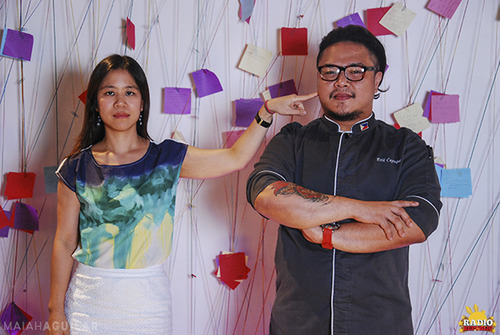
1. Erik Capaque and Claudette Dy
“Let’s prevent the apocalypse by taking care of our environment so our food sources will not be endangered.  Practice a sustainable lifestyle.”

image

Erik enjoys exploring ingredients, cooking techniques and procedures and makes his own creation inspired by them. He is known for putting his signature touches to the dishes that he creates, and for his modern approach in traditional dishes. He was exposed to food and cooking at a very young age. Raised under great influences of traditional Ilongo and Bulacan cooking, as a kid he cooked his recreations. During his elementary school days he was able to create several interesting dishes like gumamela (hibiscus) chips, Candied Calamansi Peel, Tomato Jam, Homemade Cured Ham and Bacon to name a few. He pursued his interest in cooking and took up Bachelor of Science in Hotel and Restaurant Management and trained under a Belgian chef at The Old Manila in The Peninsula Hotel. He headed the School of International Hospitality Management of one university in Antipolo, Rizal for 4 years. He is accredited trainer of Commercial Cooking and Baking of Technical Education and Skills Development Authority (TESDA). He finished his Masters in Business Administration and pursued his culinary education at Centre International Culinaire and Culinary Institute of Asia. He is now the Chef and the Manager of Eat. at V Hotel in Malate, Manila.
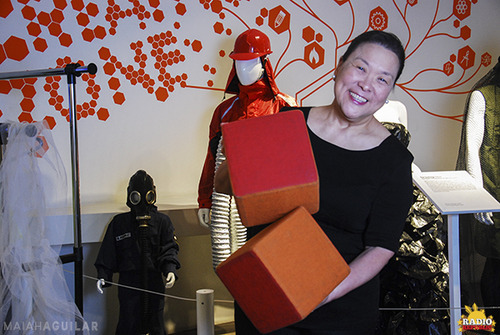
Claudette Dy

True passion is never extinguished. JV Claudette Dy had always been fond of creating food—cooking, baking, as well as being a resident food critic. After graduating with a degree in management from De La Salle University and having kids, she realized this so she pursued the knowledge at Enderun. Balancing raising kids, a day job, and a full course load at a prestigious culinary school was definitely a challenge which she surpassed and used well. She now channels this passion and love for food in her cafe at a boutique hotel in Malate, Manila.
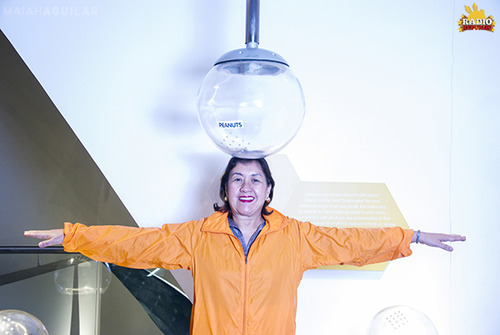
Eat. At V Hotel Manila

(63 2) 328-5553

2. Ian Carandang

“Let’s prevent the apocalypse by doing what can be done NOW instead of regretting what we should have done in the future.”

image

Ian Carandang is the owner and head Chef of Sebastian’s ice Cream, the country’s premiere artisanal ice cream brand in Manila. Opening Sebastian’s in 2006, he pursues the dual ethos of excellence and creativity, believing them to not be mutually exclusive. This self-taught sorbetero is a pioneer in artisanal ice cream and constantly strives to elevate, innovate, and discover what can be done within the realm of ice cream and frozen desserts.  Among the dishes he has been recognized for are the Champorado Kakanin Ice Cream with Candied Dilis, Green Mango Sorbet with warm sweetened Bagoong, and “Once In a Blue Moon”, his Blue Cheese Ice Cream with Palawan honey and walnuts.
Sebastian’s Ice Cream

sebastians.icecream[at]gmail[dot]com

3. Sau del Rosario

“Let’s prevent the apocalypse by giving love and respect to Mother Nature.”

image

Chef Rosauro del Rosario is a native of Pampanga, one of the Philippines’ culinary centers. He earned his bachelor’s degree in Hotel and Restaurant Administration from the University of the Philippines. He first worked in several hotels in Manila before moving to Nice, France where he worked with one star Michelin chef Christian Plumail of Restaurant l’univers. He then moved to Paris and worked with three star Michelin Chef Jacque Divellec of Le Divellec Restaurant. Shanghai later lured Sau, where he opened the Mediterranean-themed restaurant Luna. Afterwards, he moved to Singapore to be a chef at Raffles Hotels and Resorts.

Back in Manila, Sau has opened several restaurants: the popular Museum Café, Chelsea Market and Café, and Le Bistro Vert, a sustainable organic restaurant that helps local farmers, with his partners. Le Bistro Vert earned recognition from MBKS Awards as Best New Restaurant and recognized him as among the Best Chefs of the Year. Sau uses his classical yet chic style of cooking by incorporating local ingredients. He is the Executive Chef of F1 Hotel Manila, a consultant for Bluewater Maribago properties and Cauayan Resort in El Nido, and the founder and owner of Food Garage that produces artisanal breads.

 F1 Hotels and Resorts

sau.delrosario[at]f1hotelsandresorts[dot]com

4. Kyle Imao

“Let’s prevent the apocalypse by polluting the environment less. Let’s ride bikes and patronize local produce.”

“Let’s prevent the apocalypse by living a sustainable lifestyle and by just getting enough for our needs and not our greed.”

image

Kyle is a young cooking prodigy.  At the tender age of 11, he was the Philippines’ first grand winner of Junior MasterChef Philippine Edition.  Now, 14 years old, his climb to the culinary world just keeps on soaring.  He owns and operates his own café inside The Mind Museum, at the Bonifacio Global City, aptly named Kyle’s Lab –a science themed café created by a kid for kids.  He has also been a contributor for Junior Inquirer and other publications, sharing his recipes and creative cooking creations.  He teaches cooking to kids at The Maya Kitchen and does cooking demos at various events, conventions and TV programs.  Truly an inspiration and a shining example that age is not a limit to what one can strive for and achieve.

Kyle’s Lab  (0916) 310 0704

5. Judy Lao

“Let’s prevent the apocalypse by taking care of our environment now.”

image

Judy Lao is a baker and the owner for Ju.D’s Fruitcakes since 1975. She is the maker of the world’s first fruitcake cookie and coffee fruitcake made with Blue Mountain coffee from Australia which she specially selected. She has been a vegetarian since 1998. She is a volunteer / commissioner of Tzu-Chi Foundation, teaches vegetarian cooking on Taiwan DaaiTV and at Tzu-Chi Foundation Manila. She wrote two vegetarian cookbooks, “Western Vegetarian Cooking” in 2002 and “Children’s Vegetarian Feast” in 2005.
Ju.D’s Products Philippines / Ju.Ds Fruitcakes

(02) 633 0260, 633-1188

 6. Nancy Reyes Lumen

“Let’s prevent the apocalypse by committing to a new lifestyle of sustainability in food and beverage, for now and for the future of God’s children. God told us to take care of His Creation, so we should.. Amen.”

image

Nancy Reyes Lumen is the self-proclaimed  ”Adobo Queen”  because of her advocacy that Adobo will be the National Dish “because it is the favorite dish of every Filipino.” She wishes for world gastronomy to recognize this as a Filipino dish.  She is the co-author of bestselling books: “The Adobo Book and World Gourmand Winner for the Philippines” and “Make Good Money with Malunggay”. She is a freelance multimedia cooking show host.

Pinoyfoodies

09189135834 / 09178819314

Catch their dishes at Future Feast this Saturday, and check back here at The Apocalypse Project for their dishes and recipes!

Thanks to our collaborator, Radio Republic, for the beautiful photos!

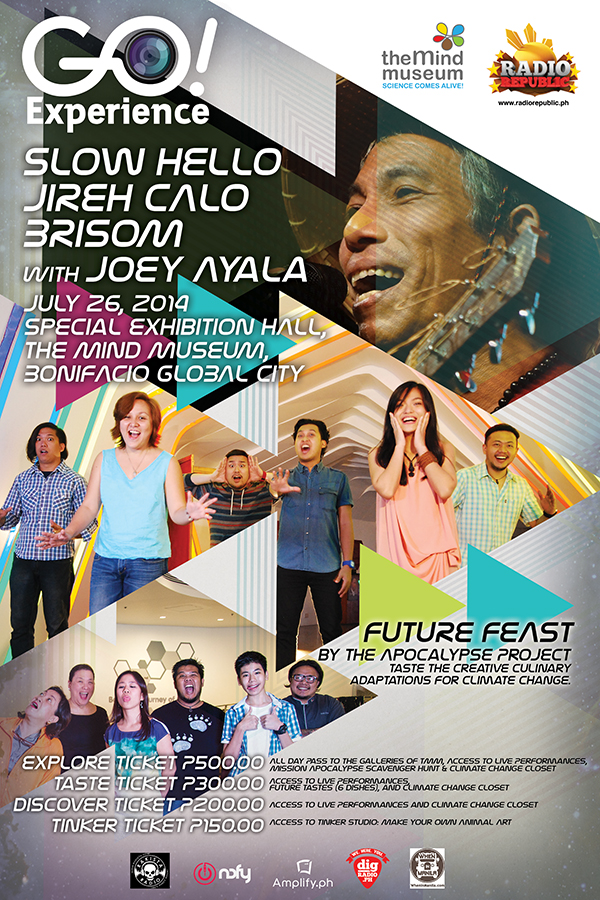
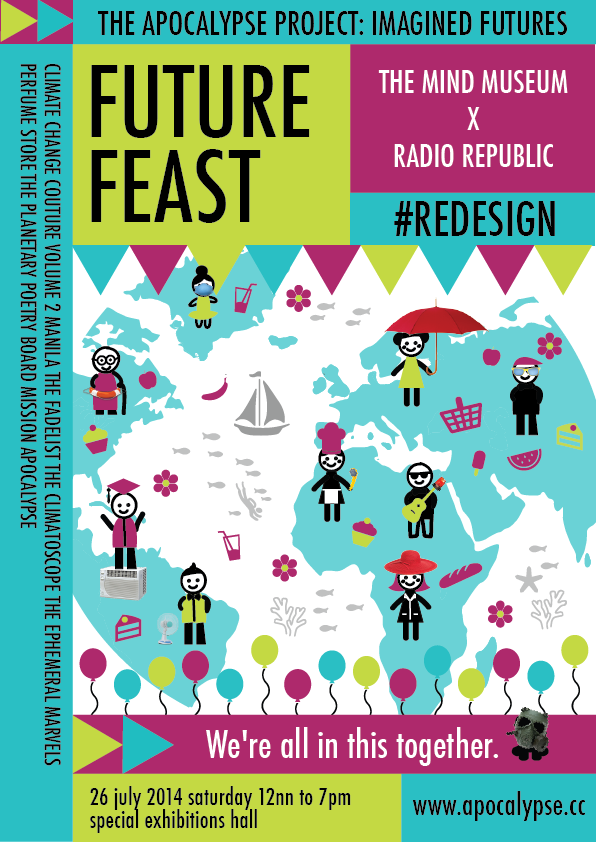
Hello, apocalypters! I’m excited to announce that as a culminating event for The Apocalypse Project: Imagined Futures, The Mind Museum is collaborating with Radio Republic to bring you Future Feast, a celebration of human creativity and our hopes for a sustainable future. The event will be on July 26, Saturday, 12PM to 7PM at the Special Exhibition Hall of The Mind Museum.

FutureFeastTMMposter-01

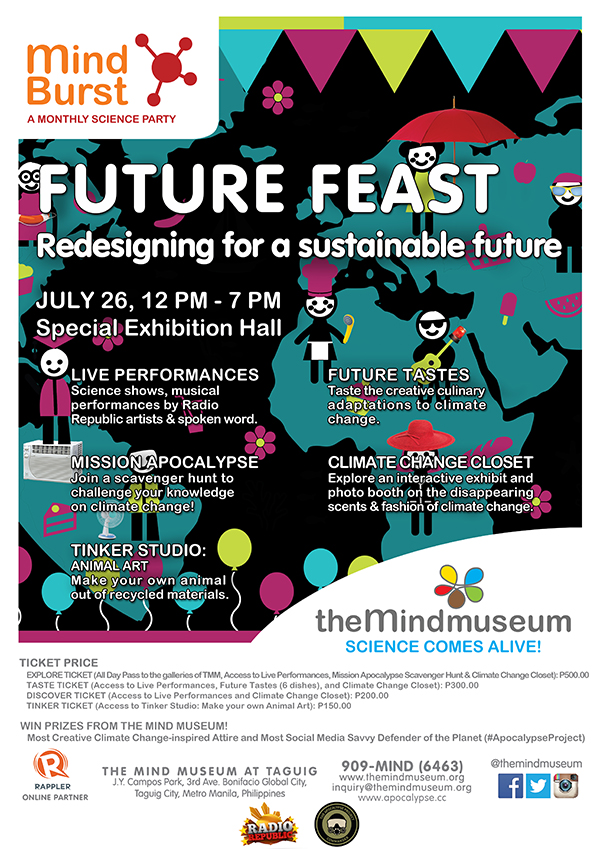
With the theme of Redesign, I am working with chefs who are creating new dishes for a Convenience Store of the Future. Radio Republic is bringing in their featured artists for July: Slow Hello, Jireh Calo, and Brisom. There will also be a performance by special guest artist Joey Ayala. This is an event for all ages, so bring in your families and get the kids to play at the Tinker Studio, watch spoken word performances and science shows, dress up in clothes from the Climate Change Closet and have your photos taken at the photo booth, smell the perfumes of The Ephemeral Marvels Perfume Store, participate in Mission Apocalypse Scavenger Hunt and win an Apocalypse Project Commander Badge, and think of how you can help build a sustainable future by making an Earth Pledge.
Future Feast poster by The Mind Museum, which highlights activities

Future Feast poster by The Mind Museum, which highlights activities

Future Feast poster by Radio Republic, highlighting featured artists, special guest artist, and the chefs

Future Feast poster by Radio Republic, highlighting featured artists, special guest artist, and the chefs

Ticket prices are as follows:

EXPLORE TICKET (All Day Pass to the galleries of TMM, Access to Live Performances, Mission Apocalypse Scavenger Hunt & Climate Change Closet): 500.00 PHP

TASTE TICKET (Access to Live Performances, Future Tastes (6 dishes), and Climate Change Closet): 300.00 PHP

DISCOVER TICKET (Access to Live Performances and Climate Change Closet): 200.00 PHP

TINKER TICKET (Access to Tinker Studio: Make your own Animal Art): 150.00 PHP

You can buy tickets online here. You can also buy your tickets at the museum on the day of the event. No reservations are required.

See you there!


(Or maybe re-crew-ting for The Apocalypse Crew. Haha. Ha. Ha. Uhm. Yes. Anyway, back to this post.)
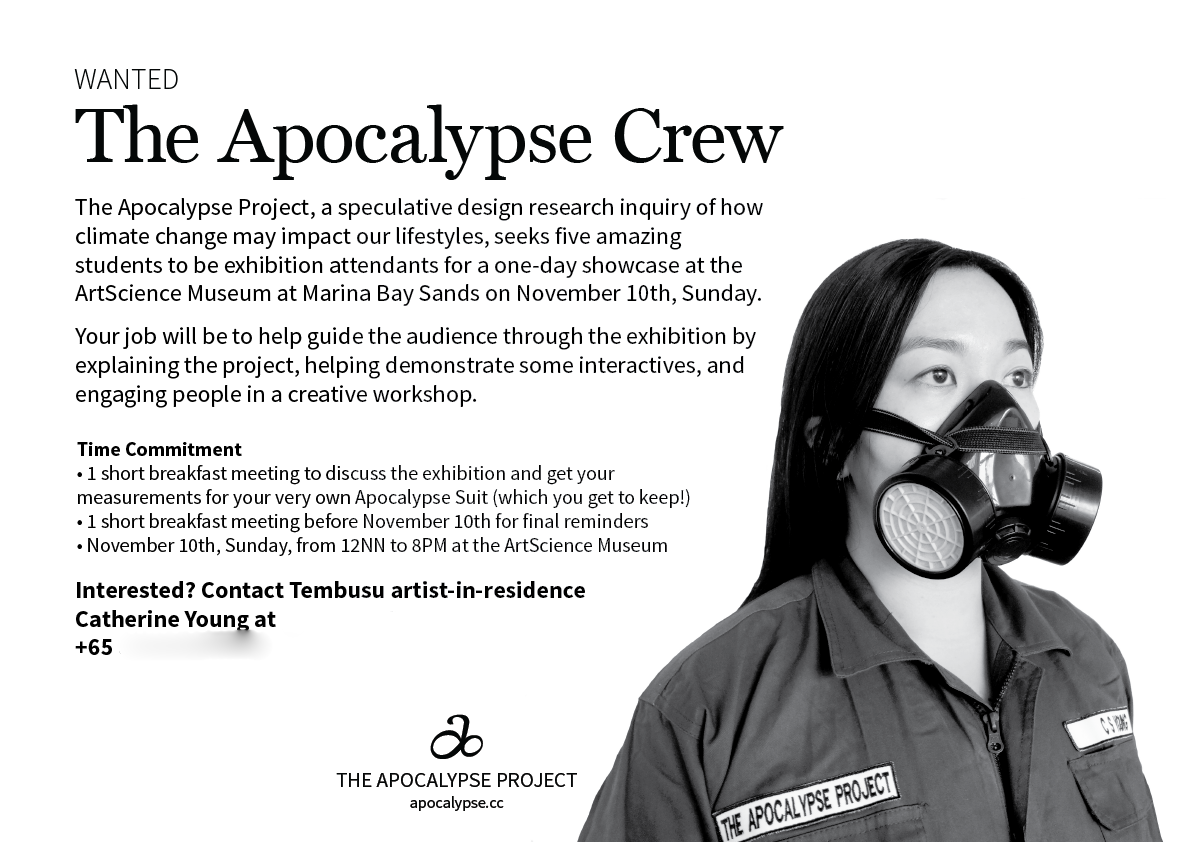
Last week, I was busy recruiting students to be exhibition attendants for our Art/Science Residency Showcase on November 10th. There are too many pieces in my part of the show that I can’t do it alone. I posted this ad in Tembusu College at the National University of Singapore, where I currently live.

TheApocalypseCrewAd-01

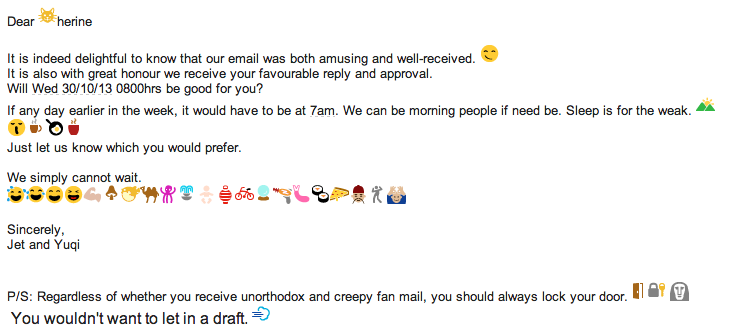
I was expecting to have to beg the students, as it’s midterm crunchtime for most of them. However, I now have six awesome people who have agreed to help! And for two of them, they come with this interesting application letter:

Dear Catherine,

It is with great interest (and perhaps some desperation) that

XXXXX / Chinese Male / Year One Law / Year One Tembusu

and, I,

XXXXX / Chinese Male / Year One Architecture / Year One Tembusu

enlist as exhibition attendants for impending The Apocalypse Project.
After having read your A4 print of a woman wearing a hazmat respirator in our recently-LED-lit elevators of Tembusu (the dimly lit environment did enhance the dystopian intent of your exhibition, though making posters slightly harder to read) , here prize two eager students at your disposal.

We believe that your exhibition would prove valuable, enlightening and practical if we were to face the brink of extinction (have you yet not seen the signs?).
Perhaps we could also offer our insights during the tour, perspective of a Law and Architecture student (if our professional endeavours prove relevant, if not useful).

We will be faithful minions to your cause – to educate people in end of the world preparations, as gaily as possible.
We will be the last two remaining outlasting volunteers, lasting in resolve, even if it were the last few days to the end of the world. Last.

I hope you find our response to your conch call and enthusiasm appealing, if not incredibly weird (both strange and funny).
Hope to hear from you soon.

Sincerely,
XXXXX and XXXXX

I replied back with a ‘yes’ and an attempt to be as clever in language—something about how I didn’t know whether to laugh or to lock the front door—and here was their reply:

Screen Shot 2013-10-24 at 1.52.44 AM

What crazy person wouldn’t hire these two?

On another note, I wonder what kind of emails I’ll get if I design something more complex, such as a dating service or something.

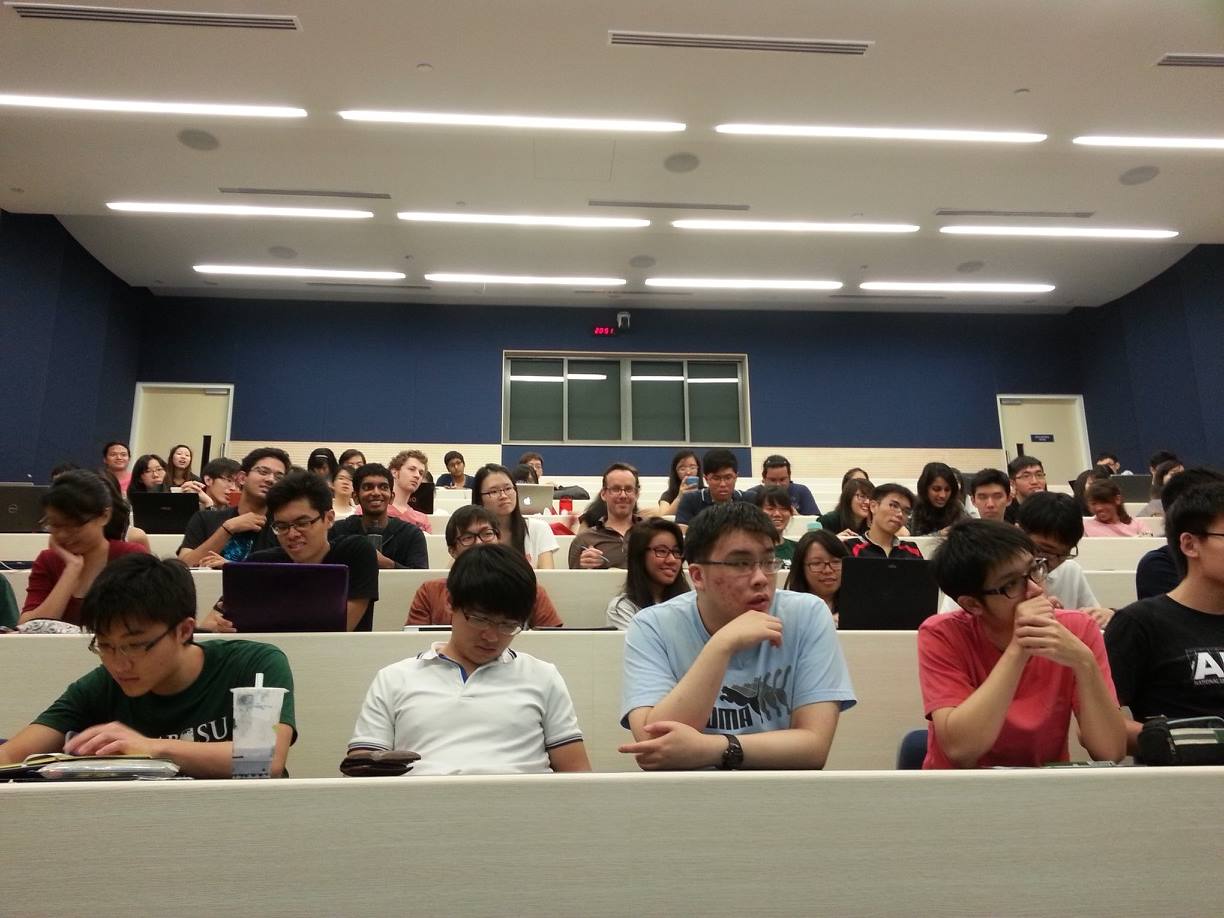
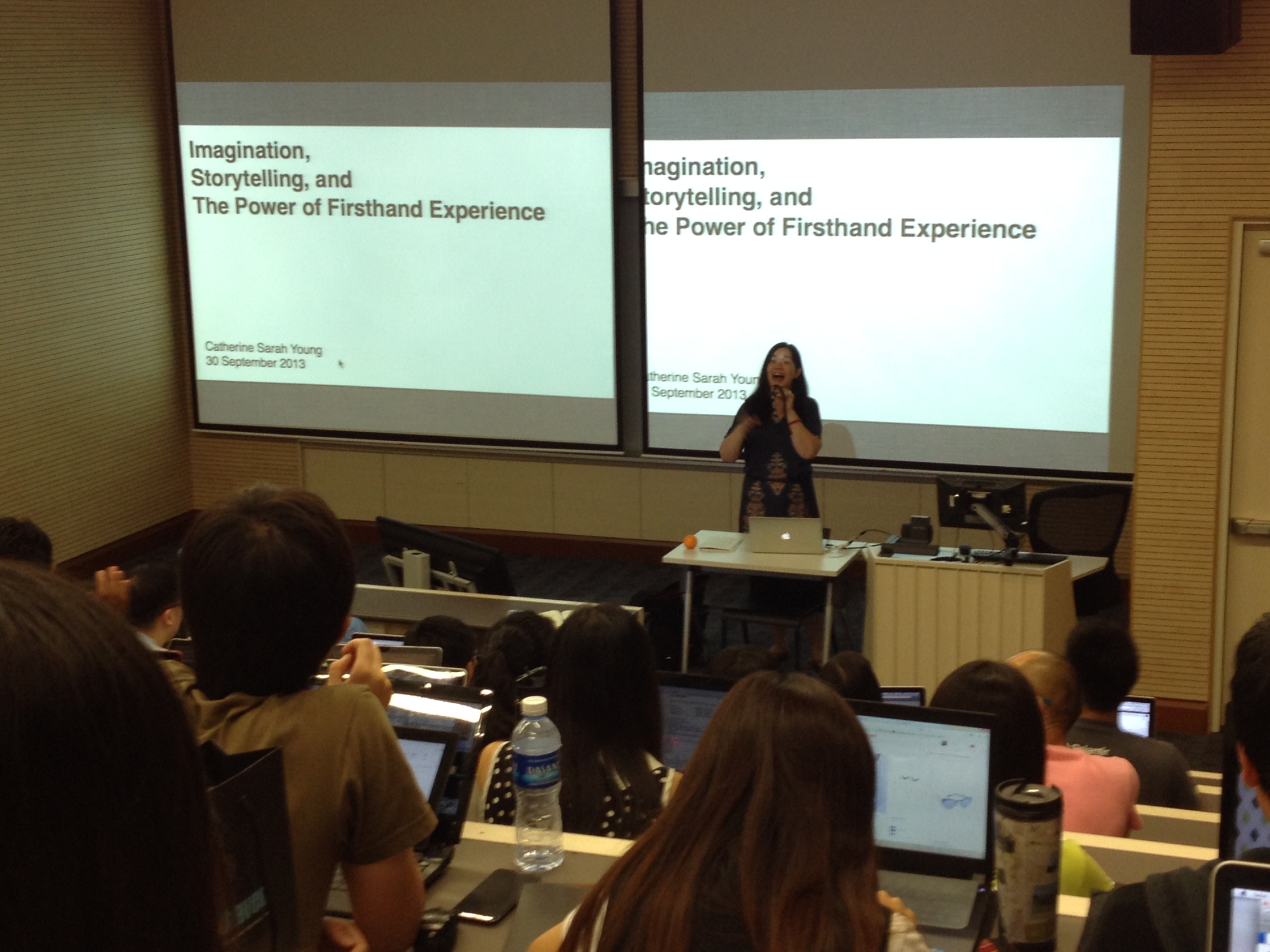
This week, I and my fellow artist-in-residence Michael spoke in Tembusu College’s Singapore as Model City class.

IMG_2532

It looks like I’m singing, but I’m not. I was just saying hi and asking if they could hear me. Thanks, Dr. Margaret Tan, for the photo.

902221_10153374097075122_226053046_o

I think I like it when the stage design is reversed and I’m looking up.

I won’t elaborate on parts of my talk that I’ve posted before, such as what happened during The Apocalypse Workshops or the comments on DrawHappy that made me rethink what the project could be about. So instead, I’ll emphasize some of the things I learned about experience design and collaborations between art and science.

Experience and memory
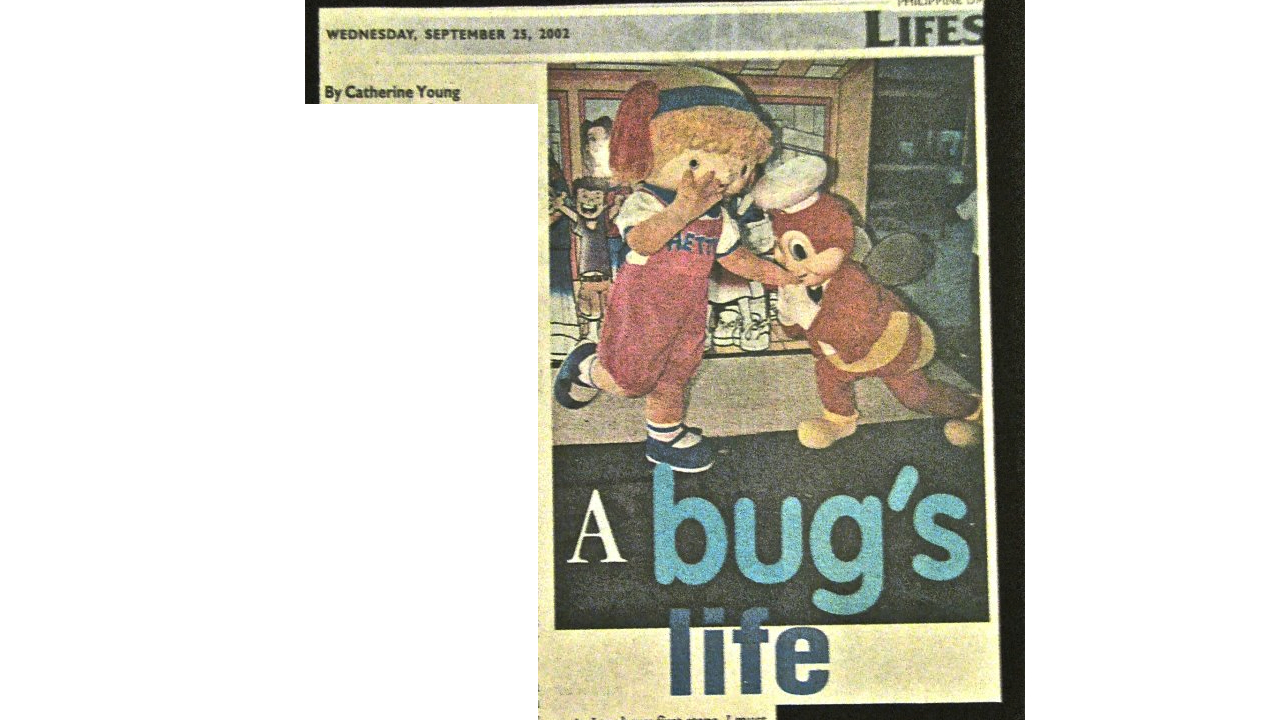
The image my have the last word, but for me, experience is the one that stay with you forever. I referred to a series of articles I wrote when I was a young journalist, oh so many years ago. This is a photo of me when I was 19 years old:

Jollibee.002

In this photo, I was wearing the costume on the left, although I also wore the one on the right. These are mascots from Jollibee, a Filipino fast food chain that, for me, is one of the icons of modern Filipino culture and taste. It was for a series of articles called Temporarily Yours, where I took on a job for a day and then wrote about it. Looking back, these are exercises in empathy, albeit short ones, where I realized how it was to be on the other side of the fence. Most of these jobs were in food or customer service, such as a barista or a sushi chef. Others were about performance, such as a magician’s assistant or a zookeeper. In this particular article, I wrote about how it was to be a mascot and embody a character beloved by children. I still vividly remember these experiences more than a decade later, such as how the head of Hetty (the female character, short for “spaghetti”) was so big and difficult to balance, and how Jollibee’s butt was so huge, it took two guys to shove me through a door. You know, good times.

Projects like these have shaped my views on how I execute future projects. Though I don’t feel that my work fits just one area of inquiry, I think that the common thread between all of them is that of experience. Experience is very powerful. The image may have the last word, but in a world where we are saturated by images, I believe that experience makes these images last longer and gives them more meaning.

Korea and Experience Booths

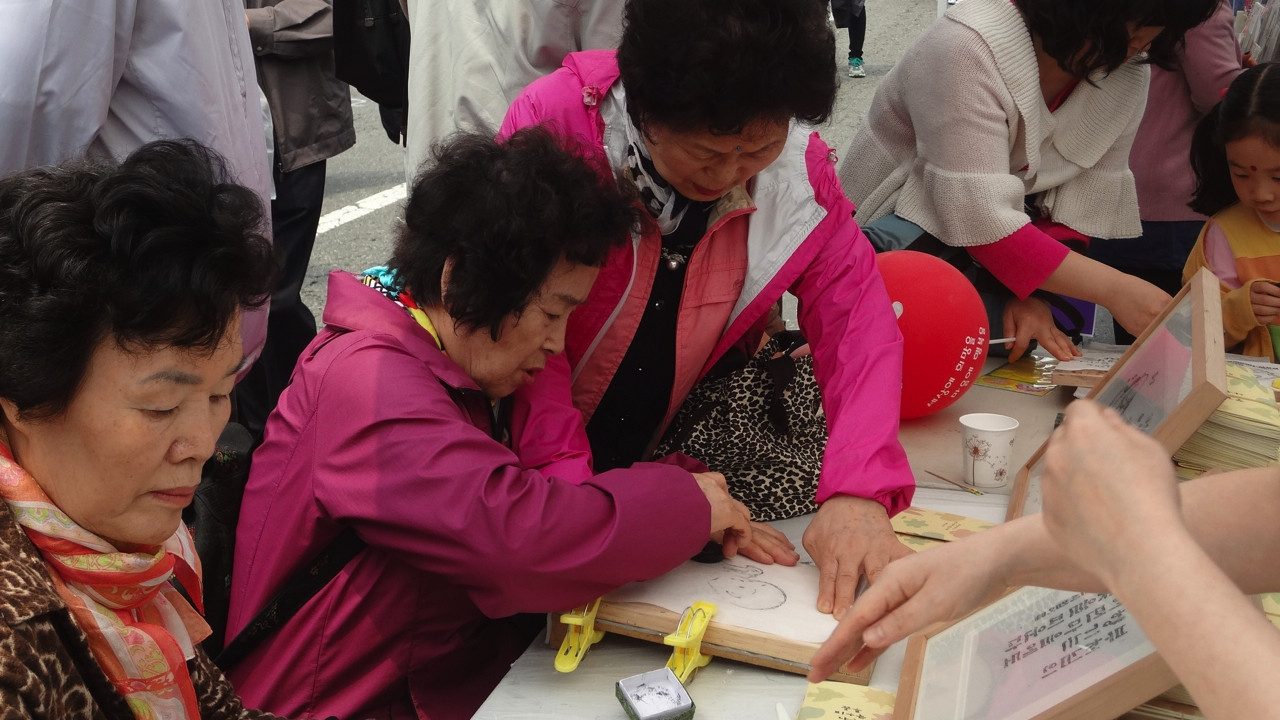
My views on experience design have also been honed through seeing South Korea’s experience booths in festivals, which will always mark my memories of that country. In festivals in the US or in Europe, I would usually find people selling me a finished product, let’s say a ceramic pot. But in Korea, I will be sold the experience of making or painting my own pot. In this case, I will find myself sitting down at the booth and getting messy at the table, thus slowing down, making my experience more personal, and hopefully have a longer lasting memory than just having the generic festival experience. Perhaps I will end up treasuring the pot I made myself rather than just another cheap souvenir. I also think these booths give wonderful creative opportunities for families, children, and the elderly.

Korean experience booths.048

A Korean experience booth on printmaking

Korea can get quite creative with their experience booths, such as this one I saw down south in Hampyeong.

I believe that the role of artists / scientists / designers is not just to have these unique experiences through their work, but to share these with others. Typically, we share that experience by writing about it for others to read. Through that reading, perhaps someone will profoundly connect with our writing. However, I think that human bonds can be stronger through a shared experience. Your audience can create their own experiences for themselves and yield results that are unexpected, like what I’ve learned from previous projects. This is when you realize that your audience teach you something as well, which is a wonderful thing. Projects become a conversation between creator and audience, which will only serve to fuel human creativity and progress.

Art, Science, and Sustainability

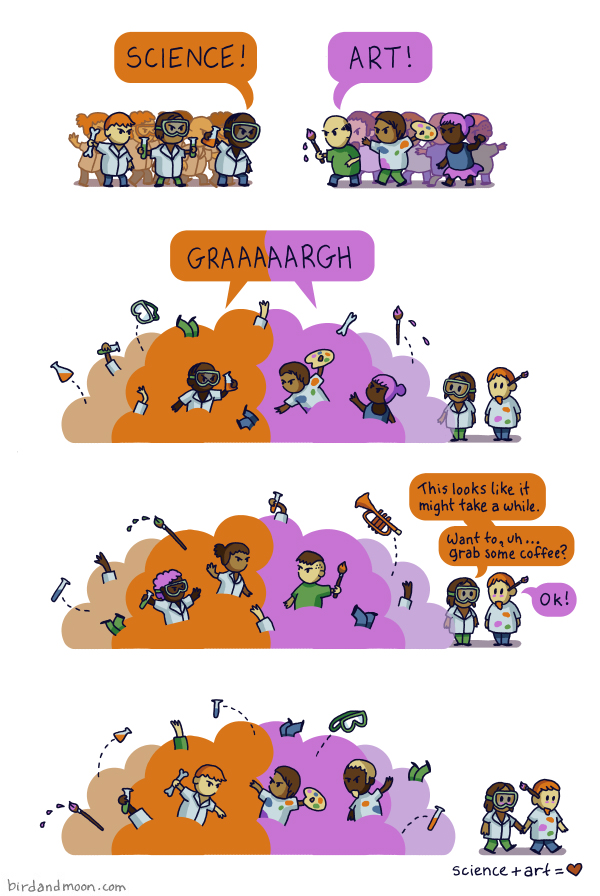
Personally, I believe that the wealth of human knowledge is too vast to just break down into two, but for the sake of simplicity, let’s go with these two fields: art and science. As I have been trained in both, I have felt what it was like on each “side”. I have been “the scientist” in an art/design studio, and “the artist” in a science lab. Both types of experiences have been very unique to me. Both sides have their own ivory towers. Those who choose to be in those towers, I think, should quickly parachute off. Our world is too vast and our problems too complex for petty squabbling. Unexpected things can happen when ideas from each side, as they say, have sex. Here is a nice comic by Bird and Moon that shows that.

sciencevsart

Image copyright by Bird and Moon

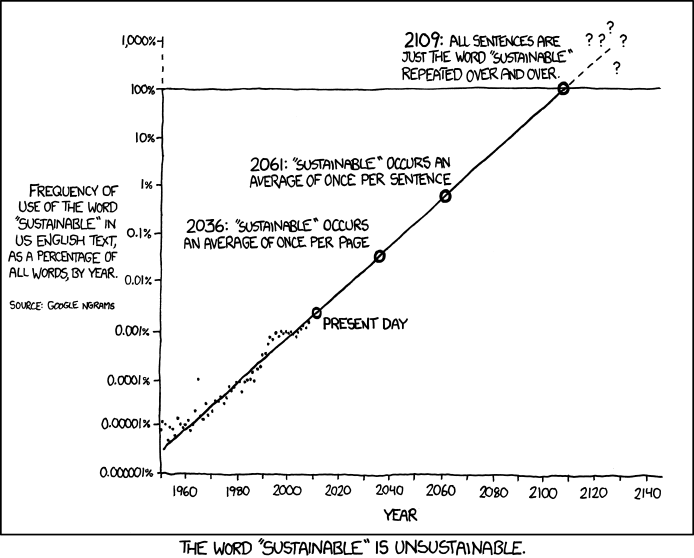
Collaboration is especially important in the realm of sustainability, which is a world I did not expect to enter. It’s quite a booming area, especially in Singapore. Everyone and your mother is doing sustainability.*  (That, and “cities” and “resilience.”) I referred (again) to this Ngram by xkcd.

*Did I really say that in a university class? Yes, I did.

Image copyright by xkcd

Image copyright by xkcd

Instead of being a part of the echo chamber that such “trending” fields create, perhaps new solutions can emerge by letting disciplines hang out together, as they used to do, way back when.

In the end, I emphasized empathy to these bright eyed young students who are in the middle of creating sustainable urban interventions for their class. I said this as someone from the Philippines, a developing country. I cannot tell you how many international consultants in there right now, wanting to save it from XYZ problems. Now, I am very grateful that these brilliant people are there, and I am sure they have great intentions. Certainly foreigners can see opportunities locals may have overlooked, as I have had, being a foreigner in four other countries. But I’ve seen enough projects that never get implemented or never have their full potential realized because of these gaps in empathy. I believe we can do better.