When one wakes up in another world, the previous one seems like a dream. Korea, magical as it is for me, seems like it ended a year ago instead of just last month. I’m now in Singapore for the 2013 Art Science Residency Programme in partnership with ArtScience Museum™ at Marina Bay Sands, Tembusu College National University of Singapore (NUS) and the Singapore-ETH Centre’s Future Cities Laboratory.

It is such a wonderful opportunity, and a very timely one as well. I am very grateful. Because of the Seoul43 project, I realized that one potential application of my work is the environment. The things I saw while I was in the mountains made me care about what humans are doing to nature in a more visceral way. Don’t get me wrong; I’ve always cared about recycling, global warming, and polar bears, but having my hikes directly affected by what humans were doing to the environment (and ultimately affecting the direction of the project) was very unnerving. That project wasn’t too long ago, and I still have more questions than answers. (Visit the project site here.)

Climate Change and Environmental Futures

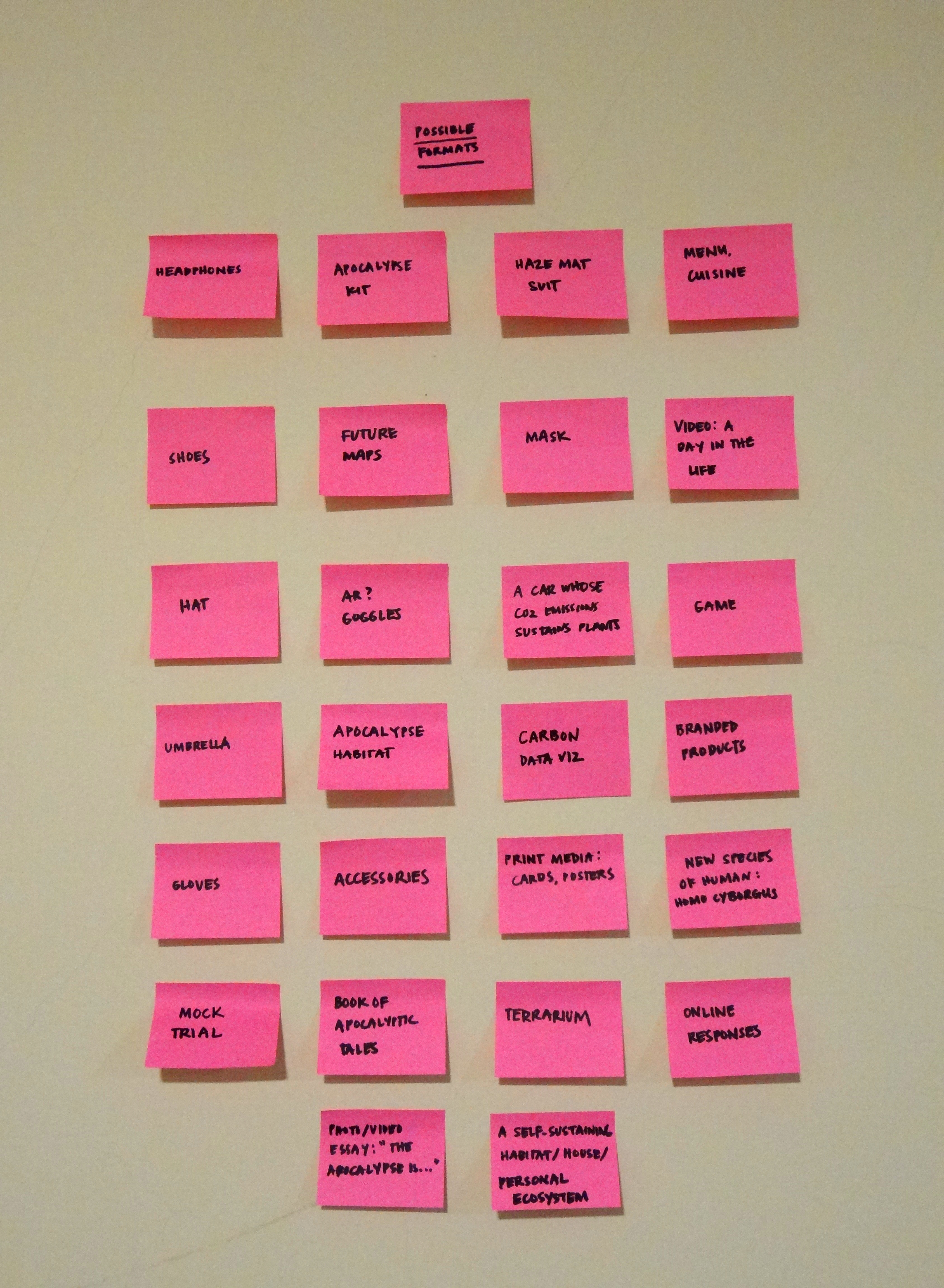
I am working on the theme, Climate Change and Environmental Futures. My project is about a potential “apocalypse” that may ensue in the future because of climate change. I aim to design objects that examine our perceptual lifestyles when that occurs. So. How will we see, hear, smell, touch, taste, etc. when we need to adapt to a less habitable earth? And on the other side of the spectrum, what can be designed along the lines of perception when we are able to mitigate climate change? These are questions that intrigue me and will keep me happily preoccupied in the next four months of this residency.

This project is also an experiment for myself and the direction of my work. I suppose this is why despite my excitement, I want to proceed with caution. This is definitely my science background talking. There are enough people misleading others about climate change; I don’t want to be one of those. I’m happy to have scientists and humanists in the college to give me their perspectives and share their research, thus informing my work.

Cousteau

I never thought I would work along the lines of climate change. And yet, I did kind of foresee this last year. Because of my passion for nature and exploration (and flying up in an ultralight), I came across the works of Jacques Cousteau, marine explorer and conservationist. In his book, The Human, the Orchid, and the Octopus (Bloomsbury, 2007, co-authored with Susan Schiefelbein), he said that “Had I known where I was going, I would not have gone.” This resonated with me, along with him quoting Albert Szent-Gyorgyi’s distinction between Apollonians and Dionysians. I fear applied research sometimes, because when one drops a product into the real world in the hopes of solving something, oftentimes there are consequences you did not account for. That, plus I think my best ideas and projects are those when I was just in states of play.

The Anthropocene 

In the past few weeks, I’ve done a lot of research on recent findings and ideas in our Anthropocene. I am encountering a lot of very interesting work by artists, scientists, journalists, etc. I will be updating this site frequently, so check it out for my progress. 

Goals

There are specifics of this project I will be working out within the next few weeks. But now that I am here and have seen the labs and met with the staff, I have a better idea of what I can and cannot do. But just like my previous projects, I aim for these qualities:

1. Inclusivity—I hope to engage not just people from within the field of climate change, architecture, sustainability, and urban design, but also the people outside of it. I want to reach out to those who have no professional stake in my project, because I believe that climate change is a human issue that affects all of us.

2. Interactivity—I intend to create pieces that people can have an experience with and engage their senses, instead of just making something people will look at.

3. Empathy—I aim to collaborate with both the sciences and the humanities. The former is to ground my work in facts, and the latter is to allow for profound human connection. I hope for the audience to move from mere awareness of environmental issues to mindfulness where they are spurred to act and maintain positive environmental habits for the long-term.

The Weekend with the Eameses

This past Saturday, as part of my research, I visited the wonderful ArtScience Museum, where we artists-in-residence are supposed to give a talk and be part of their Sunday Showcase sometime in November. I loved the Mummy exhibition and the National Geographic’s 50 Greatest Photographs, but it was the Eames exhibition that made me rejoice and gave me some level of encouragement as I begin this admittedly crazy project.

I loved seeing the Mobius Band from their Mathematica exhibition:

DSC08403small

And thanks, Charles, for this:

DSC08406

Oh well, as always, here goes nothing.

(Written last week, posting only today!)

It’s hard to pack when one hasn’t unpacked, I tell myself as I examine my suitcase whose contents have not been voided in the past four weeks of transience in Manila. I had left Korea and am now en route to Singapore for another project.  I chide myself, because the reality is quite the opposite. As the ninth (?) move, I realize my luggage hold the memories of my most immediate past. There is little to give away, and little to buy. Everything I need is in this big red bag that has traveled the world with me.

It is a suitcase that has known many stories, from its first trip more than 10 years ago, when I visited Cold Spring Harbor Laboratory as a potential graduate candidate. (I didn’t get in, but it was amazing seeing Barbara McClintock’s lab!)  This bag was with me in the interrogation room in the train station in Barcelona, when security, in their amusement, told me I was not allowed to bring training sai during my trip. Outraged, I pointed the blades to my neck, took a stab, and cried, “Mira! Mira! No sangre! Estan no peligroso!” (Look! Look! No blood! They’re not dangerous!) They let me take them in the end. I brought this bag with me again to New York, with my Fulbright bag tag on the strap (I figure if potential thieves think it’s just full of nerdy books, they will never take it.)

A few weeks ago, a couple of well meaning friends asked me where is home? It’s in my heart, distributed in pieces, all over the world, I gamely quipped. It was midnight, and I was working like mad on my computer, beating another deadline. I stopped thinking about this question in recent times.

These past few weeks have been a sharp change from the constant busyness and preoccupation in Korea to the downtime and quietness in Manila. From mowing a mountain in a monsoon and getting swept up in the flurry of goodbyes, I finally had a lot of time for thinking about how things might be in the next few months. And I realized I didn’t have a clue.

When one starts out with the mentality of an explorer, of going into the unknown (and the fearlessness of a child with that nagging curiosity of sticking her finger in an electric fan) it is difficult to discern where one will end up. In between the lives I’ve led, I found it necessary to have moments of reclusion—of, as I recently coined to a friend over dinner, my “armadillo mode,” to refer to the shell I have to ensconce myself to have time to process what just happened.

There are few things one can take with her when the airline only allows for baggage weighing 20 kg. I suppose we leave part of ourselves behind with the people we love and take only what is necessary for the next life.

My friend Kate Kirkpatrick, who also serves as producer of my Seoul43 project, has been working making sure that its extension project, Pyeong Chang Mobile Garden, a piece currently in the 2013 Pyeong Chang Biennale, is finished. This weekend, she reported back to me (I’m currently in Manila in transit to my next project), with these photos.

1375605923070 1375606195305

I smiled when I saw this photo with Pyeong Chang Biennale curators, Mr. Hyunchul Lee (left) and Mr. Yoonkee Kim (right), who helped finish the job. Kamsahamnida!

1375606435365

View a previous post about the installation and another piece here.

(SEOUL)—The Asian Students and Young Artists Art Festival (ASYAAF) 2013, co-organized by the Chosun Ilbo Daily and the Ministry of Culture, Sports, and Tourism, is currently happening at the beautiful Culture Station Seoul 284. It features 500 art students, post-graduates, and professional artists. It runs until August 18.

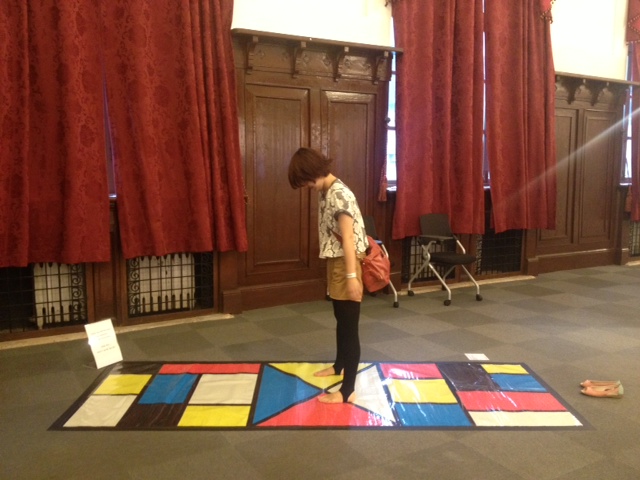
If you are in town, go hop on one of my Mondrian Hopscotch boards, and check out art from all these vibrant artists 30 years old and under.

IMG_0008

IMG_0003

View the ASYAAF 2013 website here.

With thanks to the awesome people at Gallery LVS, especially Ms. Dain Oh for the photos.

Among the fascinating people I have met or seen in Korea are the haenyeo, or Korean female divers. I encountered them in Jeju, an island in the south. The haenyeo dive for abalone, clams, and seaweed without any special diving equipment. The women are mostly old, as the younger ones do not want to become haenyeo any longer. I am told that the youngest is in her fifties. There are only a few thousand haenyeo left.

DSC07880

In a diving show, the women sang before getting in the water.

DSC07894

They could be mermaids, after all!

DSC07910

To prepare for the Winter Olympics in 2018, Pyeong Chang is having a biennale from July 20 to August 30, 2013. As an extension of my Seoul43 project, I was commissioned to do a 1-day community planting project reflecting their theme, Earth Harmony.

Last week, I installed the first half. During the opening of the biennale, participants will be invited to plant seedlings and assemble them on the letters so that both artist and audience form the words of the biennale’s theme, Earth Harmony. After the event, people will be invited to take the plants to bring home, to plant in their gardens, or in any public area where planting is permissible.

I wanted to use a framework similar to Seoul43, where I create a piece that the public is invited to collaborate with to achieve one goal, and then disperse it to their local environment. In Seoul43, I bring a piece of all the mountains for participants to plant with and bring back individually to the mountains, giving them an opportunity to design their own experience.

DSC08321

20130712_094234


It was a grueling 2-day installation, with me having to mow the mountain with a sickle all my myself in a monsoon. But here I am in taekwondo pants, my American Museum of Natural History sweatshirt that I got as an intern, and my Korean ajusshi barbecue gloves.

DSC08279

It was painful and hilarious at the same time. I’m a bit worse for the wear, but hey, no pneumonia!

Another piece commissioned is an 8-meter-long Mondrian hopscotch board. This is the fourth one I’ve made so far.

DSC08255


Visit the Pyeong Chang Biennale website here.

For my Seoul43 project, where I hiked all the mountains in Seoul and borrowed soil samples from each mountain, the public was invited to plant using the mountain soil. Afterwards, people were invited to go on scavenger hunts to plant the soil back to the mountains of their choice. I have held two children’s workshops where participants planted using the soil, and together we went to a nearby mountain to do the scavenger hunt.

The scavenger hunt is designed to use small tasks that will promote positive hiking habits in the participants.

1. Greet and bow to the elderly.*
2. Give candy to fellow hikers.
3. Pick up trash.
4. Arrange fallen leaves or flowers into a sculpture.
5. Recite poetry.
6. Balance rocks.**
7. Use an exercise machine.
8. Write on a postcard.
9. Read official signs.
10. Plant!

* In South Korea, it is considered polite to bow to one’s elders.
** Many Korean mountains have Buddhist temples, and rock balancing is a common sight in and around them.

In addition, some people who previously learned about this project from my participation in the International Sculpture Festa in the Hangaram Art Museum at Seoul Arts Center this May signed up to participate. During the exhibition in the National Art Studio of Korea, they came to pick up a plant and hike a mountain. They told me the mountain they wished to hike, and I gave them their task list. Later, they will email me with documentation of what they did. Participants will be featured on the Seoul43 site with their permission.

The project website will be regularly updated, but here are some photos. If you are interested in doing a scavenger hunt even after this project is finished to join a community of city hikers here in Seoul, please email me at csgyoung[@]gmail[dot]com.

Hiking in Choansan:
DSC06951

After greeting an elderly lady:
DSC06956

Giving candy to fellow hikers:
DSC06958

Rock balancing:
DSC07016

Planting:
DSC06986

Planting:
DSC06993

The most hilarious moment during my weekend, a summer camp with the kids from my taekwondo class in Daehyeon Beach in Boryeong, was this 17-year-old personal mystery finally solved:

DSC07260

Behold, the fate of taekwondo boards once they’re broken. The masters reuse them to fire up the barbecue grill to make bulgogi (Korean barbecue). Cycle complete.

Yesterday, this sweet couple came over to pick up a plant from my installation so they can plant it to Wausan, a mountain near the lady’s school.

DSC07303

It’s lovely to be reminded why I did this project. Visit the Seoul43 site here. I’m still working on the text, but I’m glad the exhibition is done and I have no more mountains to climb. And eek! Look at the shelves on the right—lots of planting going on, eh?
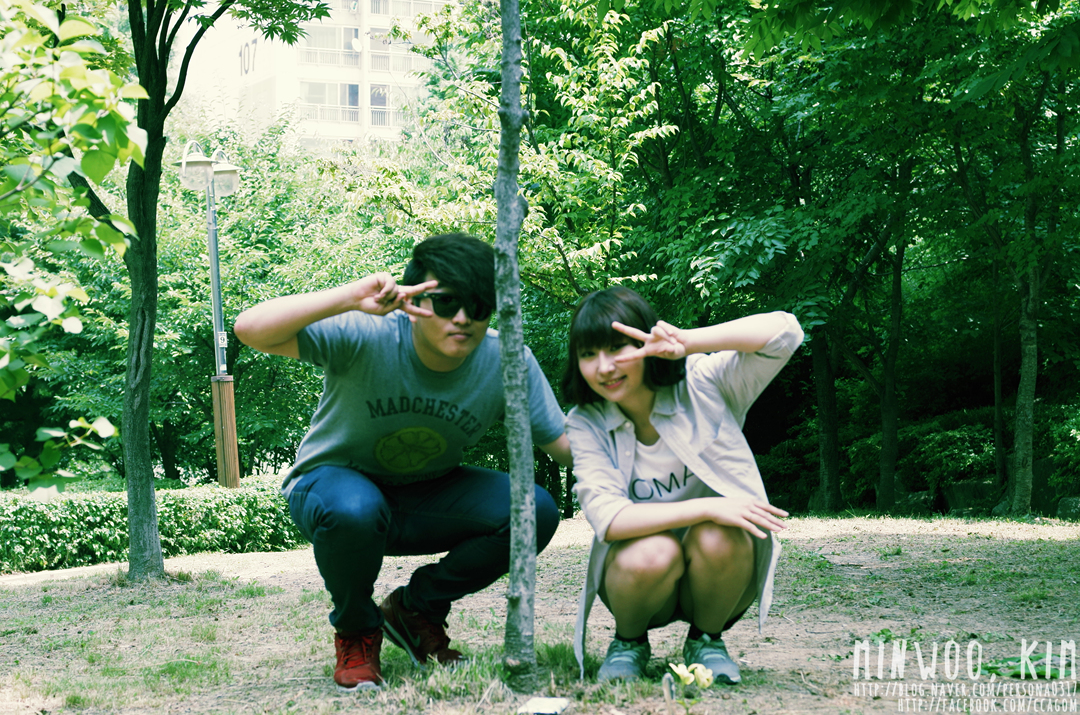
Late last week, on a much needed break from the studio, my friend Kate and I visited Changgyeonggung. It’s a palace I previously visited and nicknamed the Feminist Playboy Mansion, as the first female royal physician was there, as were a lot of concubines. It was very soothing to see the palace so green, since my last visit was in winter. In the middle of our visit, Kate pointed out a family of ducks who were about to jump into a pond.

For a few minutes, we watched as the little ducklings practiced swimming.

DSC06789 DSC06792

So, so cute! And quite fast, too!

Ok, now back to work.