Amanda Mok of Design Taxi featured Climate Change Couture. Thanks so much! Read the article here.
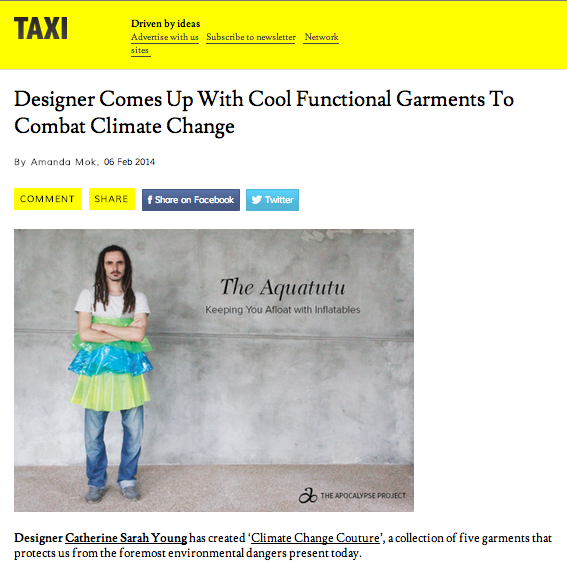

Amanda Mok of Design Taxi featured Climate Change Couture. Thanks so much! Read the article here.
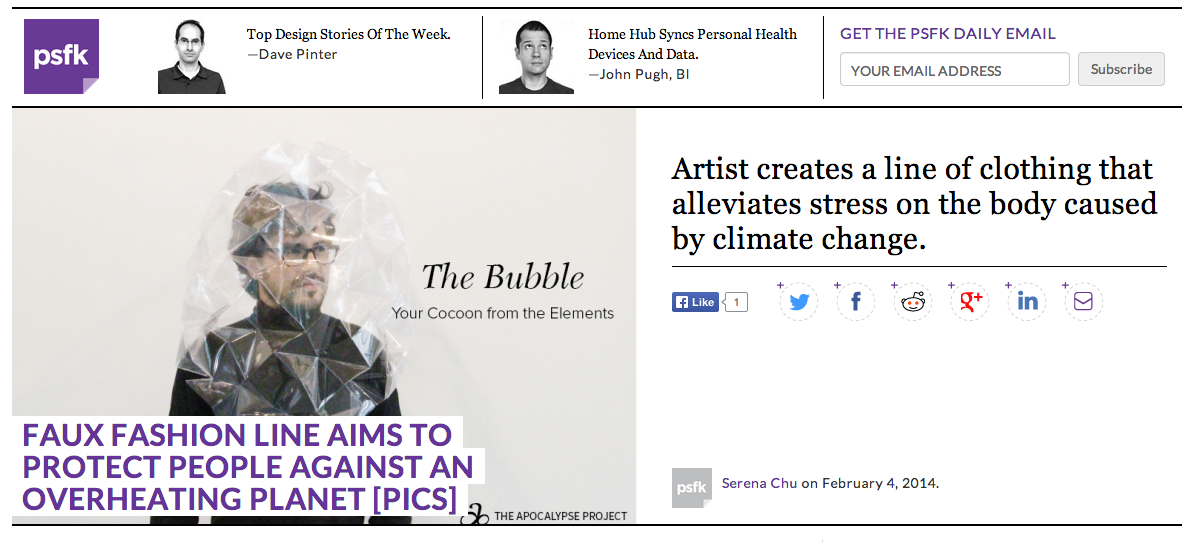
Serena Chu features Climate Change Couture on PSFK. Thank you for your support! Read the article here.
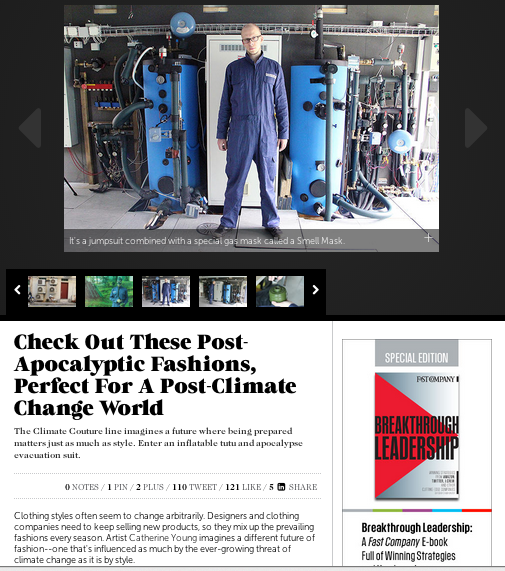
Ariel Schwartz of Fast Company interviewed me about Climate Change Couture. Check it out here. Many thanks to all my collaborators! Stay tuned for more updates.
Hi all! I and my friends at the National Art Studio of Korea will be part of the International Sculpture Festa 2013 at the Hangaram Museum of Art in Seoul Arts Center.
It opens tomorrow, May 4, with art talks by yours truly and other international artists.

via ISF 2013 Facebook page
We installed today, and here’s how mine looks, on the second floor.
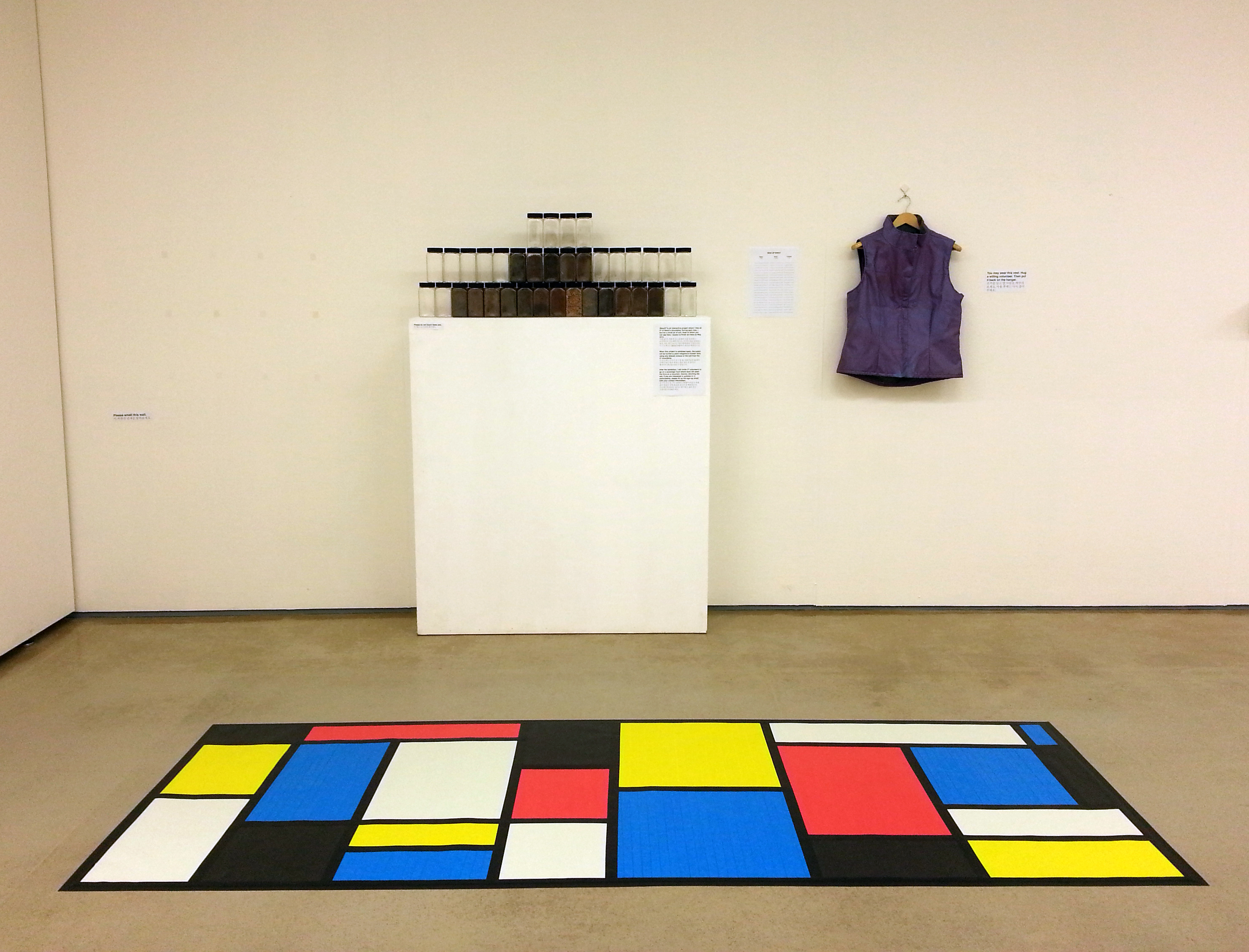
Installation view
As an interactive and perceptual artist, I’m placed in the category, “What Can Sculpture Be?” I have four pieces: a wall with microencapsulated odors you can smell, The Hug Vest that you can wear, a Mondrian Hopscotch board you can play with, and 37 jars that are and yet to be filled with soil from all 37 mountains of Seoul that I’ve hiked. The last one is to be exhibited again in the National Art Studio in June, when I’ve finished all the hikes and get willing participants to join me on an interactive project afterwards.
Check out the festival website here.
If you’re in Manila, please check out The Mind Museum, where two of my hug vests are installed on the second floor.

The Hug Vest lives! In adult and kid’s sizes.
I would greatly appreciate it if you take a photo of yourself wearing it, hugging someone with it, and showing the color change after the interaction. Go! Go! Go!
What the clouds can teach you about imagination and everyday things
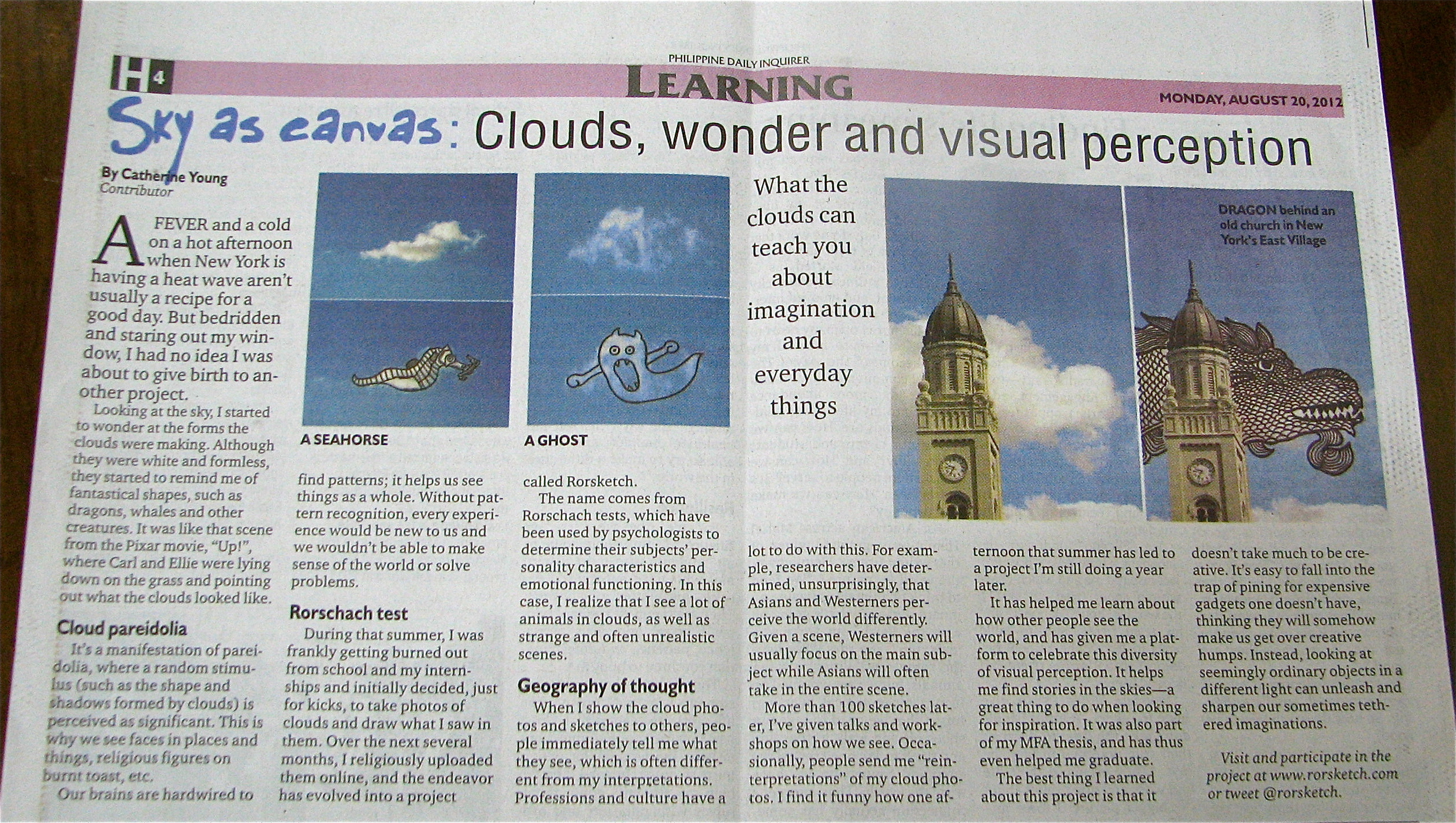
A fever, a cold, and a hot afternoon on a New York heat wave aren’t usually a recipe for a good day. But bedridden and staring out my window, I had no idea I was about to give birth to another project.
Looking at the sky, I started to wonder at the forms the clouds were making. Although they were white and formless, they started to remind me of the fantastical shapes, such as dragons, whales, and other creatures. It’s not unlike that scene from the Pixar movie, Up!, where Carl and Ellie were lying down on the grass and pointing out what the clouds looked like.
Cloud pareidolia
It’s a manifestation of pareidolia, where a random stimulus (such as the shape and shadows formed by clouds) is perceived as significant. This is why we see faces in places and things, religious figures on burnt toast, etc. Our brains are hardwired to find patterns; it helps us see things as a whole. Without pattern recognition, every experience would be new to us and we wouldn’t be able to make sense of the world or solve problems.
Rorschach test
During that summer, I was frankly getting burned out from school and my internships, and initially decided, just for kicks, to take photos of clouds and draw what I saw in them. Over the next several months, I religiously uploaded them online, and the endeavor has evolved into a project called Rorsketch. The name itself comes from Rorschach tests, which have been used by psychologists to determine their subjects’ personality characteristics and emotional functioning. In this case, I realize that I see a lot of animals in clouds, as well as strange and often unrealistic scenes.
Geography of thought
When I show the cloud photos and sketches to others, people immediately tell me what they see, which is often different from my interpretations. Professions and culture have a lot to do with this. For example, researchers have determined, unsurprisingly, that Asians and Westerners perceive the world differently. Given a scene, Westerners will usually focus on the main subject while Asians will often take the entire scene in.
More than 100 sketches later, I’ve given talks and workshops on how we see. Occasionally, people send me “re-interpretations” of my cloud photos. I find it funny how one afternoon that summer has led to a project I’m still doing a year later. It has helped me learn about how other people see the world, and has given me a platform to celebrate this diversity of visual perception. It helps me find stories in the skies—a great thing to do when looking for inspiration. It was also part of my MFA thesis, and has thus even helped me graduate.
Wonder in the everyday
The best thing I learned about this project is that it doesn’t take much to be creative. It’s easy to fall into the trap of pining for expensive gadgets one doesn’t have, thinking they will somehow make us get over creative humps. Instead, looking at seemingly ordinary objects in a different light can unleash and sharpen our sometimes tethered imaginations.
Visit and participate in the project at http://www.rorsketch.com or tweet @rorsketch.
—
This article first appeared in the Philippine Daily Inquirer’s Learning section, 20 August 2012, page H4. With thanks to my editor! Full text in their digital edition here.
This week, something unexpected happened; I’m a published print journalist once again. Pop the champagne! It’s nothing I haven’t already wrote or spoke about before—I wrote about DrawHappy (full article below) for the readers of the Philippine Daily Inquirer. This is the first print article about the project, and I hope to write about my other projects, too.
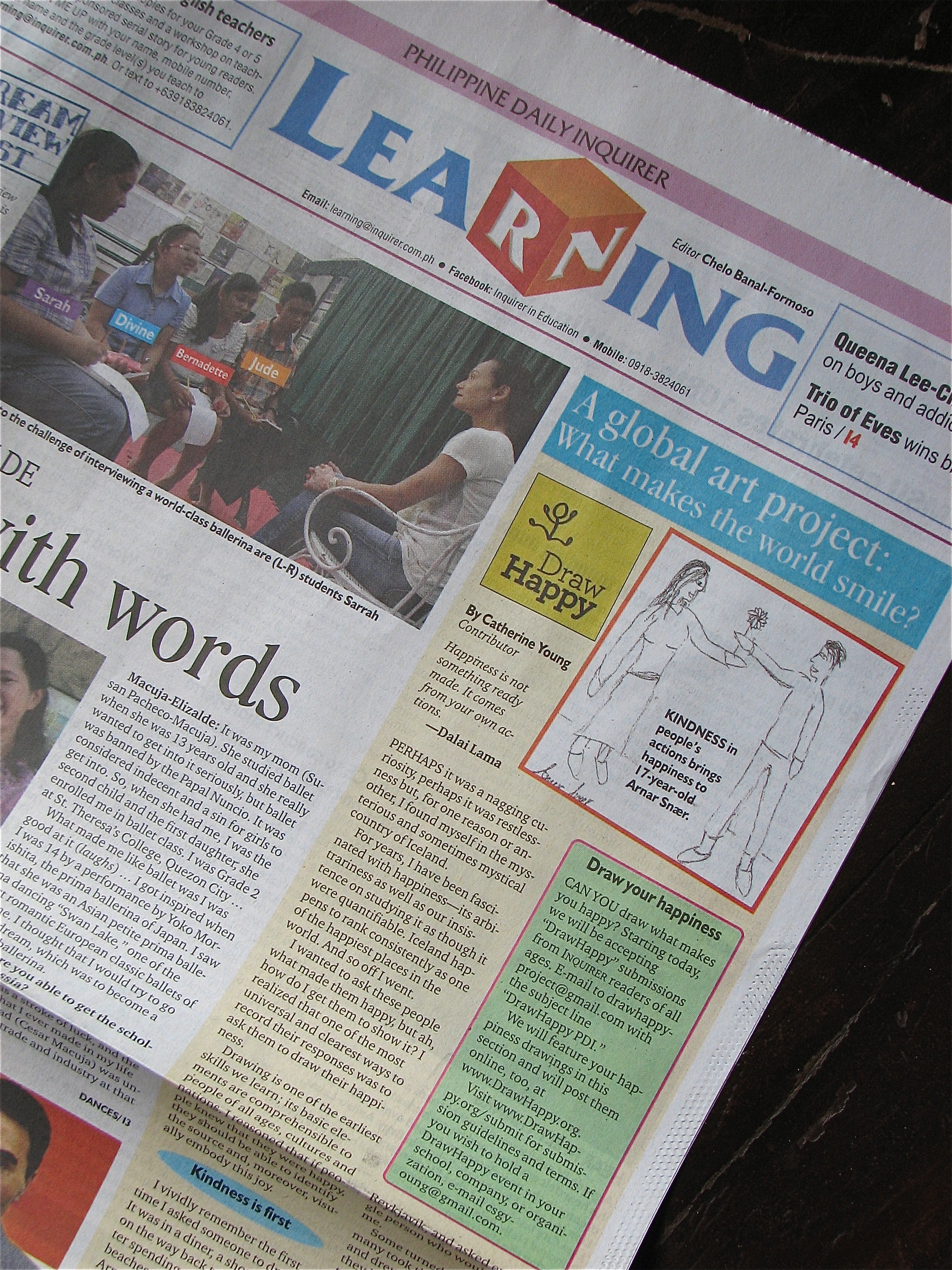
DrawHappy in the Philippine Daily Inquirer’s Learning section
How did this happen? Last week, I had coffee with my former editor, whom I hadn’t seen in eight years and who now runs the Learning section. She was kind enough to listen to the projects I am running. That was on a Wednesday; my first article ran five days later. I have been through enough to be grateful for paths of least resistance. It’s pretty much the same routine of me looking at all submissions, except that whatever I send to my editor will exist in print first, then this blog.
Why this newspaper? Well, I used to write for them. While I was rarely in their offices—the consequence of the Internet—I did meet my editor, the president, and the chairperson once, and they’re quite lovely people whom I respect. I have quite fond memories of assignments involving me as a zookeeper, a magician’s assistant, a mascot, a sushi chef, as well as the requisite book and movie reviews. The Philippine Daily Inquirer also has the widest readership in the Philippines. Because it exists in print as well as online media, I hope my projects reach even those who can’t afford technology.
Back in the day, I was what they would call a youth correspondent, and I was just out of high school. (No need for gasps of ageist-related awe; there were people younger than I was, and trust me, the differences in depth of writing among them were vast.) During college I wrote over 100 articles until I moved to New York.
I am very thankful for those years with the Inquirer because it taught me to be able to write about anything with the tightest of deadlines and with the barest of writing instruments and technology. It has taught me to take criticism, hate mail, and the occasional death threat with as much poise and dignity as possible. Going back to those old articles has always made me smile and wince at the same time. What one writes when she is 29 years old is quite different when she was 17.
It’s also funny because, as someone who was always taught that writing is no way to make a living, it has been helping me pay the bills in the almost-two months I’ve been finished with my Fulbright. Back in those days, I deposited all my writing-related paychecks in a couple of local bank accounts that I promptly forgot when I left to travel. It’s not much, but hey, guess who just paid herself while she gets her projects off the ground? Oh, the irony.
Below is the article, with the link to PDI’s website here.
What Makes the World Happy
DrawHappy: A global art project on drawing your happiness
“Happiness is not something ready made. It comes from your own actions.”
—Dalai Lama
Perhaps it was a nagging curiosity, perhaps it was restlessness, but for one reason or another, I found myself in the mysterious and sometimes mystical country of Iceland. It wasn’t just the need to get away from the mania of New York City. I went there on a hunch. For years, I have been fascinated with happiness—its arbitrariness as well as our insistence on studying it as though it were quantifiable. Iceland happens to rank consistently as one of the happiest places in the world. And so off I went.
I wanted to ask these people what made them happy, but ah, how do I get them to show it? I realized that one of the most universal and clearest ways to record their responses was to ask them to draw their happiness. Drawing is one of the earliest skills we learn; its basic elements are comprehensible to people of all ages, cultures, and nations. I reasoned that if people knew that they were happy, they should be able to identify the source and moreover, visually embody this joy.
Kindness is first
I vividly remember the first time I asked someone to draw. It was in a diner, a short pit stop on the way back to Reykjavik after spending time in the black beaches of Vik. The young man, Arnar, who worked the register and couldn’t be more than 17 years old, was such a warm an genuine character that I knew I had to ask him.
When you have a project in your head, the initial step is always one of uncertainty and awkwardness. I didn’t have a name for the project yet. I felt foolish for even asking. But I was immensely touched when he drew something that I never thought would be the first sketch. “When I see people do an act of kindness, that makes me feel truly happy,” he said. Kindness! In a world that’s often depicted as materialistic and disconnected! Perhaps there was something to this after all.
A one-woman happiness machine
That first encounter made it easier for the succeeding ones. I became a one-woman happiness machine right afterwards, asking everyone in my path. Even a particularly cold and windy day (in Iceland, “windy” means “being swept off your feet”) didn’t stop me—I went through the entire street of Laugavegur, the primary commercial street in Reykjavik, and asked every single person who would listen to me. Some turned me away, but many took my offered pencil and drew, which they confessed they hadn’t done in years. Some told me that no one ever asked them this question before, which made me do a double-take (Seriously?) and a cartwheel (Yes! About time!).
I set my goal for the Iceland trip to 100 drawings, a big yet manageable number since my trip lasted around two weeks, with half of the time spent chasing waterfalls, volcanoes, and the Northern Lights. But I persisted, even asking people on the plane with me en route to New York. Upon returning, I reviewed the sketches I had, reflected on why I was even interested in doing this to begin with, and decided to put everything online and continue the project.
Drawings as data
My teachers and classmates at the Interaction Design program at the School of Visual Arts, where I received my MFA this May, helped me a lot in tightening up my story and clarifying my intentions with DrawHappy. A final project for my Data Visualization class led to me creating an infographic about the sketches I had. I began treating the drawings as actual data, categorizing the countries where people came from and what they drew. I think doing this helped me understand why people chose to draw what they did.
Until now, I ask people to give their name, age, country of origin, and profession. They don’t have to, but I encourage it because I think it’s important to own up to your happiness and it gives me a way to see how it is defined by people of their demographic. I also ask them about what they were doing right before they made the drawing; I think our notion of happiness is contextual and affected by the things that surround us. How a person views happiness also changes through time, and occasionally, I get another submission from a previous participant, whose definition of happy has evolved.
Going global
It has been more than a year since Iceland. The project has since received submissions from 47 countries. Even now, my heart would skip a beat every time I get an email from a complete stranger, wanting to participate in the project. I have smiled, laughed, wondered at, and cried at the stories I have gotten from people I may never meet. DrawHappy has been a window into our shared humanity, one that is universal and timeless. I hope to run this project forever; I think it has sustained me as well as the people who have supported it.
Lessons on happiness
DrawHappy has also made me understand happiness in a deeper way. Happiness is a paradox. To quantify it, as I have found, is less interesting to me than to qualify it by what people have chosen to draw. Happiness is also a way of life, not an end. How we are happy, that is, whether we can see the little joys in the day, matters more than the bigger payoffs of life. Finally, I now believe that happiness is something that can be cultivated or practiced every single day. I hope that in getting people to draw, they will be reminded of their happiness and that they take steps to pursue it.
Parts of this article have appeared in the project’s site, http://www.DrawHappy.org as well as my personal blog, http://www.ThePerceptionalist.com. Follow the project at http://www.DrawHappy.org or @idrawhappy.
Starting today, we will be accepting DrawHappy submissions from all PDI readers! Visit http://www.DrawHappy.org/submit for submission guidelines and terms, and email drawhappyproject@gmail.com with the subject line “DrawHappy PDI.” We will feature a drawing every week in Inquirer Learning, and will post them online at http://www.DrawHappy.org. If you wish to hold a DrawHappy event in your school, company, or organization, please email me as well.
 Catherine Sarah Young