Archive

Korea

My favorite part of Gyeongbukgung, the main palace of the Joseon dynasty of Korea, is a lovely pavilion named Hyangwonjeong and its surrounding pond.

Hyangwonjeong pavilion. Isn't she lovely?

Hyangwonjeong pavilion. Isn’t she lovely?

It is usually more known for the ghastly assassination of Queen Myeongseong by the Japanese government. But in Choi Joon-sik’s book, Soul in Seoul (2005), I came across another interesting (and less gruesome) fact: This pond is the place where an electric light was turned on for the first time in Korea in March 1887. Mr. Choi writes:

“The Joseon government sent off an official letter to the American bulb inventor Thomas Edison in 1883, asking him to set up the lighting system within the palace. Four years later in 1887, the first light bulb was switched on at this pond, which was two years before the Forbidden City in China was brightened with electricity. One of the reasons why light bulbs were installed here so early is because King Gojong, with his kingdom on the verge of collapse, was very afraid of potential threats from his rivals. He was particularly scared of nights, so he seemed to have wanted his residence to be brightened up with lights at night. The reason why the power generator was set up around the pond was because it needed water to produce electricity. There are many other interesting stories involving the nation’s first power generation: for example, it is said that people couldn’t sleep because of loud noise coming from the generator or that the fish living in the pond went belly up due to hot water flowing from the generator.”

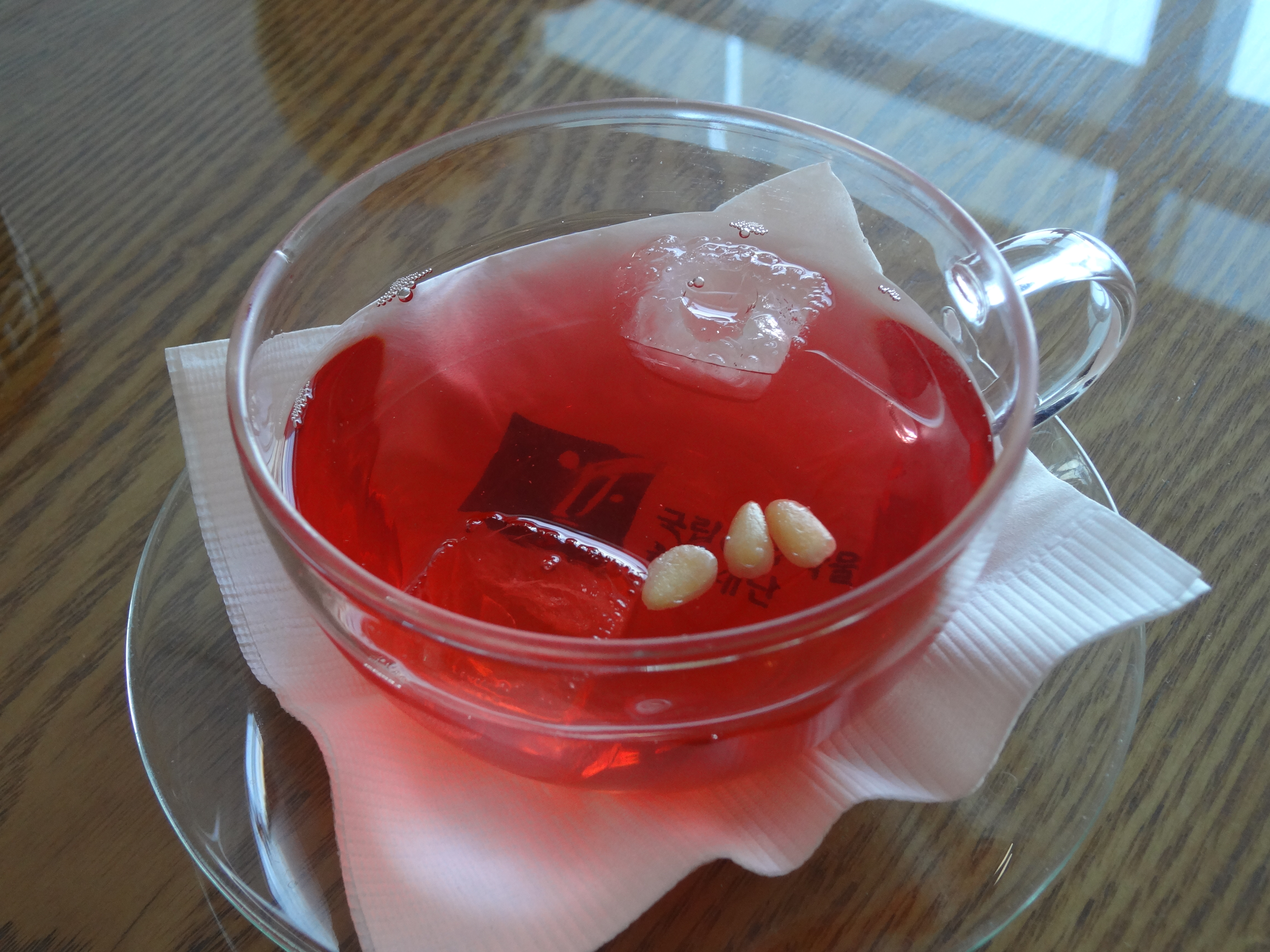
Omijacha, also known as “five-taste tea,” is a Korean tea made from the dried fruits of Schisandra chinensis, a berry native to China and Russia. It has that nickname because it has five tastes—sweet, sour, salty, bitter, and pungent. It is usually garnished with pine nuts.

Omijacha (five-taste tea)

Omijacha (five-taste tea)

The sensations caused by ingesting such a beverage with both opposing and complementary flavors are almost indescribable. It’s quite like drinking an entire universe in a cup. I could give up coffee for this. Really.

Thanks for the tip, HJP!

A popular dish in Korean cuisine is bibimbap (bibim means “mix” and bap means “rice”). It is a dish of rice, vegetables, meat, and egg. The vegetables and meat are stir-fried and arranged in individual circles on a bed of steamed rice. The fried egg is placed on top. When eaten, diners will mix everything together, sometimes adding chili or the many side dishes that accompanies a Korean meal.

Bibimbap is emblematic of many Korean dishes, in the sense that it consists of a staple (in this case, rice), that is mixed with other main ingredients and is served with a multitude of side dishes. It is one of my favorite foods, but I have never made it myself. This changed last Friday, when I took a bibimbap cooking class together with other artists at the Food and Culture Academy Korea.

The similarities of bibimbap and design nagged me throughout the process, from preparation to consumption. For me, Korean cuisine is quite an apt metaphor for many steps in design, both from the perspectives of the designer and the consumer.
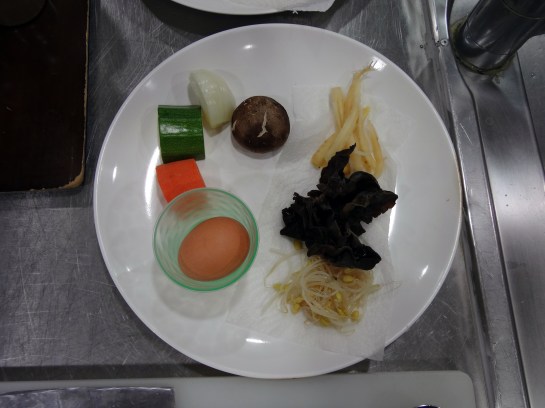
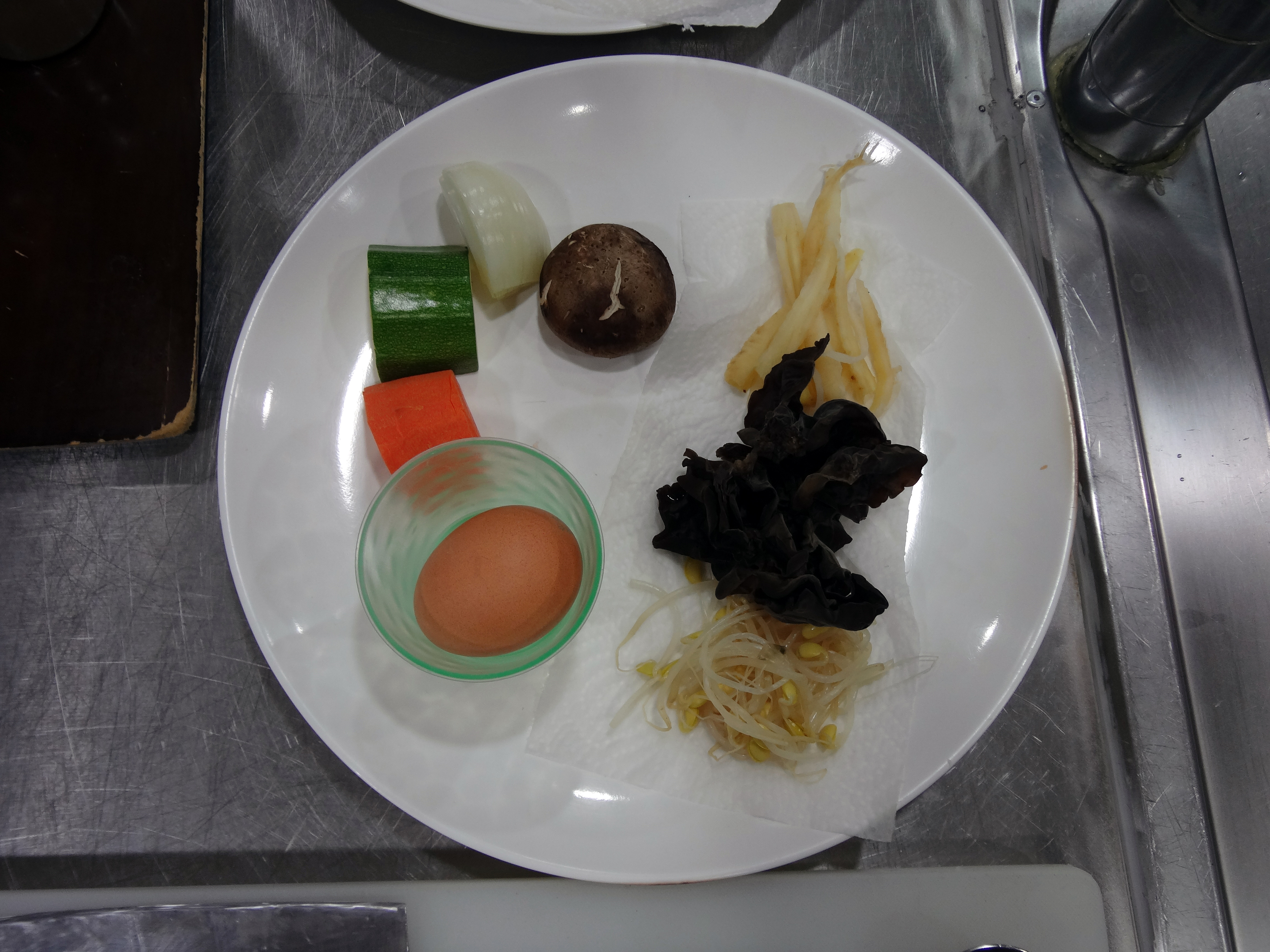
DSC01781

basic bibimbap ingredients

Preparation: Bibimbap and Design from a Chef’s Perspective

1. Simplicity

The ingredients in Korean cuisine are very simple. In a basic bibimbap dish, there are bean sprouts, carrots, zucchini, mushrooms, onions, doraji (a Korean root crop) and an egg. (A little bit of beef is given to meat-eaters, but not for me; I’m pescetarian.) For me, the best products and experiences are those with few features.

2. Purpose

The ingredients in bibimbap all have a function. Their number and colors are important as well. The nutritional value of the food matters as much as the presentation of the dish. In comparison, the best products and experiences are those whose building blocks and functions are clearly articulated. Each piece has a purpose, and those pieces that do not are removed from the final design.

Consumption: Bibimbap and Design from a Diner’s Perspective 

3. Flexibility

Korean cuisine is a visual feast. Unlike Western meals where main courses are served one after the other,  everything is served together in a Korean meal. Rice and soup are always at the center of each diner’s place setting, with the side dishes surrounding them. As Korea started out as an agricultural society, all meals are designed to complement rice. Thus, diners can design their own meal to customize their tastes. This framework allows for a wide range of flexibility. One can order bibimbap every night in the same restaurant, yet his experience of the dish will always be different. Similarly, my favorite products and services adjust to my situation. Each encounter with them gives me a different experience. A smartphone enables me to call, send an SMS, take a photo, share a video with a friend, or download a file from an email, depending on my needs.

4. Recovery

Korean cuisine allows for each diner to recover from his “mistakes”. If he eats something too spicy, he can eat a side dish that is a bit more bland. If he is tired of a particular texture, he can move on to something else. The diner is given control of his experience. Moreover, while the chef of a Korean meal may not know of the diner’s tolerance for certain flavors, he gives the diner solutions in the form of complementary side dishes that allow him to compensate. This is in contrast to most Western meals where the diner has to focus on each course and, if he is unsatisfied, just wait for the next one. In design, my favorite products and services give me ways to rectify unpleasant situations. An email service can automatically send spam to a folder, delete viruses before they affect me, allow me to label messages so I can have a more orderly inbox, and so on.

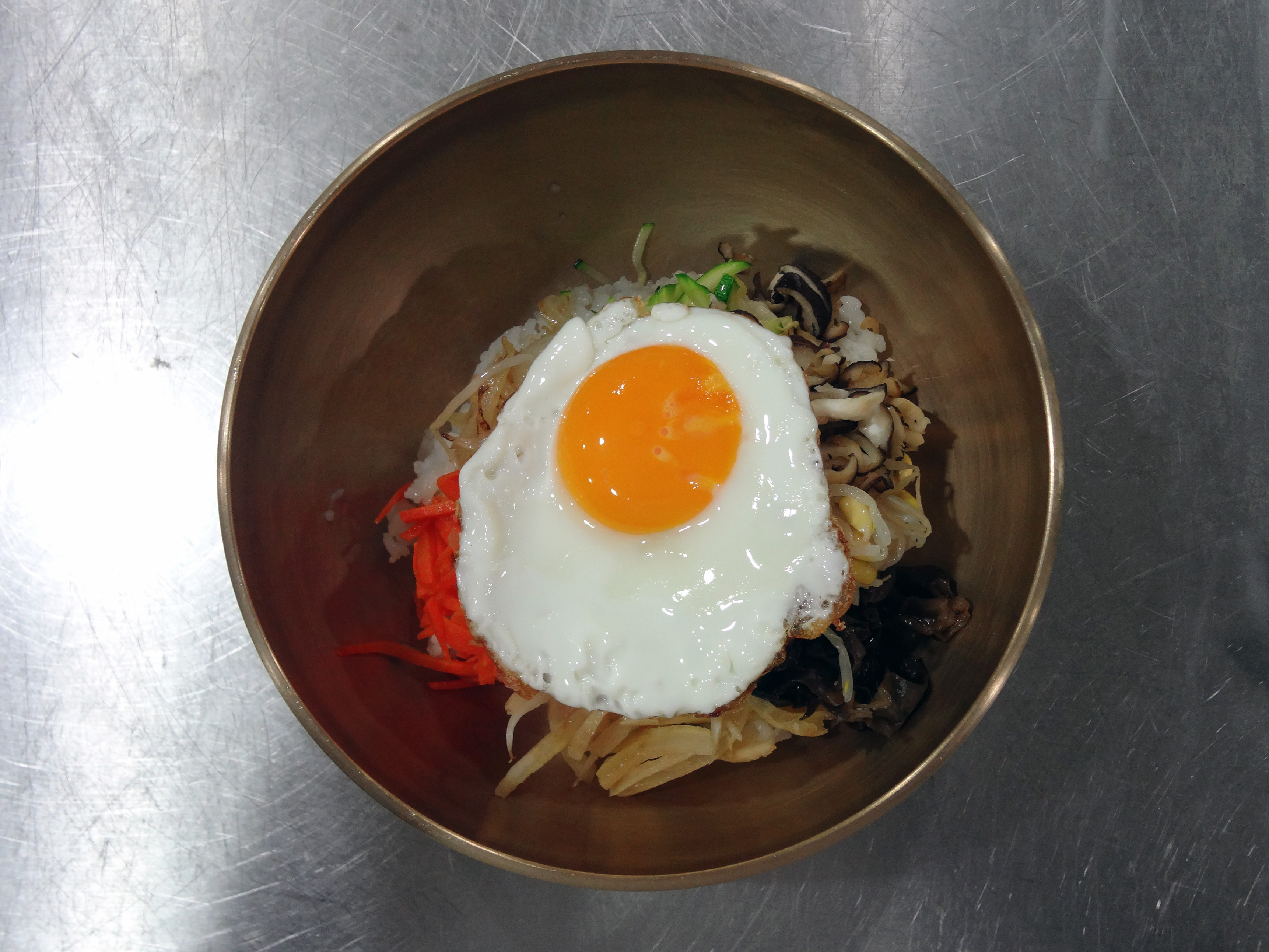
But enough academic musing. Behold, my first (and hopefully not last) bowl of bibimbap I cooked myself:
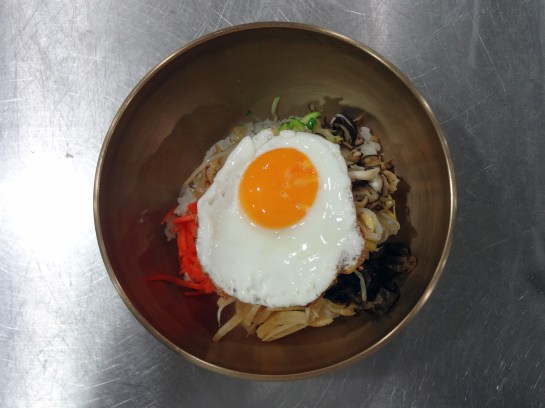
The first bowl of bibimbap I have ever made in my life.

The first bowl of bibimbap I have ever made in my life.

I feel proud. Even though all I did was slice and stir-fry.

With thanks to the staff of the National Art Studio, Changdong and the Food and Culture Academy Korea!

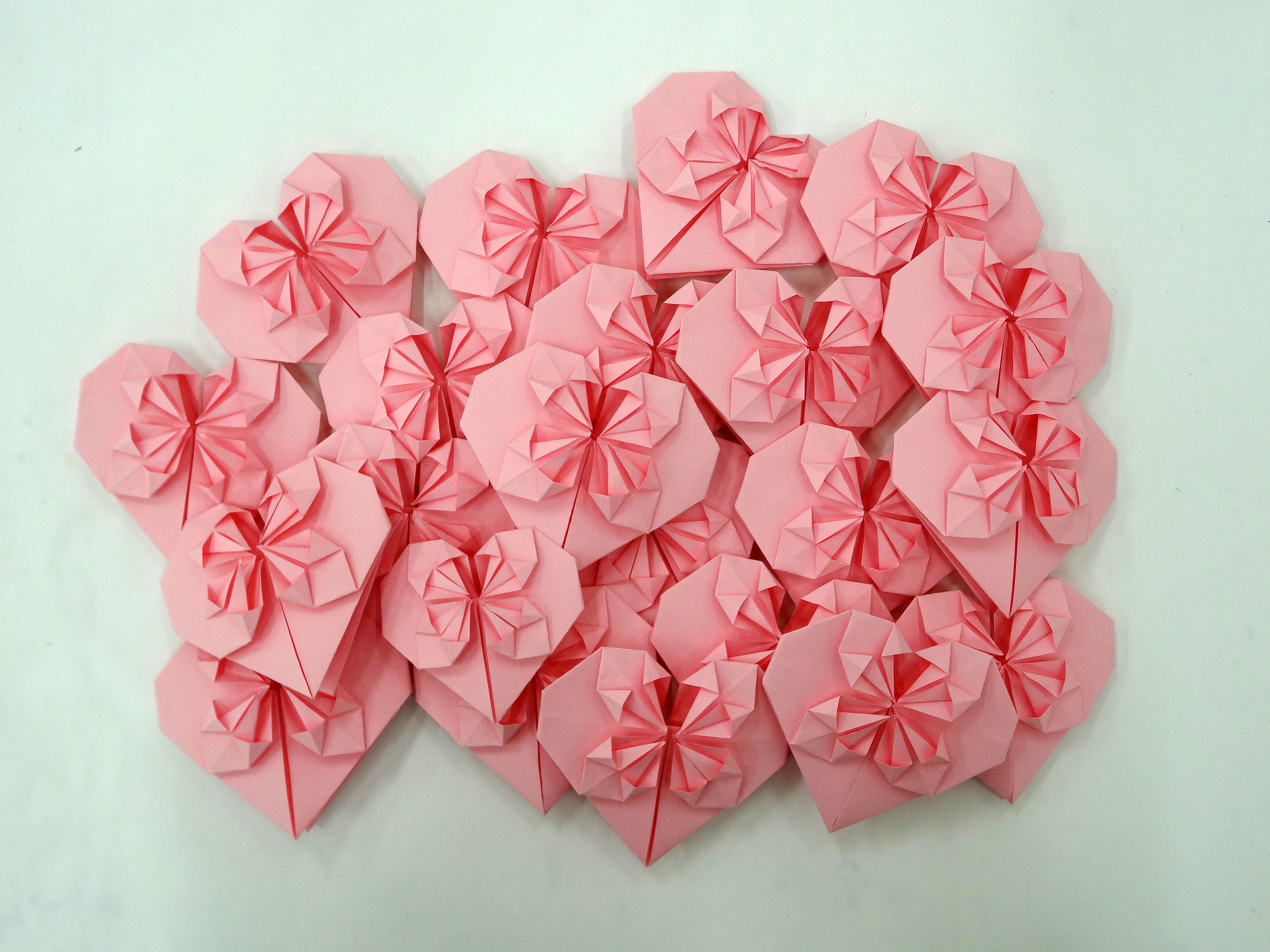
(Seoul)—Today for Valentine’s Day, I made origami hearts for all the local people here, mostly from my taekwondo class. I love the quiet meditation that origami brings and sometimes use it in my work. But for this, my goal was to give the locals something they probably haven’t received before. From what I’ve seen, some Koreans give each other flowers and chocolates on February 14th, but I haven’t seen paper valentines. Or at least these kinds of valentines:

fancy origami hearts by yours truly!

Fancy origami hearts by yours truly

I was tempted to write, “You’re waegukin (foreigner) loves you!” but I decided against it. Baby steps, people, baby steps.

Kidding aside, I made these because aside from the fact that I like them, the people I’ve met here have been so lovely and generous despite the apocalyptic language barrier. I just wanted to let them know I’m trying, too! Kamsahamnida!

In a field trip to the National Museum of Contemporary Art of Korea, I came across the piece Wol In Cheon Ji (2012) by Korean artist Choon Sup Lim in his solo exhibit, Luna, and Her Thousand Reflections.

On one side stands an enormous wooden structure that resembles a loom. The other side consists of four columns with thread.

DSC01681


Wol In Cheon Ji (2012) by Choong Sup Lim

Wol In Cheon Ji (2012) by Choong Sup Lim


In the middle lies a lovely installation of a tiny pavilion that is hovering over a changing projection of the moon’s surface.

Wol In Cheon Ji (2012) by Choong Sup Lim

Wol In Cheon Ji (2012) by Choong Sup Lim

Wol In Cheon Ji (2012) by Choong Sup Lim

Wol In Cheon Ji (2012) by Choong Sup Lim

There was something incredibly light and peaceful about this piece, which took up an entire room. So lovely! The exhibit runs until February 24, 2013.


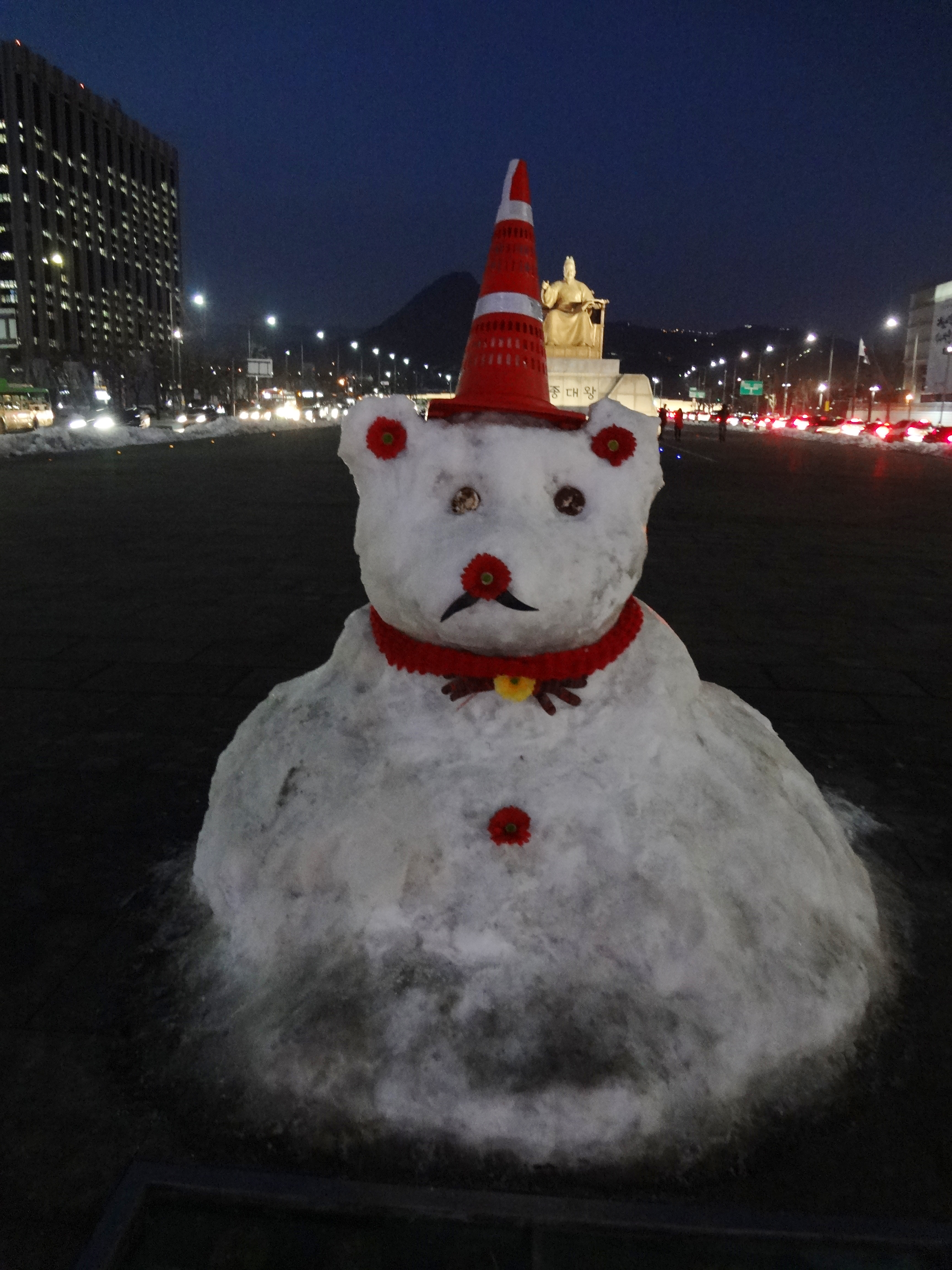
(Seoul)—In Gwanghwamun Square today, I came across a snow bear in front of the statue of King Sejong, under whose reign science and technology flourished in Korea. In his rule, Hangul was also introduced to the country.

A snow bear in front of Sejong the Great

A snow bear in front of Sejong the Great

Up close, the bear is decorated with flowers for ears, cookies for eyes, a glove for his neck and a traffic cone for a hat.

Yes, the hat is a traffic cone

Yes, the hat is a traffic cone

Flowers for its nose and ears, cookies for its eyes, and a glove for its neck

Flowers for its nose and ears, cookies for its eyes, and a glove for its neck

Behind King Sejong is Gwanghwamun, one of the gates that leads to Gyeongbokgung, the main palace of the Jeoson dynasty. The mountain behind it is Bukhansan.

Gwanghwamun by night

Gwanghwamun by night

It’s such a pretty sight in the evening, isn’t it?

The mixing of the traditional with the modern and the foreign have been a consistent source of fascination for me, as a waegukin (foreigner) living in Seoul. And so this official video of an excellently produced version of Les Miserables by the South Korean military hit home (from the official Youtube channel of the Republic of Korea Air Force):

This video is emblematic of my experiences here in taekwondo, which is used in the Korean military. While it is a daily 90-120 minute class of grueling militaristic training, there are some exercises that initially seemed to be a peculiar amalgam of tradition and Westernization.

In my class here (dojang #14 and masters #29 and #30), the language barrier is higher than the Namsan Tower, leading me and my teachers to communicate via our smartphones. They are quite patient with the first foreigner they have ever had in class (and for many, in their lives). While I’ve trained in other countries before, I have never experienced doing jump rope and taekwon dance until now. Two weeks ago, I remember laughing when the grandmaster mentioned Gangnam Style, without realizing he actually meant for us to dance it.

I thought he was kidding. He was not.

I suspect they didn’t think a waegukin will want to do it, but perhaps to their surprise, I did. (Hey, it’s still cardio.) So for the past few weeks, most of the cognitive load in my class have been devoted to learning how to dance K-pop with taekwondo moves, and learning how to jump rope to the beat of Gangnam Style and its parodies. It is quite a huge change from the traditional military-style training I’ve been exposed to. Instead of thinking it ridiculous, I actually feel that it contributes a lot to coordination and rhythm. And it shows. I see these nine-year-olds to be so disciplined, with side kicks past the level of their faces. They even gave me my own jump rope, which I need to practice with by myself as this is something I haven’t done since I was a little kid.

Here is a video of taekwon dance by Youtube user cOOlfren77:

A more extreme version of taekwondo jump rope is here in this video from Korea’s Got Talent by Youtube user taekwonropegirl:

Needless to say, I am absolutely transfixed at a rigid Confucian society making way for jaw-dropping creativity such as these. Especially for taekwondo, I like to imagine that such rigidity might have caused someone to snap and just do it to K-pop. Great fun.

A kite! A kite! I adore kites!

A kite! A kite! I adore kites!

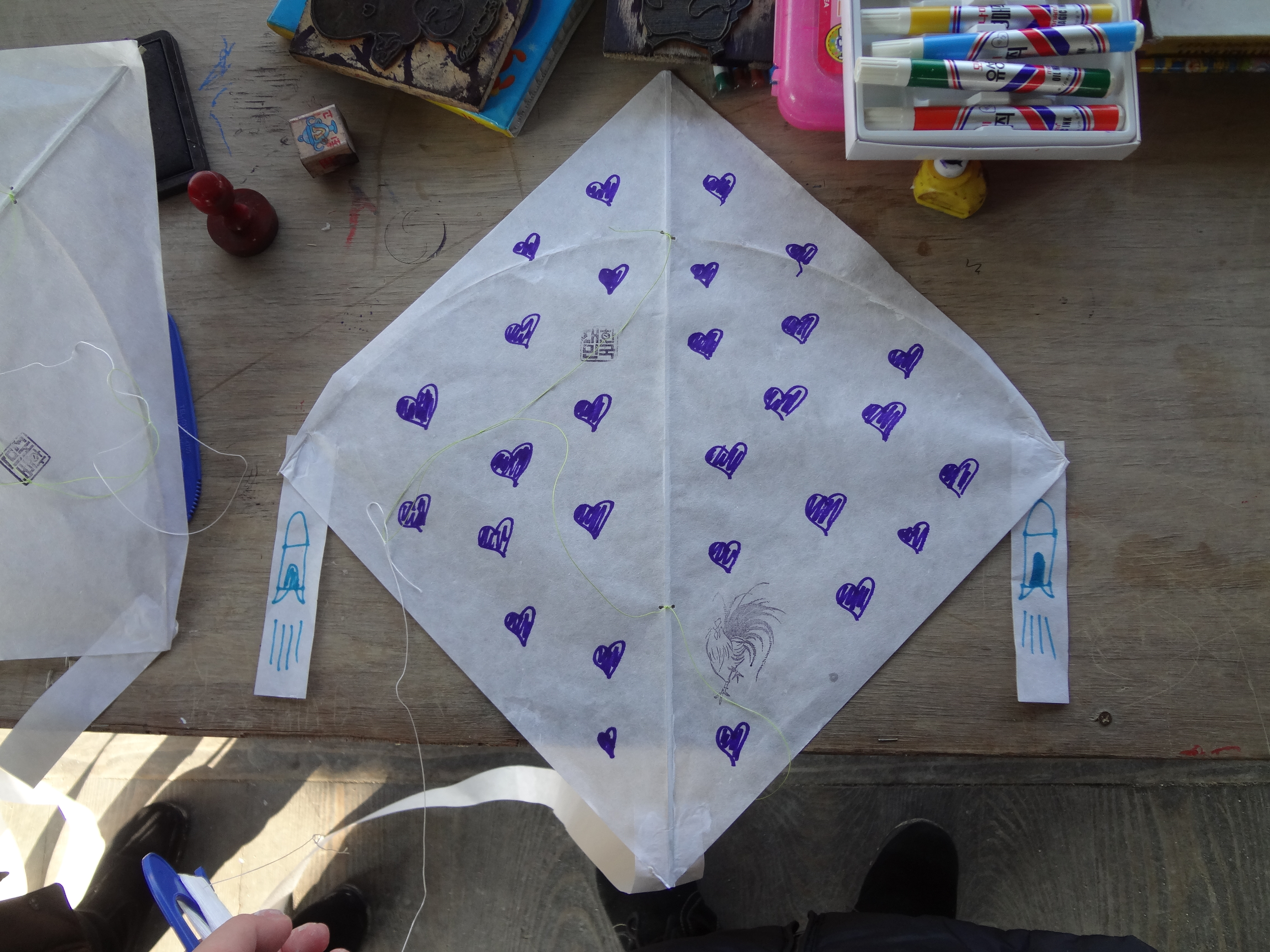
Today, on the eve of Seollal, the Korean New Year, I went with some friends to Namsangol Hanok Village. Among other things, I made and flew a purple-hearted rocket-powered kite. Kite-flying, or yeonnalligi (연날리기) is among the traditional games played during the new year. We had fortunes told, ate traditional Korean food (such as tteokguk), made our New Year wishes, and watched wonderful performances.

Purple hearts and blue rockets. It was quite cold and this was the best I could do with freezing hands.

Purple hearts and blue rockets. It was quite cold and this was the best I could do with freezing hands.

And away we go!

And away we go!

Happy Lunar New Year to you all! Gong Xi Fa Cai & Sae He Bok Mani Ba Deu Se Yo! Bring it on, Year of the Snake.