Archive

Journal

Barcelona Kawaii (December 2009), Digital illustration

Blessed are hard drives, for they shall reveal files gathering digital dust.

I did this digital illustration years back, for an exhibit called “Des de Fora” (From the Outside) in Sants, Barcelona. It was a time when I was getting over the hump of learning Adobe Illustrator. I completely forgot about this drawing! But I suppose this influenced my doodling habit later on.

The theme reflects on being a foreigner in Barcelona; I wanted to portray the increasingly multicultural nature of one of my favorite cities in the world. Futbol, Feast of St. George, Bicing, Gaudi architecture, etc. are all things I will remember Barcelona for.

It was also the year that it snowed in Catalunya for the first time in years:

Snow in Barcelona (March 2010)

It was also a time when I saw double AND triple rainbows on the day my friends and I were eating calçots and writing poetry:

Double rainbows over Barcelona (April 2010)

Look closely: Triple rainbows!

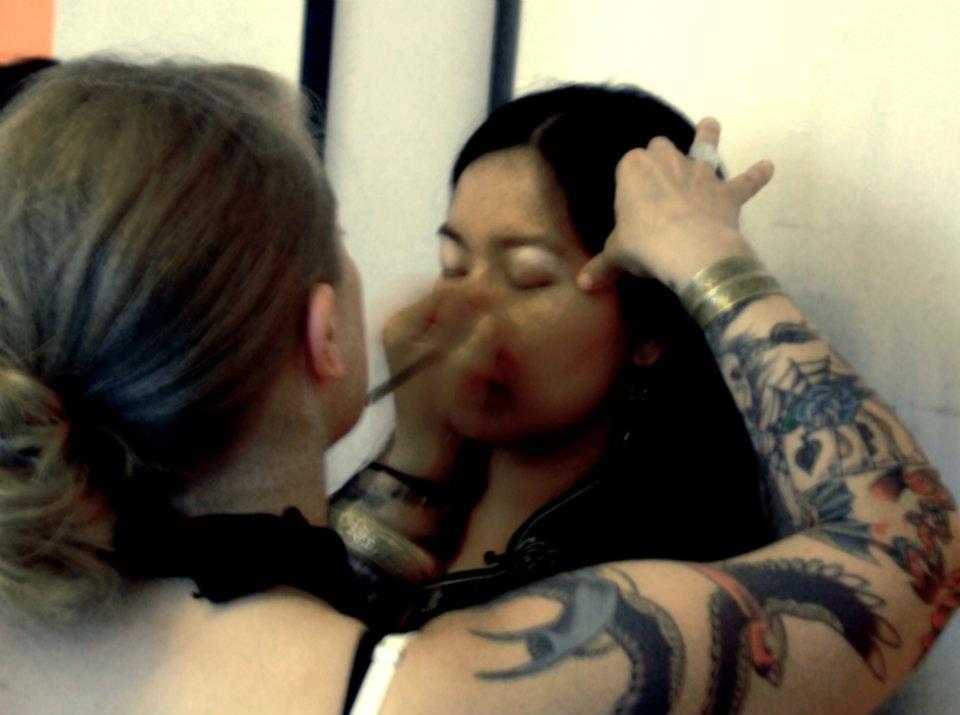
I t was also the time I was first part of the Poetry Brothel in Barcelona, which was probably one of the most influential times of my life from a creative standpoint and made me look at science from the point of view of poetry:

getting made up by Violet (Photo by Joe Wray)

I accidentally unearthed that cheongsam / qi pao the other day and was quite amazed by the wear and tear it had to withstand amidst all those poetry readings and performances.

I’ve been in Manila for five months now, and it’s been a time of looking at the city I grew up in from the outside. Despite living in multiple countries for so long, cities never fail to surprise me.

Perhaps, like cities, poetry whores, and the weather, humans, too, can pause and look at ourselves from the outside.

It’s just one of those days.

I was training by myself in the dojang tonight. While in a full split, I decided to draw. When I looked up, the hour had passed.

A sign I need a break.

This is why I usually take a class. My hips are killing me. But at least I still have this drawing. Ole!

The first step out into the real world is a fight for your dreams.

In the past weeks, I’ve received emails and had subsequent conversations with some prospective SVA IxD students. What was it like? How has it impacted me? What am I doing now? It’s only been four months since I moved away from New York City (although it feels like a few years already) and there are things I did not have time to tell them because, oh I don’t know, we were busy discussing the classes and the teachers and the lovely donuts and the Prosecco and what was awesome and what was not.

Perhaps one of the most important questions they haven’t asked yet, or were afraid to, was one about fear. I don’t blame them. Shouldn’t an MFA make one feel invincible, as though getting through two years of grueling work and critique from the best in the industry gave you immunity for the toil and turbulence that comes next?

Eh, no. An MFA is but a tool, not an end. So here are some personal (i.e not one-size-fits-all) thoughts about what happens after you shake David Rhodes’ hand onstage at Radio City Music Hall:

The biggest fear after graduate school is that one will no longer be able to do what she loves. In the first few months after graduating from SVA, at least after the chaos of saying goodbye and moving camp (again) halfway around the world, I was filled with the choking feeling of dread. It was fun playing the nomad for a few years, but once again, one goal was fulfilled and I had to give myself another one. But which?

I was (and still am) terrified of losing momentum, that I’d be stuck doing a primarily administrative job for the thing I loved instead of doing the thing I actually loved. There is quite an ocean of a difference. I think in addition to what you want to do, it’s also important to determine how you will be doing it. It also matters for whom you will be doing it.

I am extremely grateful for unexpected kindness. I am writing this post from the wifi-equipped living room of a dear friend who has generously loaned his space to me (as well as many other artists and friends before me). It feels like a co-working studio, complete with two dogs. I just replied to an email from a curator of one of my favorite museums who has always listened to my ideas and made as much room for my work as she could since the day we met a few months ago. The other day, I said happy birthday to an editor who several weeks ago very kindly agreed to let me write for her section of the newspaper as long as she had space. Two mentors have taken time out of their extremely busy schedules and have been sending recommendation letters on my behalf to prospective opportunities. I am still producing new work and continuing old ones. I seek out potential collaborators every single day. For one who doesn’t have a full-time job yet, there is hope, you all.

I really pick who I work for. By now, I realize that when I don’t like the project (or the client), the work doesn’t end up to be something I’m proud of. While I still like doing commercial projects (you do get some cool ones!), I hope I won’t forget about asking people to draw what makes them happy, draw on clouds, smell memories, eat poems, and hug each other. And other projects that are currently in the works. Those are the ones that make me feel like the world was still magical.

There are times when I do see life as a taekwondo match. No, really. You bounce around, jump forwards and backwards, and throw a kick when you find an opening. You are not kicking every single second and getting exhausted for no good reason*. A creative life feels that way sometimes—each time I do a project, I use up energy that gets less easily replaced the older I get.  And so I try to reserve the best of my creative arsenal for work I really love. Creativity is boundless, but I am a finite being, and so with that comes a  heightened perception of time.

(*Although outside competing, it’s awesome to train just … because.)

Admittedly, my candor has been both an asset and liability each time I shamelessly cold email someone with a more formal and polite version of “Hello! May I please meet you?” I’m still invited to speak about and share my work. (Hurray!) Sometimes people don’t call me back, like, ever. (Oh, boo.) But for each interaction, I am extremely alert to subtext. Many times, when I directly ask people who have jobs with awesome-sounding titles, who have to spend most of their days in meetings and other things they might not necessarily love, I do get the sense that if life gave them another choice, they would take it.

I am still learning every day. The letters MFA are not an end to my education. Just this week, I’ve devoured books and online resources about marine conservation and aviation—topics we never discussed at SVA but are things I was curious about. By now, I suppose few things surprise me anymore. Ten years ago I thought I would end up with a PhD in cancer biology and have a stuffy career in academia parroting what textbooks had to say but instead things got happily crazy.

As I wrote before, I never went to grad school so I could get a “respectable 9-5 job” afterwards. I wanted to explore and to do things I never thought I would do, but I didn’t want that intellectual and creative freedom to end. Ever. Yes, while graduate school challenged me, it wasn’t any different than how I was already challenging myself before that. People have different feelings about school, especially about doing a thesis, but I’ll say it: I loved doing all my thesis projects and I would do a thesis every freaking year if I could.

And you know what? I will. And I am.

But I can’t for the life of me see what’s going to happen within the next year or so. Each tomorrow is cloaked in fog, and I can only see the next few steps, and afterwards, nothing.

And so for those who wanted to ask, but haven’t yet, let me correct my earlier statement:

Every step out into the real world is a fight for your dreams.

For SVA IxD’s Class of 2013, who are neck-deep in thesis (you can do it!), and for myself, when I feel like giving up. 

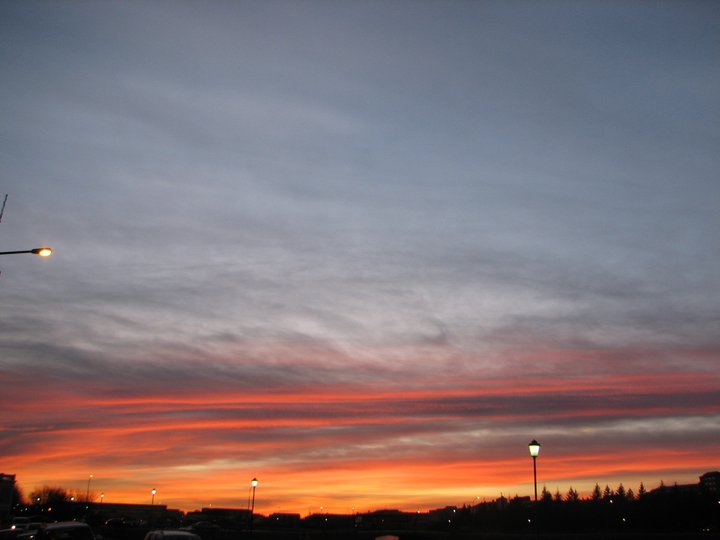
A winter sky in Reykjavik, Iceland

First, a thank you to science. The researchers who have, by the scientific method, concluded that travel is indeed good for creativity. Pop the champagne! It’s not just the coincidence of people like Hemingway, Stein, Picasso and company who produced creative work while having well-stamped passports.

In 2009, William Maddux of the business school INSEAD and Adam Galinsky of the Kellogg School of Management, reported their results in the Personality and Social Psychology Bulletin. They subjected 155 American business students and 55 foreign ones studying in the US to a creativity test called the Duncker candle problem. These students were given a candle, matches, and a box of drawing pins. They were then asked to attach the candle to a cardboard wall such that no wax would drip on the floor when the candle was lit. Maddux and Galinsky found that 60% of students who had lived abroad solved the problem, while only 42% of those who had not lived abroad did so.

For the past eight years, I have lived abroad. I have moved countries and changed lives for a total of six times. It does not get any easier, for goodbyes are never something I look forward to. It does, however, get more routine. It is a cycle that I think will repeat itself ad nauseum for most of my adult life.

For me, it is important to use travel for creative purposes. It’s the only way I can justify the price of a plane ticket and rising rent; I must use that time to further my projects. And so I try to make each trip count, making sure I have more to show for my trip other than photos to be uploaded online. The professions I now claim are many—one can read scientist, journalist, editor, visual artist, poet, student, communications director, graphic and interaction designer in my increasingly eclectic resume. Perhaps because one word can mean a variety of things in different countries, I have long been wary of labels and instead choose to tell stories about the projects I have run. (An example of which is DrawHappy, which will be in the Learning section every Monday. Go draw!)

Naturally, a thank you to the cities. I can recall stories, experiences, mishaps, and projects in in every one of them. Manila, Barcelona, and New York—places I have lived long enough to call home—are all port cities. They have been among the intersections of migratory or trading routes of humanity. All have very diverse cultures and colorful histories. Each time I return, I find that many things have changed. The dissolving streets, weather, landmarks, and people have all, in their minuscule ways, contributed to my worldview and identity. Each city’s definition of beauty has given me the impetus to compare and contrast their sunsets, cloud formations, art, and architecture. It is difficult to be a traveler without reading and rereading Italo Calvino (Invisible Cities), Jorge Luis Borges (everything), and Sun Tzu (The Art of War) as though they would give me a refresher course on the world, as though they were operating manuals for a life on the road.

Third, thank you to the cities’ inhabitants, particularly those who have opened their hearts and homes to someone who occasionally did not speak their language or understand their ways. The first time I traveled, I was more acutely aware of how different they were from how I was raised, from the food to the accents, the government, and the customs. My notions of what was “right” and “acceptable” were gutted and destroyed. Each city and country has the same familiar struggles and questions about government, national identity, and race. The more I traveled, the more I realized that human beings are more similar than different. Today, some of my best friends include those whose communications with me have necessitated dictionaries and Google Translate. Language and culture stop becoming barriers and instead become bridges.

But thank you, too, to the ones who have made me feel like I was “The Other.” The ones who have made me feel ostracized and have made me uncomfortable. It has taught me endurance, humility, and patience. I think the best way to judge a person’s character is how he treats you when he underestimates you. It has taught me to be grateful for everything I have and accomplished, and to focus on the important things.

Thank you to the grants, schools, and organizations that have given me purpose. I always hit the ground running once the plane has landed in order to accomplish the things I promised the powers-that-be I would do. My most recent stint was to do my MFA in Interaction Design at the School of Visual Arts, which was made possible by a generous grant from Fulbright. I learned to work through bad weather, sickness, ungodly hours, and alternate time zones. To this day it’s difficult for me to be idle. Creative travel, especially those involving contracts, has taught me accountability, responsibility, and a heightened sense of time.

Thank you, too, for all the things that have gone wrong. When you are out of your comfort zone, the things you fear will go wrong often will. I have taken detours, lost friends, and given up significant things for the choices I have made. Everything becomes a tool for teaching me something, whether it’s something as small as an iffy Internet connection, or something more devastating as losing relationships. It has taught me to let go of material things, because many are just too darn hard to pack.

While I can’t say that traveling is constantly great and wonderful, I know that I have always been changed by it, and that I would never have reached this level of personal and professional growth had I chosen to be anchored in one place. Not all travelers are creative, and not all creative people are travelers. (And that’s ok.) But for me, traveling has taken me outside of myself and opened worlds I never knew existed. It has been kind so far; it has taught me that the world is my home.

__

Five Ways to be A Creative Traveler (Passport not always required)

1. Try something new everyday. It doesn’t need an expensive plane ticket to have the mindset of a traveler. Even the office that you have been walking into for the past ten years can be a venue for personal growth. Try a new spot to work in, a different flavor of cereal, or a new email password. The fact that your mind is jolted to the newness can trigger your creativity.

2. Learn a new language. Last March, the New York Times reported that people who know more than one language have been shown to be smarter. While I suppose multilingualism is inherent for most Filipinos, I guarantee your mind will be squeezed (in a good way) when you try a language that is far removed from what you usually know. Try Russian, Hebrew, German, Bisaya, or any language with an unfamiliar pattern. You will learn not just grammar and vocabulary, but also the culture of a people in that way.

3. Reserve at least 15 minutes of your day for a creative habit. I would strongly recommend using the same medium, such as writing, drawing, photography, etc. That way, if you look back at your work after a month, you would realize that these small multiples add up to an awesome project. Put them all on a blog and help inspire other people, too.

4. Read everything. Don’t limit yourself to a certain genre. If you like science fiction, read the occasional children’s book. If you read novels, make time for a biography. Books are the windows to the world—past, present, and future. The more possibilities you realize, the more you will break through creative blocks.

5. Have a conversation with a stranger. While you’re at it, don’t limit yourself to the same type of people you spend time with. Make friends with those whose daily routines are radically different from yours. If you are usually stuck in the office all day, have coffee with someone who is always on his feet and outdoors. If you have conservative beliefs, talk to someone whose worldview is the complete opposite. You will discover that there is so much more to life than the things you are accustomed to.

An edited version of this article first appeared in the Philippine Daily Inquirer Learning Section, page H4, on 6 August 2012, and on their online edition on 5 August 2012. 

“You’re 29? You look so much younger!” one of the teenagers in my taekwondo class exclaims, incredulous. (As I’ve discussed before, more kids get into martial arts at a younger age in Asia. Whenever I train in the western world, I’m always one of the youngest, but back here in Manila, I always feel like their token geezer.)

We live in a world where we are judged by numbers. We are obsessed with stats—the number of miles we ran or biked, our waistline, the number of wrinkles on our faces, our credit score, the number of exes, how many times we get a retweet—the list goes on. There’s probably a smartphone app to track each one of them.

These are numbers we can improve upon, manipulate, transform. But there’s one that is universal and irreversible: birthdays. The passage of time. The number of candles on a cake that signals another 365 days have gone by.

From my experience, it’s considered rude to ask someone’s age in America. In Asia, people can ask quite directly, though it’s a question I believe people secretly don’t like once they hit 25. The question, “How old are you?” almost becomes accusatory, and the answer is usually followed up with “Do I look it?”

Consider some of the articles that have recently had so much discussion. “Why Women Still Can’t Have It All” by Anne-Marie Slaughter, “The Busy Trap” by Tim Kreider, and to a lesser, but no less important, extent, “Friends of a Certain Age” by Alex Williams. Among obvious issues the articles are primarily about, such as feminism, work values, etc., lie a crucial factor that unwittingly drives our questions of achievement and meaning: time, and whether we have enough of it to do all that we, in our limited existence in the world, desire to do.

We feel that time is a resource we are constantly running out of, and then comes the inevitable question we ask ourselves: “What have you got to show for it?” Where is the book you’ve promised yourself you were going to write? Have you gone on that big trip you said you would? Did you learn that second language, get that graduate degree, make that movie? Why are you single, separated, or divorced?

Perhaps some of us go through time hoping we can pause it. Please, hold off until I catch up. There are way too many decisions to make, hurdles to overcome, and relationships to manage to be able to check things off of our personal bucket lists. But time is like a cab ride; the meter keeps going until your journey is over.

Time impacts everything we sense. In The New Yorker’s profile of neuroscientist David Eagleman, who studies time perception and synesthesia, he says:

“But the interesting thing about time is that there is no spot. It’s a distributed property. It’s metasensory; it rides on top of all the [other senses].”

With regards to birthdays, it seems that age does affect our perception of time. Burkhard Bilger, who wrote Eagleman’s profile, elaborates in the article:

“One of the seats of emotion and memory in the brain is the amygdala, [Eagleman] explained. When something threatens your life, this area seems to kick into overdrive, recording every last detail of the experience. The more detailed the memory, the longer the moment seems to last. ‘This explains why we think that time speeds up when we grow older,’ Eagleman said—why childhood summers seem to go on forever, while old age slips by while we’re dozing. The more familiar the world becomes, the less information your brain writes down, and the more quickly time seems to pass.”

Many people try to cheat time by compromising. The hear the ringing of what I’ve heard called, rather amusingly, “marriage-o-clock,” according to Kate Bolick of The Atlantic. They set themselves a deadline for getting married and having kids. Or they choose and stay with jobs they secretly don’t love. The older we get, the less options we supposedly have, and no one wants to feel like they didn’t “make it” and that their time was a waste.

For as long as I can remember, I have always been guilty of  judging myself for what I have done in the time I was allotted. In my mental timeline of my slowly-disappearing twenties, I can narrate the past decade by the things I have achieved, such as exhibitions, degrees, residencies, personal projects, travel, and friendships I’ve made and developed. I’ve seen them as significant milestones, because each has provided me with a type of personal growth that I think is unachievable if I tried to live otherwise. I suppose that subconsciously, I do this partly in the hopes that I’ll never have to lie or feel embarrassed about my age, as the months slowly encroach into my thirtieth year, when I will ask myself whether I made excellent use of the time I had and if I feel the need to withhold the year of my birthday.

So back to my interrogation. “How long have you been doing taekwondo?” presses my gregarious young friend.

“Since I was thirteen.”

“Really? But you’re still good!”

Oh, bless you, my child. I think.

You know you’re home when old projects haunt you like spirits.

While my work is primarily about the “intersections of science and art,” I do, from time to time, do design work for things I care a lot about. Here are two of them that have appeared on my radar, physically and online, almost as if to say, “Hi! Remember me? Look at me now!”

It’s as though they were orphans I raised and gave to caring homes.

So, here are the children I gave away:

1. A logo for the Philippine Taekwondo Association 

As my friends and colleagues know, taekwondo is something that’s really important to me, but not in a competitive way. I think it has helped me a lot personally and professionally. I wanted to give back, not through competing (which I assure you, does not suit me) but through something else—design. Around 2008, I reached out to my old teacher, Coach Jobet Morales, a former medalist and currently the Philippines’ national coach, who said that coincidentally, they needed a new logo. I already had something in mind, but I also met with Coach Morales and Grandmaster Sun Chong Hong who discussed what they needed. (I remember that day! It was lunchtime and I thought that being with these two black belts was the safest place in the world. We had Korean bibimbap.)

The logo they approved has the association’s initials, rendered in the colors of the Philippine flag. The blue letter has the profile of a bird, symbolic of the Philippine eagle. The red letter is a roundhouse kick, which was a compromise because I initially suggested a side kick (better suited with the T shape), though was told that roundhouse kicks were more frequent in taekwondo (actually, true). The yellow letter has a sun from the Philippine flag.

Now it’s 2012 and, training at the central taekwondo headquarters in Manila, I keep seeing it all the time. On certificates, belts, chest guards, banners, etc. It’s quite an honor, and I’m thrilled they’re still using it.

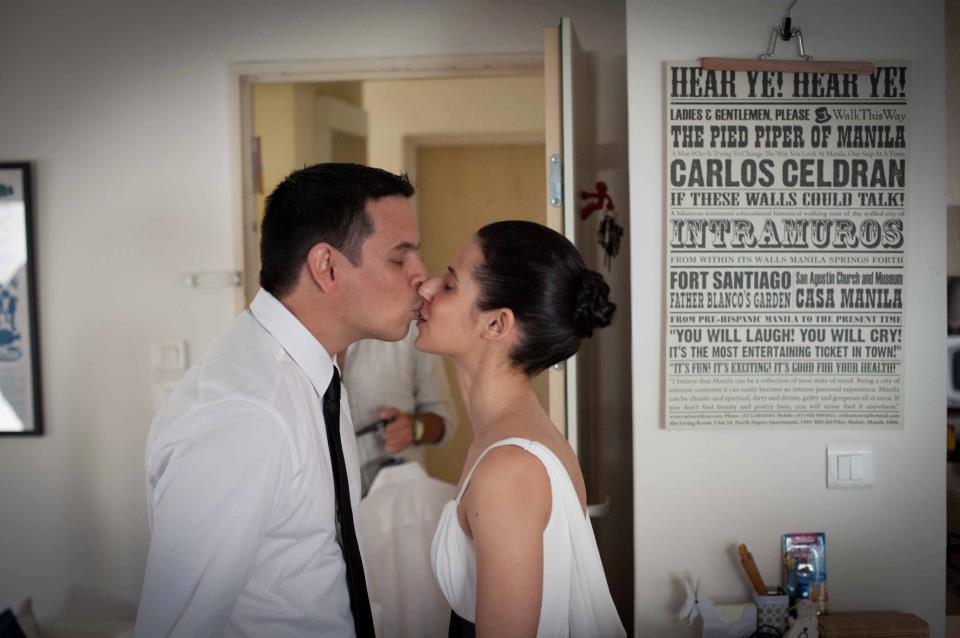
2. A poster for Carlos Celdran’s Intramuros tour

My friend Carlos, who does these awesome tours in Manila, tagged me on this photo emailed to him by some European tourists and newlyweds. The poster on the right was my first graphic design poster, which Carlos gives away on his tours. I did this around the same time as the taekwondo project, and both remain among the graphic design projects closest to my heart. What he has done for the Philippines is fantastic, and while his tours are primarily performance art, it has contributed to the discourse of critical issues in the country.

(To the people in this photo, shoot me an email if you’d like to be identified. And thank you so much! You made my day. Oh, and congrats!)

A Disclaimer

I did these projects without any graphic design education at the time. The only things I had experience in were molecular biology and journalism. I was just a girl with a curiosity for Adobe Illustrator and a thing about “making the world a better place.” Years have passed and I’m done with an art residency and an MFA in Interaction Design, and looking at back at these projects made me both smile at the exuberance of youth and cringe at some tiny mistakes. (The kerning! Rats. I need to fix that.) But my friends / clients still seem happy about them, so I suppose that’s what counts. That brief time I was in Manila, I just loved their work and what they’ve done for me, and I thought that this was the best way to help them out. I may never be in the Olympics or Games of any sort, but at least my logo will! And helping cultural gems like Carlos’s work is something that’s always rewarding to do.

I have a cold. And this is probably why I’m sentimental.

Returning to a city after many years is both pleasurable and vexing.

You are both resident and stranger. The shapes, sounds, and smells have both changed and remained the same.

My three major “homes” so far—Manila, New York, and Barcelona—are all port cities. In both historic and modern times, they have been the site of international trade, cultural intermixing, and political upheavals. Their faces dissolve and stabilize with the ebb and flow of both tide and time.

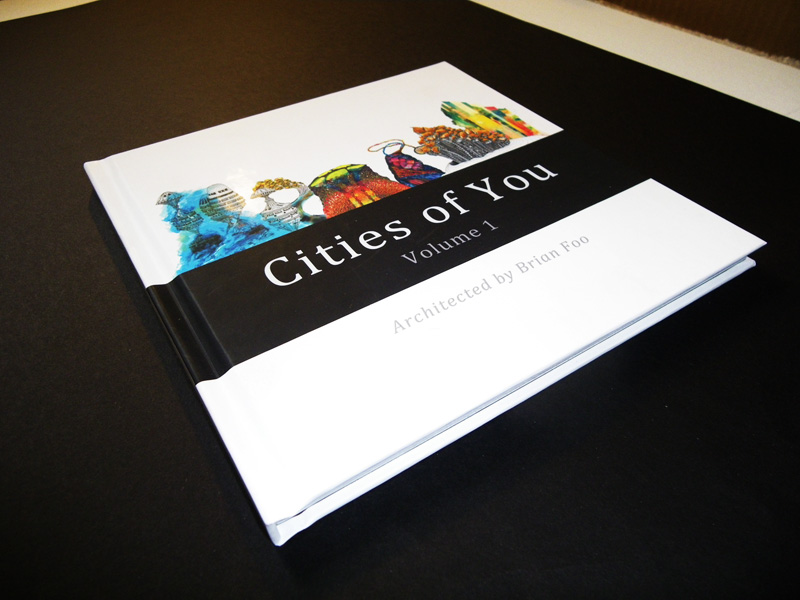
I am reminded of Cities of You, a beautiful project by Brian Foo, a web developer and “joy evangelist” whom I first encountered online when he submitted a sketch for DrawHappy.

Cities of You is a project that envisions people as imaginary places. It was inspired by Italo Calvino’s Invisible Cities. Each artwork represents a person and also a relationship. Brian writes:

“I travel through each city and describe their special properties—how the buildings are built, how the people live, its history, culture, and reputation. As the project progresses, I revisit some cities, describing how they evolve over time or enter unexplored parts of the cities. The intended result is to be able to imagine relationships as dynamic spaces in which one can visit, walk through, and explore.”

I enthusiastically backed his Kickstarter project, which surpassed his initial goal of $2,000 and raised $11,000. The project is the publication of the first 41 cities he designed. His book is a gorgeous labor of love, alive with drawings, paintings, and prose. An overwhelming response from his supporters also led him to upgrade all the rewards, including a lifetime of gifts. (Yes, you read that right. I and 140 other backers are looking forward to receiving annual presents for the rest of our lives.)

Cities of You, volume 1. Image by Brain Foo via his Kickstarter project page

A couple of weeks ago,  Brian drew me as a city, too. Voila, I’m City #44! It’s quite an honor. Even though we haven’t known each other for very long, I think he nailed it:

“If you walk through the city of Orynnaci, the buildings are tall, bare, and ordinary. However, if you stare at a building, look away, then look back again, the building may change. Or sometimes, a building can disappear, or merge with another one. As a tourist, you may begin to recognize past cities you have visited if you stare long enough. Some buildings lose their form entirely. Walk down Main Street and you will see most citizens standing still with their head tilted back, tracing shapes with an outstretched arm. On the face of city hall, three words are inscribed in Latin, loosely translating to ‘Imagination, Perception, Metaphor’.” —Brian Foo

City #44: Orynnaci
24 x 18″, Gouache and Colored Pencil on Paper
Image and Text copyright by Brian Foo

Visit the project’s site here.

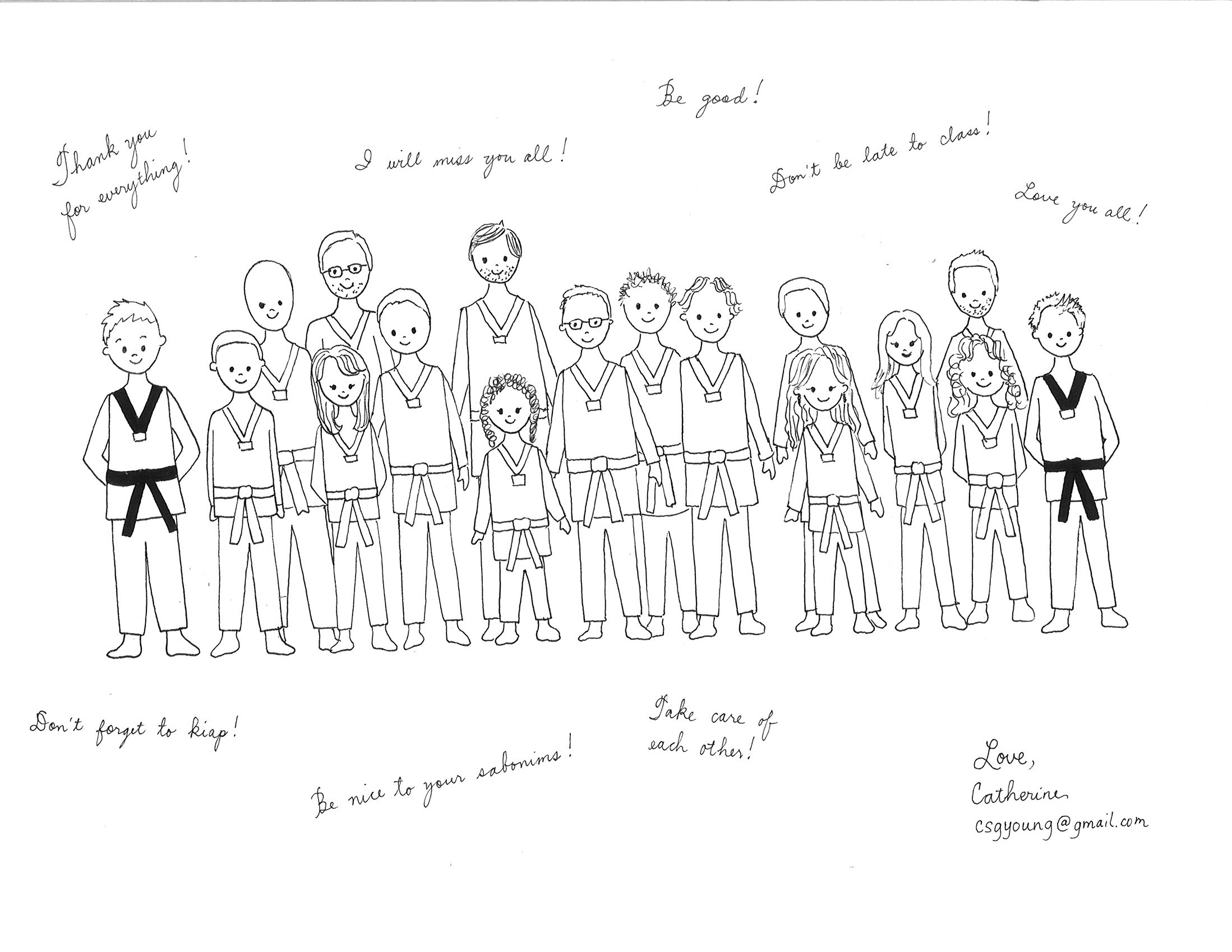
A farewell illustration I made for my taekwondo school, because I’m a sentimental crybaby.

Three days away from New York. I need to kick something.

Rewind to last Friday. I always spend part of my last day in a country in my taekwondo school. Call me strange, but for me having the final words from my masters is almost like being blessed by Buddha.*

*Sort of. Give me a break; it’s hard to keep moving.

Taekwondo is the bedrock of all my beliefs, perhaps even beyond art, science, writing, and design. It is the one thing that has remained consistent in all the years of traveling and starting over, and as such, is the one thing that has never failed to give me a sense of stability and groundedness. It has been a way not to just let off steam and counter depression, but also to channel all my energy into something that is positive. It will always be my second home.

It is the closest thing I have to a religion. I could probably do without drawing, writing, or tinkering around for a few days, but I go stir-crazy if I can’t train. I’ve trained everywhere—old buildings, white sand beaches, the streets. Even in graduate school, I missed out on most of the design talks because I would always be in the dojang every night. (Was that a confession? Oops.)

It’s an addiction whose seed was planted early. I started doing this when I was thirteen, but I only took it really seriously in the past eight years when I started moving a lot. I got my black belt after fifteen years—quite a while, but starting anew is a side effect of a nomadic lifestyle. The fact that I do this has always surprised people; surely someone who hugs and squeals as much as I do couldn’t possibly be doing something so…tough. I suppose it’s what has given me the confidence to be as open and happy; it’s quite comforting to know that I can take care of myself in potentially dangerous situations. Or at the very least, I know I won’t die without putting up a fight.

Mirrors and masters

Martial arts has always mirrored my life, including all the professions I’ve ever touched. Consider design. Long before designers came up with things like “gamification” or ways of incentivizing and motivating people, martial arts have always used a belt system to “promote” you from one level to the next. Everything from the uniforms, to how the belt is tied, to structure and hierarchy, is designed, way before we ever earned badges or became mayor of something.

Training in Asia, Europe, and America has given me some insights on how differently people see martial arts, and by extension, their personal worldview. Students in Asia are always the youngest I encounter; it’s something ingrained in them (us) from very early on. In Barcelona, it was a mix of young athletes who are set on competing, as well as older ones who’ve done it for years but just want to keep training for the love of it. In New York, it’s always the most eclectic bunch, which is probably why I learn so much about life from watching students progress.

Escapism

For the most part, I find people who either want to try something new or do what I have come to define as “escapist training” – they want to transcend the usual daily grind. Occasionally, I encounter those who find their careers unsatisfactory, or have rocky relationships that they want to think about. They find the urge to kick the crap out of something to let out the frustrations of the day. I kind of like this application of martial arts; while we can’t actually go to war (unless you’re in the military or security or related professions), we can at least use it to fight our personal battles.

At its core, martial arts have little to do with the BS of the world. You either do the kick or you don’t. I see it as a method of reflection or problem solving— all the questions in your mind can be translated into movement, similar to how I’ve felt in dance. I’ve come to appreciate how it turns into a thermometer of a sort; how I feel during the day becomes so obvious and manifest by how well or poorly I train.

Bullies and therapists

It’s so incredibly beautiful the way I’ve seen people who are not competitive athletes apply this in their lives. I’ve observed kids who were bullied become more confident and sure of themselves, and adults who have made serious life decisions because of what they’ve realized through the sport.

Once, I encountered a pint-sized five-year-old who greeted me at the door after a belt test, jumping up and down and proudly holding the pieces of a board he just broke. And I wonder, what if all kids could do that and grow up believing they can do anything, that everything can be as simple as breaking a board with your foot?

Once, I helped teach a woman who sobbed every time I touched her wrist when teaching her self-defense. She told me that she once came from an abusive marriage, and all the grabbing reminded her of those awful times. Another woman came to me and said that because of training, she felt like wakes up with a lot more purpose. Always when I hear these stories, I’ve thought that some of the techniques should be a requirement for everyone, no matter what age you are.

Perhaps on a more sheepish note, most of my masters have been my therapists of a sort. I am almost embarrassed, but not quite, to say that I have cried on the shoulders of a lot of black belts over the years (because, you know, they have no choice but to listen), and now that I actually am one, it’s a testament to how titles really don’t matter. I suppose I have traumatized many a stoic traditional instructor (who I bet was laughing hysterically inside) who have had to put up with me over the years.

Some things I’ve learned so far

The belt doesn’t matter. Seriously. I see blue belts kicking the butts of black belts all the time. (From what I’ve observed, blue—the fifth color in most belt systems—is the time when I see people getting good. They’re now familiar with the foreign terms and have gotten used to testing and are committed to getting their black belts.) It’s kind of how it doesn’t matter what one’s degree is. The belt is just the thing that holds up your pants. And on that note…

Getting a black belt doesn’t mean much if you get lazy and stop. It’s like getting a degree and then not using it. Don’t get me wrong; It takes years of hard work to earn one, but I’ve always seen it as a lifelong commitment. When I finally “graduated,” I was relieved I didn’t have to start over again when I went to another school, but it wasn’t like the belt gave me superpowers. Training went on; the only difference was that I had to hold the kick pads sometimes. And it’s a lot more embarrassing if you forget things.

How you do taekwondo is how you do everything.

For BB

Is it possible to ever say goodbye to New York City?

The past two weeks, I have been gaining weight from all the brunches, lunches, dinners, coffees, mid-lunches, desserts and other invented rituals as I say “So long!” to New York once again.

This is the sixth time I am leaving a country, so by now, I know the drill. Moving to another country is quite different from moving to another state; it involves immigration papers, customs, another currency, language, and time zone. Life has gotten simpler the more this happens to me. Two years’ worth of stuff have been packed in three boxes and shipped. I don’t accumulate much anymore.

We all have our quirks. For me, it’s saying goodbye—it’s important to say goodbye! It marks the passing of time, of “properly” saying thank you for being a part of my life, whether voluntarily or otherwise. I have had rituals that were very traditional (dining out), adventurous (climbing a mountain and hiding a pepper plant in a castle for my friends to hunt for), and nonexistent (I once just left without notice). All have had different results. For this time, I think I prefer the simple ritual of having a conversation—the last one I will have with them face-to-face for a while.

It’s not just about the ritual, because it’s always good to get together with friends. Each move represents a switch, violently or not, of career directions and personalities. I’ve been a research scientist, a human rights something-or-other, a journalist and an editor, an artist and a poet, and an interaction designer. I’m quite curious (and clueless) as to what will happen to me on this leg of the journey now. And because of the chronic change, usually when I say farewell it does mean the end for most of the people I have known, who will likely never have a reason to reconnect with me ever again, who may at one point shake their heads, wonder, and go back to the anchored desks of their (relatively) stable and mortgaged lives. Sometimes, goodbyes are heartstoppingly lonely.

But they also have their entertaining side. Just what is it with farewells that makes people say the juiciest things to me? I’m quite positive I would never have heard a lot of these “confessionals” otherwise. It’s no wonder that travelers turn into storytellers in one form or another; one by one, the people I leave behind keep spilling their guts out without me having to prompt them. Amidst all the Thai lunches, American breakfasts, Japanese dinners, and English teas, I have been privy to the hidden lives of friends and colleagues alike. The secret identities, the love affairs, the hidden longings are all revealed to me like a discontinuous soap opera or graphic novel. It’s almost like they think of me as a bottle in which they can keep a message, to be tossed into choppy waters and never to be seen again, except maybe for the stranger who will pick it up on the other side of the ocean. Perhaps then I can whisper that secret, and create a legend out of that piece of gossip. Sometimes, I think they want me to.

The stories I have collected over time remain with me, long after the memory of the place has all but vanished. Sometimes, stories are all that I carry.

To say goodbye means to die a little inside, because I feel that I am leaving a part of myself behind in all the people I have met and cared about. And so once more I feel a bit lighter, a bit rootless, a little sad, but indescribably happy that the two years have meant oh so very much.

Is it possible to ever say goodbye to New York City? Nah, I’m sure I’ll see you all very soon.

For everyone I have met in NYC on this round. 

Last May 10th, my class and I finally marched (!) on stage, culminating two years of graduate work here at the MFA program in Interaction Design at the School of Visual Arts.

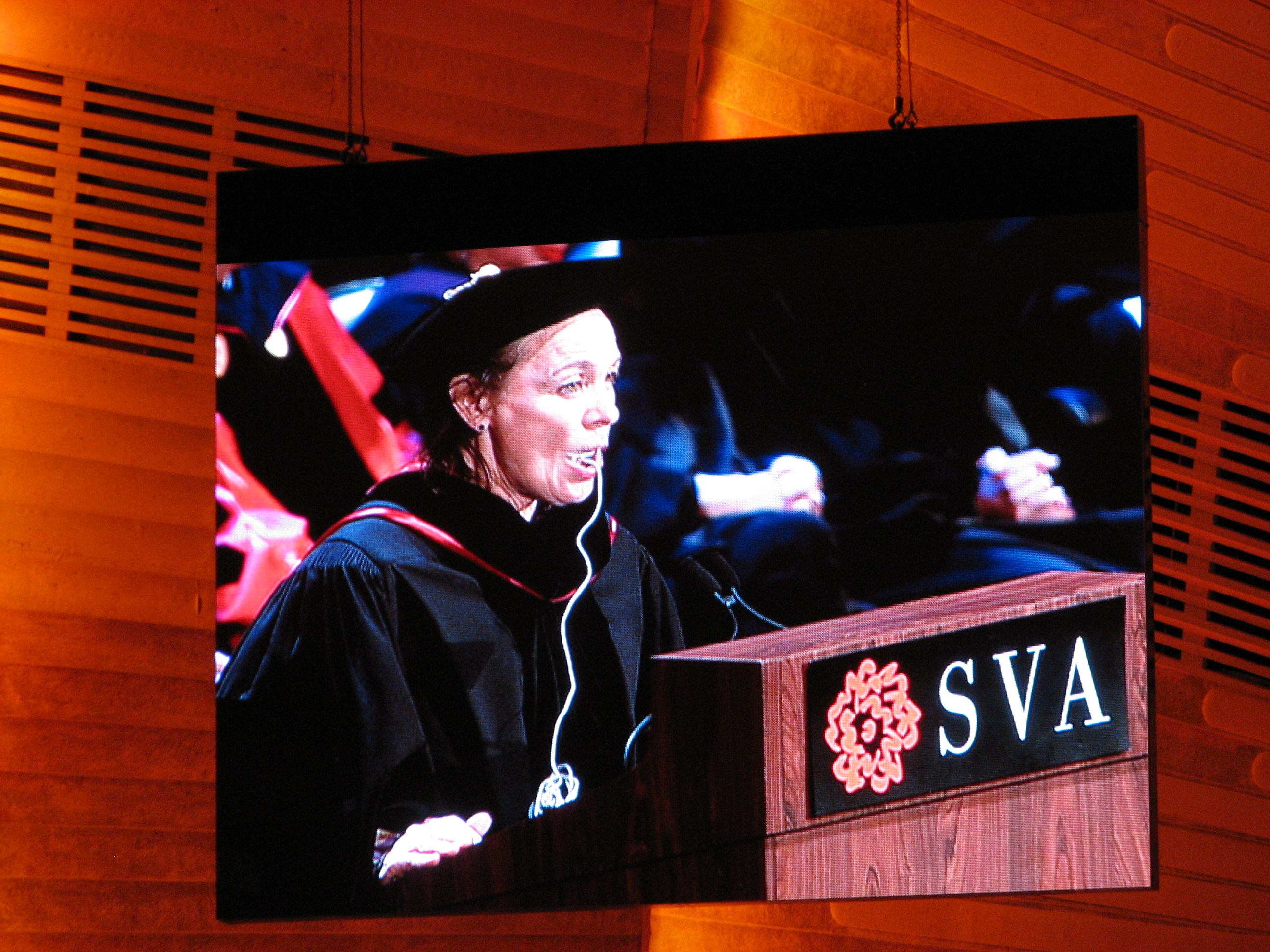
Our commencement speaker was the incomparable Laurie Anderson, experimental musician, composer, performance artist, and inventor, among other hats she wears. During her speech, she recounted her time as NASA’s first artist-in-residence and recalled how she was also the last one, after a politician sought to amend a bill making sure no such thing happened in the future. Anderson suggested that really, we should create artist-in-residence positions in institutions such as NASA, Congress, and other such places, which generated applause and laughter from the audience.

Laurie Anderson. Image via The Guardian.

It’s strange to be listening about art when I spent two years studying to be a designer. I have always questioned my artistic leanings, especially coming from a scientific background. I am and will always be immensely grateful for my geeky past (and who am I kidding, present), although from my experience in that world, to want to be in the arts was almost tantamount to self-banishment.  Thinking about the past six years out of undergrad—all the cancer lab rotations at Memorial Sloan-Kettering, art school in Spain, the Poetry Brothel in Barcelona—and frankly, I have to ask myself whether I actually have found what I’m looking for in a design program. And to a large extent, I did in interaction design. I always thought it was a way to humanize the sciences and the arts, which thankfully doesn’t always have to translate to something on screen. Two years in a design program have found me to be stubbornly conceptual, not because I wanted to upset my class but because that’s what I came to graduate school for. I think that if I do work for a company, I will probably spend all my waking hours designing apps and websites, and I have all the time in the world to do that.

So what is the use of an artist? After being immersed in interaction design for two years, I think that IxD shares an important thing with the arts—empathy. To be an artist, at least for me, requires me to place myself in different shoes and absorb various identities. The same is true as an interaction designer. Perhaps one thing that has been enormously helpful to be a practicing artist is the familiarity of actually inhabiting a character instead of simply watching people from afar, taking down notes.

To be an artist is to challenge the norm. While it’s wonderful to design apps and websites, it’s not the first thing I turn to when trying to give form to a project. Ironically, I do not own a smartphone, which will probably give most interaction designers a heart attack. No smartphone? What do you do when figuring out a bill, trying to find a place, or bored in a subway? Well, I try to do the algebra by hand, I talk to strangers a lot, and I write and doodle in a sketchbook constantly. It’s not a perfect system but it is a cheaper and more entertaining one. I think that we are more than our gadgets, and I think that an artistic practice allows one to experiment not just with what is, but what could be.

But more importantly, at least for me, artists are always questioning the self. Art will never lose its relevance, particularly in a time that is rife with uncertainty, though as I get older, I think each year in human history is tumultuous and unstable. On a personal scale, art allows for the exploration of selfhood in a manner that is less contained. I suppose that’s why I keep hearing of the banker who finally turned to painting, or the lawyer who is now a musician. As a scientist (I’m still wondering if I can call myself this), there are certain terminologies and protocols I have had to use for the scientific institution to understand where I am coming from. As an interaction designer, I do feel sometimes limited (although “limited” isn’t always a bad thing) by the words I have to use (hello, “user”) and the media by which I practice (wireframes and sticky notes). As an artist, I am moored to no such arbitrary islands; I can easily experiment with musical instruments as much as kitchen appliances and be equally at home with both of them

But enough with all this labeling. As I leave the comforts of school—though my classmates and my teachers alike are betting I’ll go for a PhD eventually—I would like to embrace the hyphen the comes when saying that one is a writer-artist-interaction designer-etc. I sometimes cringe when I’m only referred to as one of these, because to seemingly pledge allegiance to one field may appear as though one is relinquishing all her other interests. And wouldn’t that be such a shame.

Laurie Anderson with a pillow speaker in her mouth

But back to the red landscape of graduation at Radio City Music Hall and the blinding strobe lights. My favorite part of Anderson’s speech was the finale, when she stuffed a pillow speaker in her mouth and proceeded to sing to us for quite a long period of time with a sound that resembled Darth Vader’s voice, waking up even those who were dozing off. Afterwards, the school gave her an honorary doctorate. Lady, I just adore you.