Archive

Uncategorized

(Kuala Lumpur)—I’m stoked to be selected as one of the 200 Obama Foundation Leaders for their Asia-Pacific Program heading to Kuala Lumpur in two weeks. The Obama Foundation Leaders: Asia-Pacific Program is a one-year leadership development and community engagement program that seeks to inspire, empower, and connect emerging leaders from across the Asia-Pacific region, and I am one of those under the “Arts and Culture” issue area. Find the official website with the full list of Leaders here.

I have often wondered how artists can lead, especially if one tends to be on the quiet side and is semi-reclusive. (As a side note, it looks like I’m the only artist who is not a director or a boss of anything, and wow, my fellow participants have quite impressive titles!) Since my first leadership program with SEAD and the Mekong Cultural Hub and the British Council, and the many international residencies given to me in the past decade, I have realised that artists have a responsibility to keep working towards a just society using creative ways that only artists can think of. The freedom of an artist is such that we can keep learning and making and use these skills to build communities and frameworks to imagine a better future for all of us, and what better thing can one do to spend her days?

Since moving to Sydney, I am grateful for the very supportive research community in a safe and privileged environment where I can keep working on my practice in peace. This program will help me to not lose sight of the bigger picture and to remember that there is a world out there that needs fixing which requires all of us.

I am very much looking forward to participating, asking lots of questions, and learning from my fellow Leaders. It’s quite an intriguing word—to lead—and I can’t wait to see what that word means to me.

Thank you to my friends, colleagues, and an ace supervisory team for their support!

—

Below is the press release from us Leaders in Australia (FYI: I am a Philippine national who is part Chinese and part Filipino and recently relocated to Sydney, so hello to both my Aussie and Philippine colleagues!)

—

Press release

November 21, 2019

Contacts:

Nicole Anaejionu, nanaejionu@obama.org

Farah Zuber, farah.zuber@edelman.com

Fourteen Australians Announced as New Obama Foundation Asia-Pacific Leaders

President Obama and Mrs. Obama to Join Leaders: Asia-Pacific Program Gathering in Kuala Lumpur; Plenary Speakers Include YB Hannah Yeoh, Tan Sri Dr. Tony Fernandes, Dr. Oyun Sanjaasuren, Tim Brown, Arthur Huang, Helianti Hilman, Aaron Maniam, and Pat Dwyer 

Fourteen Australians have been selected as part of the inaugural cohort of Obama Foundation Leaders: Asia-Pacific, a cross section of 200 emerging civic leaders from 33 nations and territories in the region, who will convene in Kuala Lumpur, Malaysia from December 10-14. The 200 Leaders represent public, private, and non-profit sectors, and they work on a variety of issues, ranging from education to environment to entrepreneurship. 

Among the Australian leaders who have been selected for the program are:

    • Usman Iftikhar, Sydney, 29, is an award-winning social entrepreneur, passionate about solutions to global warming and the global refugee crisis. He is the co-founder and CEO of Catalysr, a startup pre-accelerator that empowers migrant and refugee entrepreneurs to launch their own startups. In its first three years, Catalysr has supported 181 migrapreneurs to launch 50 businesses. For his work, Usman was named the 2018 Commonwealth Young Person of the Year.
    • Dan Ilic, Sydney, 38, is a comedian and journalist who hosts the satirical comedy podcast A Rational Fear. He has worked in radio and television in Australia and the USA. Most recently, he was the Executive Producer of Tonightly with Tom Ballard (ABC), the Executive Producer of Satire for Fusion Network (USA) and senior satire producer for Al Jazeera’s AJ+ (USA).  Dan also serves on the board of youth community broadcaster, FBi Radio.
  • Noel Kwon, Canberra, 28, is passionate about human rights and achieving efficiency and equality in organizations. Having been a cultural and linguistically diverse consultant in community organisations before government, Noel still provides strategic advice to community organisations in the Australian Capital Territory.
  • Alice Mahar, Melbourne, 32, is the founder and director of The Corner Store Network, a non-profit working towards food security, improving nutrition, climate adaptation and minimising food waste in Australia and Timor-Leste. She is the co-founder of the initiatives Stock/Store, Harvest/Store and WithOneBean. Alice is passionate about feeding a growing global population in an environmentally regenerative way, and ensuring that no person is left behind.
  • Nicholas Marchesi, Brisbane, 25, is a Co-Founder and Co-Director of Orange Sky, a world-first, free mobile laundry service for people experiencing homelessness. On a mission to improve hygiene standards, Nic and Co-Founder Lucas stumbled on something more significant – the power of a conversation. Now facilitated by more than 1,800 volunteers, operating over 250 shifts a week, Orange Sky aims to positively connect communities across Australia and New Zealand.
  • Jaclyn Mclendon, Brisbane, 38 is the lead of the Asia Pacific Screen Awards, an international cultural initiative bringing together the 70 countries and areas of the Asia Pacific. She is passionate about film as a common language to bring understanding to our global dialogue. She recently launched the Asia Pacific Screen Forum to provide a fertile ground for collaboration for filmmakers across the region.
  • Hayley McQuire, Canberra, 28, is a proud Darumbal and South Sea Islander woman. She is the National Coordinator and Co-Founder of the National Indigenous Youth Education Coalition, and the Head of Education for the Foundation for Young Australians. Hayley previously served on the UN Secretary General’s Global Education First Initiative Youth Advocacy Group, and was a UNICEF Australia Youth Ambassador.
  • Tim Middlemiss, Sydney, 32, is a consultant who partners with global institutions like World Vision, government departments, and local organisations like Taronga Conservation Society to build and engage their communities for social impact. Tim was a founding director of for-purpose creative studio, Agency, co-founder of social impact conference, Expanse, and is senior strategic advisor to Rev. Tim Costello AO.
  • Skye Riggs, Sydney, 33, is the Founder of Y Vote, an edu-tech social enterprise focussed on building the civic capabilities of young people to create a stronger democracy. Alongside ongoing community engagement and youth voter drives, Y Vote’s action-based civic education programs are delivered by local government organisations throughout Australia.
  • William Smith-Stubbs, Brisbane, 32, is a social entrepreneur, mental health activist, and writer. As co-founder of social impact venture studio spur: and award-winning mental health non-profit spur:org, William has worked across human rights, refugee health, child safety, and youth mental health. William is also a member of the Leadership Advisory Council for the World Economic Forum Global Shapers, an UNLEASH Global Talent for the Sustainable Development Goals and a Gates Foundation Goalkeeper.
  • Zohar Spatz, Brisbane, 37, is an arts and cultural leader working within a multi-disciplinary context. She is currently the Executive Director of La Boite Theatre Company, Australia’s longest continuously running theatre company. She is also President and Chair of All the Queens Men, an independent Australian arts organisation that collaborates with communities of all shapes, sizes, and identities to produce transformative creative experiences that champion equality, social health, and human connection.
  • Alan Wu, Canberra, 35, is the youngest member of the Board of Directors of Oxfam Australia, one of Australia’s largest international development organisations. After serving as an executive and lawyer with the Australian Government, he is now also the Regional Coordinator for Asia Pacific at the Open Government Partnership, a multilateral initiative that brings governments and communities together to advance reforms to make governments more inclusive, responsive and accountable.
  • Catherine Sarah Young, Sydney, 36, is an award-winning artist, designer, and writer. She uses her background in molecular biology, fine art, and interaction design to create interdisciplinary and experimental artworks on the environment. She has an international award, exhibition, collaboration, and fellowship profile, most recently in China, Southeast Asia, Austria, and the Amazon rainforest. She is a Scientia scholar at UNSW Art and Design, working on climate change and sustainability.

The Leaders: Asia-Pacific gathering will serve as the kick-off event for a year-long leadership program and is designed to further inspire, empower, and connect the emerging leaders to change the world. While in Malaysia, the Leaders will be joined by prominent speakers and thought leaders who will discuss topics such as progress and opportunity in the Asia-Pacific region, values-based leadership, and the intersection of purpose and entrepreneurship during a series of plenary sessions. 

In addition to President and Mrs. Obama, confirmed speakers include:

  • YB Hannah Yeoh, Malaysia’s Deputy Minister of Women, Family, and Community Development;
  • Tan Sri Dr. Tony Fernandes, Malaysian entrepreneur and co-founder of AirAsia;
  • Dr. Oyun Sanjaasuren, Director of External Affairs at the Green Climate Fund;
  • Tim Brown, co-founder of Allbirds;
  • Arthur Huang, Taiwanese entrepreneur and founder of Miniwiz;
  • Helianti Hilman, Indonesian entrepreneur and founder of JAVARA;
  • Aaron Maniam, member of the Singapore Administrative Service; and
  • Pat Dwyer, Director and founder of The Purpose Business.

The five-day convening in December will also consist of skill-building workshops, leadership development training, and opportunities for Leaders to connect with one another. Leaders will have a chance to apply their skills and knowledge to various real-world scenarios while using creative, values-driven approaches to problem-solving. Additionally, to underscore the important relationship between service and leadership, Leaders will participate in a community service project. 

Although the gathering is closed to the general public, the plenary sessions will be made available via livestream at obama.org.

Each Leader’s journey of growth will continue remotely for a year after the gathering, through webinars and a virtual speaker series, as well as support, amplification, and other opportunities from the Foundation.

The Asia-Pacific program follows the Obama Foundation’s inaugural international Leaders program launched in Africa in 2018 and represents the Foundation’s commitment to the region, along with the belief that these emerging leaders, through the extraordinary work they do in their own communities, have the potential to positively affect change across the globe.

Meet the inaugural Leaders: Asia-Pacific cohort and learn more about the program here.

NOTE TO MEDIA: Select sessions during the gathering will be open to media, although space will be limited. Members of the media interested in applying for credentials must send an email request to AsiaPacificLeaders@edelman.com by December 2 at 1:00am MYT / 12:00 pm ET (Dec 1). 

For interview requests or other press related questions, please email AsiaPacificLeaders@edelman.com or leaderspress@obama.org.

###
 

I’m excited to let you know that I have moved to Sydney to join the Arts-led Energy Humanities group at the Faculty of Art and Design at UNSW as a Scientia scholar, continuing my art-science work on the environment! Hurray for deep work in what looks like a supportive community. (TLDR: same schtick, but deeper and down under.)

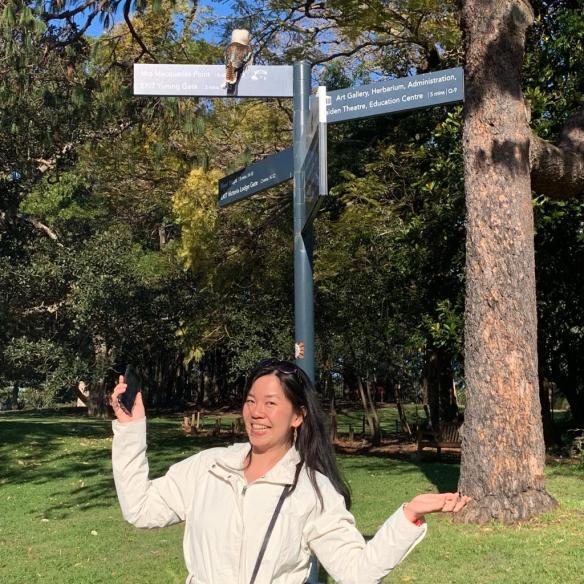
I saw a kookaburra on my first day so I hope this is a good sign!

Image by Nicola Turner

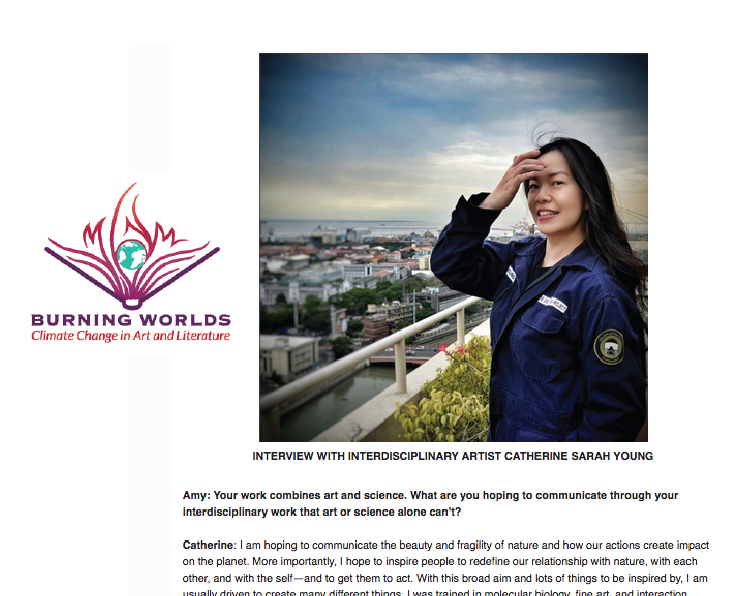
I talk art, science, Beijing apocalypses, and taekwondo (among other things) in this rad interview with Dr. Amy Brady of Guernica Magazine and the Chicago Review of Books for her monthly “Burning Worlds”! Here I mentioned the fellowships I just concluded and will continue and how they have shaped my practice, in Beijing with China Residencies and Red Gate Residency, Southeast Asia with Mekong Cultural Hub, Vienna with KulturKontakt Austria, and Berlin with Haus der Kulturen der Welt. Thank you very much!

Check out the interview here: https://mailchi.mp/9dc8381fcb68/burning-worlds-climate-change-in-art-and-literature-514617?e=%5BUNIQID%5D on Artists and Climate Change: http:// https://artistsandclimatechange.com/2019/02/05/an-interview-with-interdisciplinary-artist-catherine-sarah-young/

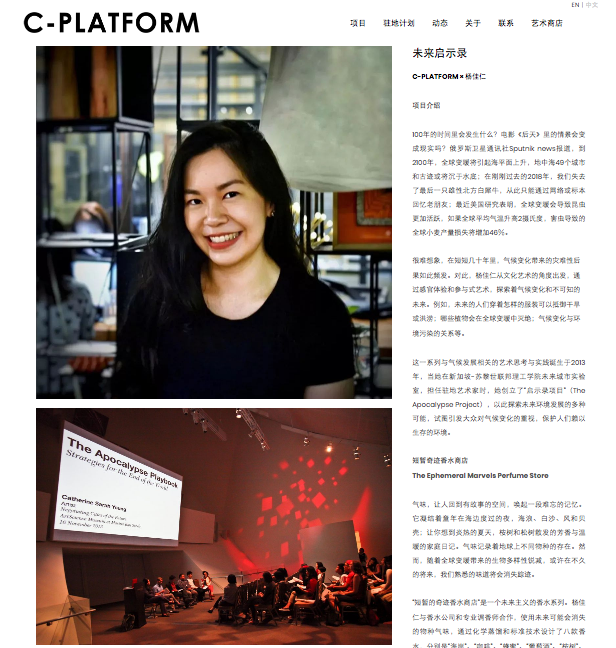
C-Platform, a culture and art research and curatorial organization focusing on current trends and future concepts in the realm of mixed media based in Xiamen, China, profiles The Apocalypse Project series. Many thanks to all the residencies and grants that have supported this work. I trace my Chinese half from Xiamen so this is quite special for me, indeed. Xie xie!

Article in Chinese and English: https://www.c-platform.org/event/%e6%9c%aa%e6%9d%a5%e5%90%af%e7%a4%ba%e5%bd%95/?lang=en

What’s up, Taipei! I’m honored to be one of the 10 inaugural SEAΔ fellows for 2018-2019, with my aim to develop the arts-led climate change educational program of The Apocalypse Project. Very excited for what looks like a kick-ass program and to meet some incredible people. I’ll be in Taiwan from November 25 to December 8; an obvious invite to meet up of you’re there! 😙

SEAΔ is a program co-created by Mekong Cultural Hub @mekonghub and the British Council @britishcouncil which creates space for cultural practitioners to reflect on how their work in arts and culture can contribute to sustainable development within South East Asia through their individual and collective leadership.

Learn more about the program and the other fellows here: https://mekongculturalhub.org

Last April 16th, I gave a talk at the Academy of Fine Arts in Vienna, together with some of the other artists in the residency. I’m writing about some highlights for those who missed it.

I often talk about being part of the different worlds of art, science, and design, and when I was younger, I used to think deeply about their definitions. What was “art”? What was “science”? What was “design”? One can slide down a very long rabbit hole.

But nowadays, I find it more relevant to use all of these skills and knowledge to address environmental and social concerns of society.

I talked briefly about some of my projects in The Apocalypse Project. This year is its 5th year, hurray!

In the years of doing art about climate change, I sometimes see some art projects as a way to curb the disturbances that prevent systems from running smoothly.

I’ve also had lots of opportunities to think about making and distributing this thing we call “art”.Then I segued into why I was beginning a new body of work, Wild Science. It was because the discussions we have around sustainability have changed over the years. Since I started The Apocalypse Project, the world went from wondering what is climate change to fighting climate change denial to finally starting to address the broken systems that got us to where we are today.

Here in my residency in Vienna, there are two general things I have been doing. The first is finding artistic responses to historical knowledge in the context of our post-truth, filter bubbled era.

For example, looking at the Globe Museum, while it may seem old and stuffy, I find it to be extremely important especially since we live in a world where some people still believe the world is flat. I loved looking at the old globes—essentially old models of what we thought the world was like and thus, what our place in it was—and am thinking of the other arbitrary lines and divisions we have made.

Another thing I’ve been obsessing about in Vienna is their cake culture. I love cake, and there is cake in all the other places I’ve lived in, but here in Vienna they do cake very differently. From the well-trained servers to the logos that declare the confectioner to have baked for emperors past, it has become a symbol of something that no longer exists—the old dynasty—and still we consume it.

I’m currently looking at the power dynamics of cake. How does it go from an exclusively imperial institution to something that commoners and tourists can now partake in? There are 360,000 Sacher tortes that are made each year and 1/3 are shipped overseas. That’s a lot of demand for chocolate cake that is kinda dry.

I talked about what i think art can give—a set of alternative norms to counteract the present norms in society. I believe that art can change mindsets and behaviors if we can do it convincingly enough.

I ended with one of my favorite quotes: “Beware of artists. They mix with all classes of society and are therefore the most dangerous.” So my fellow artists, let’s go out there and be a menace.

The awesome staff of Science Gallery Dublin sent me these photos from the “In Case of Emergency” group exhibition, which features The Apocalypse Project’s An Olfactory Portrait of the Amazon Rainforest, an ongoing work about the past, present, and future scents of the Amazon, which I began thanks to the support of LABVERDE and the INPA National Institute of Amazonian Research n Manaus, Brazil.

The show runs until the 11th of February; last few days!

Images courtesy of Science Gallery Dublin. Thank you and happy anniversary, you guys!

In Case of Emergency installation view

In Case of Emergency launch

An Olfactory Portrait of the Amazon Rainforest

interacting with Amazonian scents!

One of the scourges of the modern city are fatbergs. You know what I’m talking about. Or wait, maybe you don’t (which is why I did this project). The big blobs of coagulated fats, oils, and toiletries that get stuck in the sewers, making urban flooding even worse. In a congested city like Manila that already experiences super typhoons caused by climate change, this means that a few minutes of rain translates into a few inches of water on the streets. If you’re unlucky enough to be out of the house when this happens—and if you’re commuting—it turns into a nightmare.

This was the situation I found myself in one day as I was stuck in the rain in Manila. No taxi will take you (well, a few did, then promptly threw me out as the rainwater level went from foot to ankle deep), so I was left with one of the last options—a pedicab (a tricycle or a tuktuk in other countries). And as I sat inside, cold and miserable with the pedaling driver talking about charging me three times the price and my rage further heated up by global warming, the water rushed into the pedicab and I, hugging my knees in a fetal position, vowed to turn this into a project.

People keep wondering about where I get my ideas for The Apocalypse Project and I tell them simply that on many days, I’ve already lived it.

Several months later, I finally have results whose journey transcended continents. In my not-so-recent residency in Medellin, Colombia, I was determined to scratch this creative itch and thankfully, a few phone calls later thanks to the Platohedro staff and boom, an engineer from Medellin’s EPM (the company that manages their sewers, or, ahem, alcantarillas) actually came over to the house and a few minutes later, I was looking into the sewers of Medellin.

sewersoaperiehemel

I learned a lot about sewage and how different it is depending on the district. We were near a coffee factory and the sewage smelled like really old drip coffee and looked like it, too.

sewersoaperiecoffee

Interestingly, we could take readings about the sewage. This is a device that is supposed to check toxicity based on the particulates in the liquid.

sewersoaperiedevice

Medellin doesn’t get flooded the way Manila does. One reason for the latter’s epic floods is the dumping of used cooking oil down the sewer systems. Eventually the liquid saponifies and clogs the city’s arteries. In Medellin, I learned that most people actually recycle the oil. Also, the population in Medellin isn’t as much as Manila’s.

img_0762

I also got to research the alternative sewers that people throw their waste in. In Medellin, that would be the Medellin River, which is so polluted you could smell it from a distance.

catherine_medellinriver

Back in Manila, it was interesting to compare the struggles of both cities. Manila and Medellin have similar histories and so it is fascinating to see their journeys to development. Medellin is a bit ahead of the game, winning the 2016 Lee Kuan Yew World City Prize and 2013 City of the Year Award, thanks to its urban planning.

As I navigated through the neighborhoods of old Manila and Malate, I interviewed the managers of fast food chains on how they disposed of the cooking oil used to deep fry their chickens and fries, I was expecting to see hand wringing of we-don’t-know and why-are-you-even-asking, but it turns out, there are procedures that they do to conform to legislation set by the Department of Natural Resources. Their used oils are picked up by licensed agencies and people who recycle it for several purposes.

And so I was left scratching my head. If these restaurants actually do dispose of their oils properly, who is responsible for all the clogging? One possibility is the smaller canteens that are unregulated, and another possibility are the households themselves. How do you dispose of the remaining 1 tablespoon of cooking oil in your frying pan, leftover peanut butter, or other fatty acids embedded in our lifestyles? Pouring it down the drain might seem simple and harmless, but imagine millions of citizens thinking the same thing.

The project became an investigation on the journey of oil—the palm oil that is made from palm forests and used in households and commercial kitchens and end up in sewers or recycled. I researched the most common brands of cooking oil (palm oil was normally used), collected used cooking oil, and got grease from open pipes that were common in Manila. A few dozen saponification experiments later, I had several bars of soap for three types: palm oil (which needed too much caustic soda to saponify that I am actually suspecting of how pure it is, but that’s another story for another project), used palm oil (collected from restaurants), and sewer grease.

sewersoaperietypes-029

If you ever think of doing this yourself, well, kids, get your tetanus shots ready and make sure you’re suited up properly. Working with used cooking oil was always a surprise. The most information I could get was what food the oil was used to fry. They always came out different, and even though I used the same molds, there were some instances when the soap actually rose out of them, emerging like the spawn of Godzilla. There were also times when the soap didn’t look that great, because it was mixed with so many things, including water.

img_20160909_123932

Layers of different types of fat were in these soaps. There was something faintly geological about them, don’t you think?

img_20160909_124910

I boiled the sewage before turning them into soaps to kill as much bacteria and pathogens as possible. (I would still use gloves to handle these, though.) It’s both disappointing and fascinating to see them so normal-looking.

The Sewer Soaperie

The Sewer Soaperie

I also placed them in airtight engraved containers for the 1335Mabini exhibition.

The Sewer Soaperie

The Sewer Soaperie

It’s so great to get this off my chest, and I’m looking forward to continuing the project and looking at it from other perspectives.

Research for this project was made possible by a residency at Platohedro and Casa Tres Patios, with support from Arts Collaboratory and the Ministry of Culture of Colombia.

Thanks to Mr. Hemel Serna of EPM and his team for giving me administrative support in researching Medellin’s sewer systems.

Thanks to 1335Mabini for exhibition support.

Photos courtesy of Platohedro, Events by HD, 1335Mabini, and Catherine Sarah Young

Iconic photo of the first Earth Day (photo from Smithsonian Magazine)

Iconic photo of the first Earth Day (photo from Smithsonian Magazine)

The above is the most iconic photo of the first Earth Day. Held on April 22, 1970 in New York City, the first Earth Day manifested the emerging environmental consciousness of the US, largely due to the publication of Rachel Carson’s Silent Spring in 1962. On April 22, 20 million people marched to demonstrate for a sustainable environment. Currently, Earth Day is celebrated in more than 190 countries.

A black-and-white photograph of a man wearing a vintage gas mask and stretching his neck to smell some flowers became iconic of this day. The photographer is unknown; the credit simply read “Associated Press”, and AP identifies the person as a freelancer. In August 2010, Smithsonian Magazine reported his name as Peter Hallerman, then a sophomore at Pace College. Hallerman recalled that he was one of the 30 Pace students who held a demonstration in a park near City Hall. Hallerman wore a gas mask that he once belonged to his mother, Edith, who worked with Red Cross during World War II. The AP photographer told Hallerman to smell the flowers of a magnolia tree with his mask on.

EarthDayRecreation

This historic photograph is still relevant as we reflect on Anthropogenic climate change, and I used it as inspiration. After recreating the original photograph, I expanded it to reflect my current location. Medellin, Colombia is a city of rich history and culture. Once a hotbed of violence, it has emerged over the years as a city of innovation and urban design—a city of “cool”. Among other things, Medellin is known for winning the 2016 Lee Kuan Yew World City Prize and 2013 City of the Year Award, as well as emblematic and permissive graffiti culture, though it hasn’t completely shaken off its violent past. The photographs were taken near the Museo Casa de la Memoria, a museum dedicated to victims of armed conflict in Medellin. The city also faces environmental challenges as it works to modernize itself and in the context of the Anthropocene. These photographs are meant to reflect the city’s character, culture, and contradictions as it projects its identity into the future.

IMG_2261small

Title of Work: Earth Days

Deepest thanks to Platohedro and Casa Tres Patios, where I did a residency supported by Arts Collaboratory and the Ministry of Culture of Colombia.

The Apocalypse Project: House of Futures opens soon in Future Gallery of the Institute for the Future in Palo Alto, California. This seven-month exhibition explores our environmental futures under climate change through the lens of high fashion. I’m deeply grateful for the support of IFTF, swissnex San Francisco, the Consulate General of Switzerland in San Francisco, ETH Zürich, Singapore-ETH Zürich Future Cities Laboratory, and University of Applied Sciences and Arts, Northwestern Switzerland.

The Apocalypse Project: House of Futures

The Apocalypse Project: House of Futures

We have three events this September. Check them out and register now!

September 18, Friday, 6:30PM-10:00PM at swissnex San Francisco. Climate Change Couture: Fashion for a Hotter Planet. Get a taste of the exhibition by watching a Climate Change Couture fashion show and DJ/VJ performance plus talks from the artists involved. (Tickets at $10. More here.)

September 21, Monday, 6:30PM:10:00PM at Future Gallery, IFTF. The Apocalypse Project House of Futures Grand Opening Reception. See the exhibition plus celebrate with a Future Feast! (Free! Register here.)

September 22, Tuesday, 9:00AM-8:00PM at Future Gallery, IFTF. The Apocalypse Project: Future Now. Join us at Institute for the Future for the inaugural Future Now, an all-day event of futures thinking. (Free! Register here.)

I’m also even more excited to have old and new friends being part of this exhibition. Stay tuned for more in the coming days!