Archive

Design

Hello. My name is Catherine and I would like to give everyone in the world a hug.

I’m a hugger. I can’t help it. When I see someone I know, I just go for it as a greeting with barely a thought.

There are perfectly good explanations for this. I was raised in the Philippines, land of extremely happy and friendly people. I also grew up with a lot of stuffed animals. I still sleep with a pillow I’ve had with me from the crib—it’s the only material possession that has been with me forever. And dang it, it feels good. Hugging releases oxytocin, the hormone that promotes love and trust. In fact, studies have shown that a lack of human interaction, such as touching, is detrimental to growth and development. Touch ranks up there with food and water as a basic need.

But I do realize that not all people like to hug others. The idea of touching as a greeting is largely cultural, and I’ve had to adapt accordingly, depending on where I’ve lived and whom I was interacting with. In the Philippines, I hugged. In Spain, I kissed (both cheeks). Here in America, I shake hands. It is especially in the latter that I’ve felt that people respond the least positively to hugs. Many people, I’ve observed, have an invisible “wall” that illustrates their personal space. Touch may be considered as an intrusion, an interruption, or a threat. On the other hand, a hug can also be a sign of great physical intimacy that is only reserved for one’s closest family and friends.

I wanted to investigate our perception of touch. Moreover, I want this project to be a personal reminder of being physically connected to people.

Thus comes HugPrints. I designed a thermochromic (temperature-sensitive, color-changing) vest, so that it was possible to see evidence of the hug. The purple fabric temporarily turns to blue when touched. Right after each hug, photos of the front and the back of the vest are taken, showing where I was touched and how warm (literally) the person is. The patterns people intentionally and unintentionally make have been an interesting exploration of human contact.

I also record the ambient temperature of the environment. Hugging people indoors versus outdoors would give different intensities of color change.

I would love to give you (yes, you!) a hug. But hey, I would love it more if you give your loved ones and perhaps that sad-looking stranger next to you one, too! Visit the project site for more details.

Ready? Go!

A rainy, chilly Saturday and there is only one thing to do: head uptown to one of my happiest, most wonderful place in the world—the American Museum of Natural History.

It was the opening of Creatures of Light, an exhibition that explores bioluminescence—its functions, its mechanisms, the organisms that have it, and how scientists study it.

Just inside, the exhibition greets you with a giant (!) glowing mushroom. Like so:

Creatures of Light opens with a giant glowing mushroom.

Immersive environments will instantly transport you. You can climb into a model of a New Zealand cave with magical looking strands of glowworms. You can pretend you are in a bioluminescent bay in Puerto Rico with tiny lights following your movement. You can gaze at giant glowing jellyfish from the Pacific Ocean.

Inside the New Zealand cave with glowworms

I love this:

Admittedly, I forget what this is. A worm? A firefly larva? Let me get back to you.

I think my favorite was this gorgeous dinoflagellate model.

A dinoflagellate model at Creatures of Light

You can even participate in the fun; if you tire of watching the fireflies glow, then pretend you are one by trying to match their mating patterns. Check out the interactive of a fluorescent coral wall that you can explore with one of the exhibit’s iPads. There are also live bioluminescent creatures, such as flashlight fish that are so tiny but fascinating to watch. As always, the immersive 3D models and the interactivity are the key strengths of the AMNH. Although packed with a lot of concepts, it was a joy to get through.

This exhibition is especially memorable for me because I helped research for it during my internship with the exhibitions department last summer, cataloging the bioluminescent creatures that were known and helping to explain to some of them the process of bioluminescence, which I studied in university. This is probably why I recognized most of the creatures there. My boss also very nicely allowed me to play somewhat, which led to me making this tiny encyclopedia of bioluminescent animals. We never got to use it, but it was fun, regardless.

On that note, some stills here, back in the day when I had a clay fetish. This was also one of my projects for my prototyping class.

You’ll have time to see the exhibition, as it runs until January 6, 2013. I, however, will likely see it over and over again.


I’m thinking deeply about who I want to use the Hug Vest that I’m designing, and while I can always wear it to hug friends and strangers alike (which I will do eventually), one specific audience I am looking at would be parents and their young children (roughly aged 3 to 7). The reason is that the desire to hug varies drastically among adults; witness the reactions I got with prototyping the vest. There were those who readily hugged, those who refused to, and those who reluctantly did it for the sake of helping the project.

Ah, but parents and kids! According to American psychologist and educator Virginia Satir, we need four hugs a day for survival, eight a day for maintenance, and twelve a day for growth. But for working parents, it may be difficult to find the time to hug their child, let alone get a young one to sit still to receive or to give a hug.

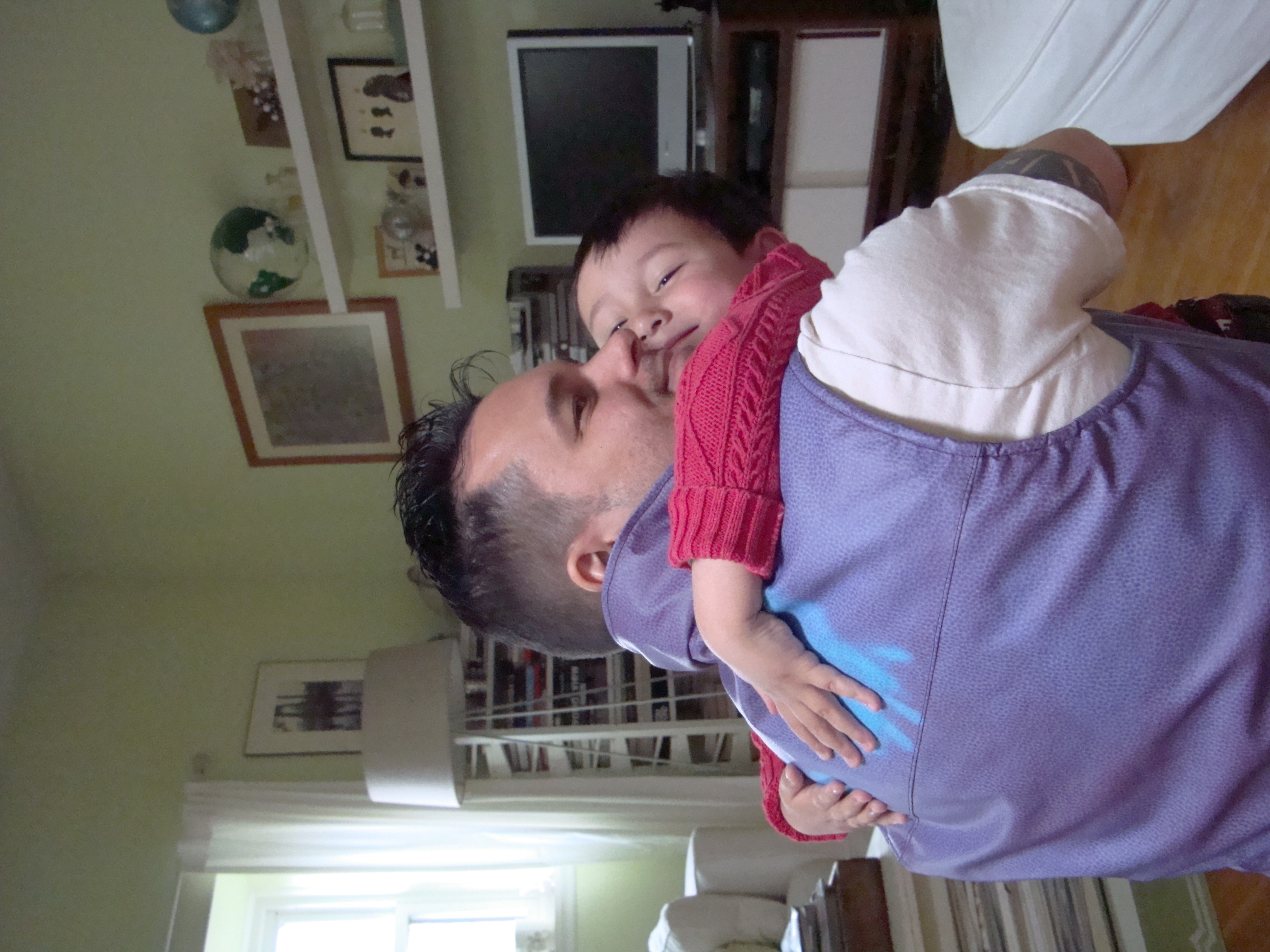
I wanted to find out how parents and children will interact with the thermochromic vest. I loaned the vest over the weekend to my friend and studio seatmate, Chris Cannon, who has a son, Alex, who is almost four. The vest was ill-fitting for both father and son; it was designed to fit a well-endowed girl or a large man, and neither of them fit these descriptions. I was interested specifically in how the material would affect their interaction. Chris, who has been in the clutches of graduate school for two years, says that he has made hugging important:

“Hugs are very important to us, especially since I don’t see much of him these days. I ask him for hugs everyday. We also bond in countless other ways: singing silly songs, making fart jokes, playing with his toys, sitting on my shoulders when we go out for walks, riding the subway together (he loves the G train), bedtime reading, etc.”

I doubted that Chris and his family would be the ideal audience for the vest. They already hug a lot, and I’ve seen Alex on many a day or event in school enough not to doubt that Chris and his wife, Yong, put family first in spite of how busy life can get. I was curious about how Alex would interact with the reactive material and how this can affect his manner of touching, as I knew his attention span was short based on what Chris has told me over the years.

As many of my friends with children have told me, the thing about hugging and young children is that they don’t hug the way adults do. The “standard” hug I’ve observed is putting one arm over the receiver’s shoulder and the other one around the waist. Or both arms over the shoulder or around the waist, depending on the height difference of the hugger and the huggee. But kids are less structured in how they hug or touch. Chris tells me about how Alex hugs him:

“It depends on whether I’m sitting or standing. I guess he hugs me in anyway imaginable, including head butts to the groin (hey, it counts as a hug!) and climbing up my back and putting me in a chokehold.”

The good thing about the thermochromic vest is that the entire vest is reactive. Thus, it didn’t matter how Alex hugged or touched the vest because it would change color despite what type of touch he gave it.
Below are the results, and further proof that I should always get my friends involved in my project. (So great!)

Chris Cannon and son, Alex

Hug Daddy, come on!

When I asked Chris if Alex enjoyed it, he says:

“He liked it. He didn’t want to hug me as much as just slap my back with his hand repeatedly to see his handprints. I enjoyed watching him experience something new, even if it was just for a few seconds before he got bored and moved on. He liked wearing it, probably because he likes wearing our clothes in general.”

Alex wearing (or perhaps a better term would be 'swimming in') the Hug Vest.

The bit that struck me was how Alex played with the material. Why he didn’t necessarily see the vest as a way to hug his Dad, he paid more attention to what the vest could do.

I liked how in the middle of playing and touching the vest, Alex ultimately plays with Chris, who is wearing it.
I loved this interaction, though I am mindful of who this vest is primarily for. As I said earlier, a well-bonded family like the Cannons wouldn’t have as much use for something like this. When I asked Chris frankly about whether he would buy one, he said:
“No, because we hug enough as it is (or at least I threaten to take away all of his toys until he hugs me!). Besides, then it’s a hug motivated by something other than enjoying a hug for its own sake. I’m sure he’d enjoy lights and sound added to it since a lot of his toys have that effect when he interacts with them.” [Note: italics mine]
I would be interested to see how this can play out in families where hugging is a chore. What about working parents who can’t squeeze time for a hug? Or children who need a sensorial “hook” to be sufficiently engaged in human contact? I am mindful of children’s short attention spans, especially in this video where Alex throws the vest on the couch and runs away when asked by his parents to show them how the handprints worked:
More to come, and soon.
A HUGE thank you to the Cannon family for agreeing to participate in this! Especially to Chris, who is repetitively awesome.

Over the years, I’ve come to be wary of labels. In past lives, I have been identified as “the scientist who writes,” “the artist who does science,” “the designer who’s an artist,” and a lot of other ostracizing phrases. These words, I have felt, have caused more exclusion than inclusion, and has served to contain a person’s identity into one silly box as dictated by someone else. Isn’t each world enriched by the knowledge of the other?

My mother was a genetics professor in a family of painters and photographers; thus I had childhood diet of Punnett squares and DNA sequences, and would often smell formaldehyde on Mom when her students learned about Mendelian genetics through crossing flies. (Her students secretly called her the Drosophila Queen). My summers were always spent in art school and piano lessons. I ended up doing my degree in molecular biology and biotech while working as a correspondent for a national newspaper. In between PCR reactions, dissections, and other tedious experiments, I would take photographs, write, and make. Later, doing art in Barcelona made me miss the lab; I would often always show work that had a scientific slant of some sort, which puzzled some of my colleagues. Even the poetry I was writing was geeky.

Why these two? I’ve often looked at things with wonder, and thought that artists and scientists pursued their paths with the same curiosity.  I realized that I wouldn’t have one without the other; I could not choose between two halves of myself*. I loved the rigor of science; to be able to discover things and arrive at exact answers. I also loved the looseness and profundity of the arts; it allowed me a lot of time and opportunities to play. Doing science alone was too tedious; doing solely art felt like I was floating aimlessly. At the same time, I found that many of the questions I was fascinated with were investigated by artists and scientists alike; it came to the point where it was difficult to tell where the boundaries lay.

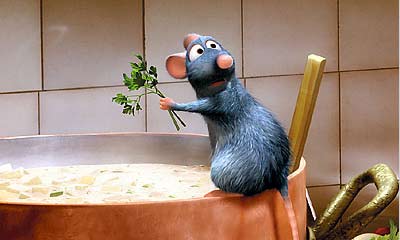
(*That line feels familiar. I believe I am quoting Remy from Ratatouille. Yes, a rat.)

Remy from Ratatouille. Copyright Pixar.

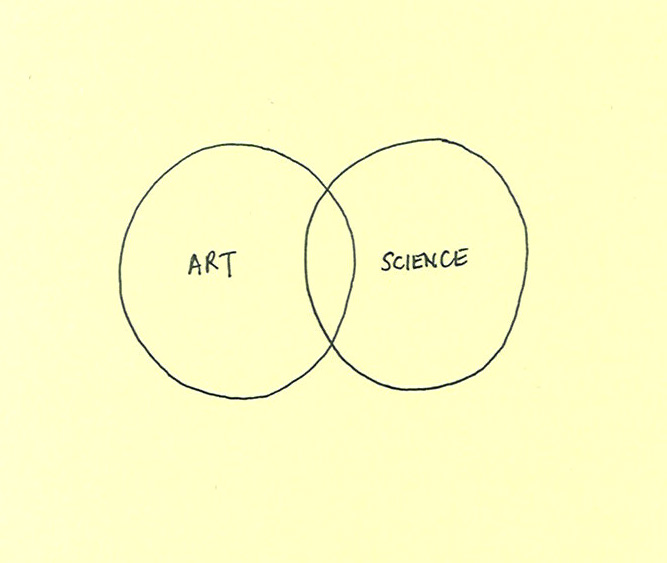
Admittedly, in the beginning of doing an MFA in Interaction Design, I had the notion that my own Venn Diagram of Personal Beliefs and Interests, which only had two circles…

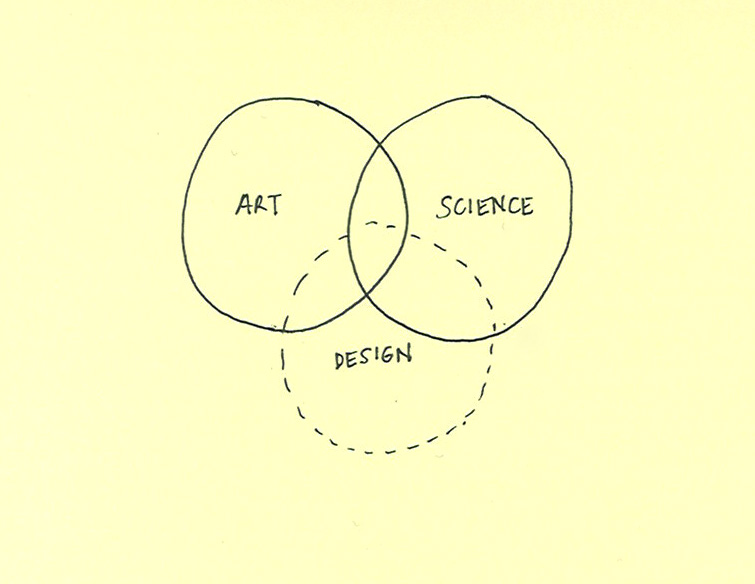
…would look like this after an MFA, adding design to it, because good things come in threes:

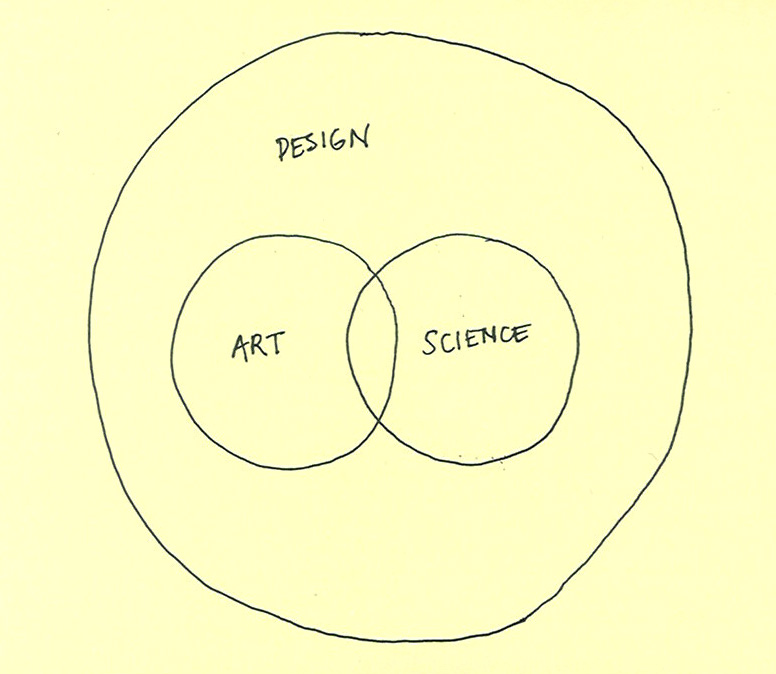
But now as nearly two years have passed and I inch slowly towards graduation, I find myself thinking that this is my point of view of Art, Science, and Design as I have used them, based on the common themes of what I have done so far:

I think that up to this point, I have used design to contain the concepts and questions I have grappled with in art and in science. Things like “What makes you happy?” or “What do clouds look like?” or “What do you remember in a smell?” are questions that have both scientific and artistic facets to them, albeit in varying degrees. When I think about design in this way, I’m really happy that I chose interaction design as the third thing I wanted to study. Art and science are always the two broad areas that interested me, but it was design that allowed me to see how I can articulate these concepts to others. More importantly, design is a way for me to get other people to participate in what I do. I don’t think this makes one field better than the other; but it reminds me which hat I have to put on and which language I have to speak depending on where and when I am.

I think this why I’ve struggled (i.e. drowned in ennui) with making things that are purely utilitarian. Design without the poetry of art and science at its core feels hollow and flat. I don’t think I will ever be truly happy by making living out of making things less inconvenient, or by satisfying people who just want to make more money—it seems like the stuff midlife crises are made of. It’s not that they aren’t important, because they are. It’s just that my happiest ideas and moments have been borne out of uncomfortable situations—getting the flu, waiting for hours in line, being stood up by someone. But I have always tried to make the best of them—I fill sketchbooks from cover to cover, I scribble poetry on napkins, I talk to a lot of strangers. I think that if everything were to run too smoothly for me, my life would be dull and flat, and I would never have had the happy accidents that have led to all these amazing opportunities and adventures.

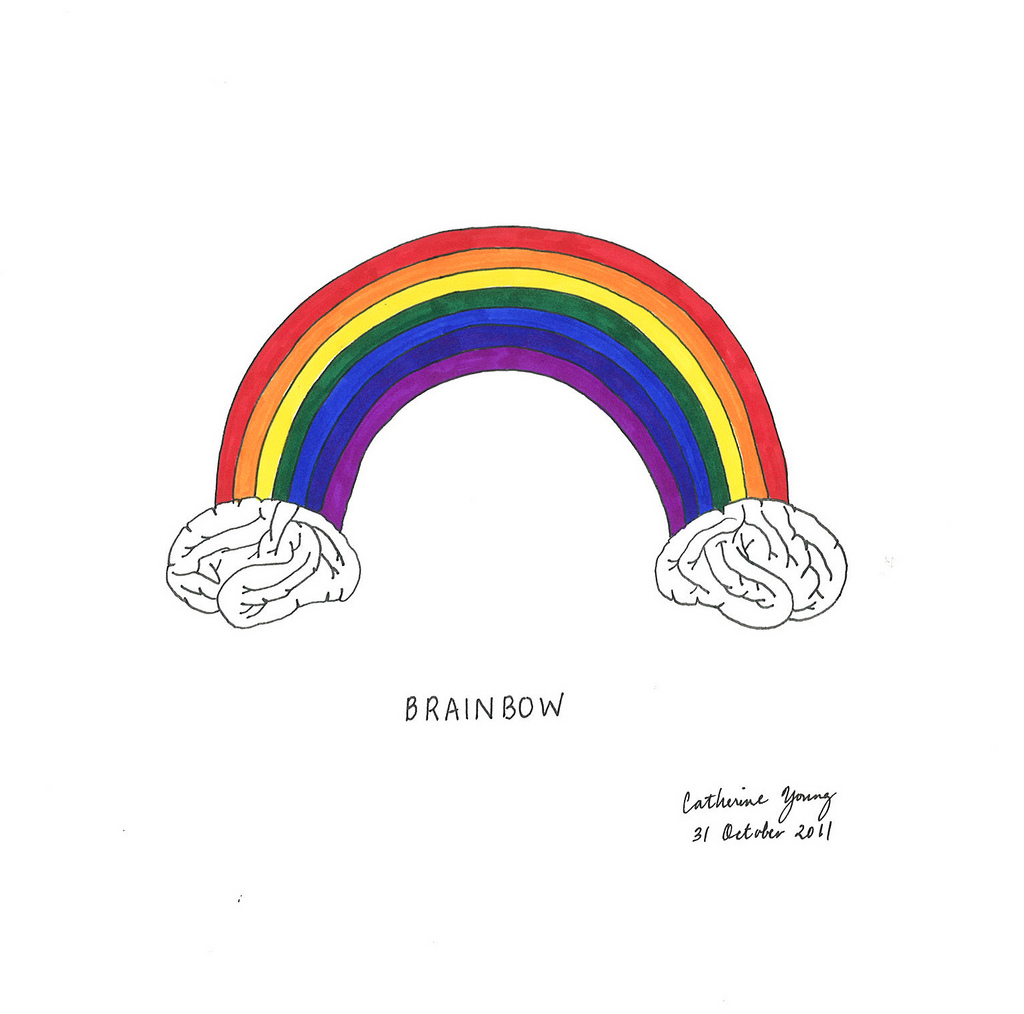
This reminds me of a pivotal conversation I had with one of my classmates, who said that I had to create a bridge between my mind and the mind of my audience.  This led to my joke about “brainbows“—a rainbow bridge between the mind of an artist (or scientist) and those whom they want to connect with. In art and in science, I usually worked by myself, secluded and uncaring about what other people thought. To care too much about other people was seen as a disadvantage if you wanted to do something authentic and brilliant.

But in design, it is imperative to care about other people, perhaps not everyone, but at least the user, the participant, or whatever word you wish to refer to the person you are designing for. And I think this is probably the best thing I have learned in the two years I have been in graduate school: to know how I can make my ideas as an artist or scientist accessible to everyone. The invisible walls I’ve seen that made art and science too abstruse and irrelevant to many are broken down by design, making these concepts available, relevant, and malleable by all, regardless of gender, language, education, and culture. And because of this, I like to think design creates bridges that people can walk on, so that they can allow the experience to be a part of their lives, thus enriching them. I’m hoping I will able to do that by posing simple, universal questions, and by coming from the point of view of joy and actual human contact, which I think is common for everyone, regardless of whether you have an MFA, or a PhD, or an MD, or no letters at all.

Part of writing this is because I have been perusing journals from five years ago, and man, one knows how much she’s grown when, upon reading, she alternates between “Aww” and “Yikes!” I’ve done the painful and hilarious rereading of events—I went through quite a blur of taekwondo belt tests, French classes, and mammalian dissections—back in the day when I still ate red meat and wrote on notebooks with lines. (I’ve since gone pescetarian, finally with a black belt, and now go for the blank Moleskines. Hurray for all of it.) I smiled when I saw familiar things—one of my earlier (and forgotten) entries in 2007 was entitled “Celebrating the Senses”—some things just persist from youth, I suppose.

I wonder then, if my future self would challenge this current view. Just as I am alternately charmed and exasperated at the naïveté of my 23-year-old self, perhaps my future self would read this post and smile knowingly at all the things she has yet to learn. Perhaps when we look at the totality of all our different identities, we will find that we are all of those things and none of those things at the same time.

And I think, isn’t that marvelous.

On a recent trip to New Orleans, I was without a plan and without a clue. And yet, on this plan-less and clueless visit, there were two things that captured my attention amidst the remnants of Mardi Gras beads, tourists with stale beer in their go cups, capybara sightings, and fascinating reptiles.

1. Puzzle animal sculptures by Peter Chapman

My absolute favorite store in New Orleans is undoubtedly The Idea Factory, a wonderful shop that sells interactive wooden toys in the French Quarter.

The Idea Factory is located on 838 Chartres Street in the French Quarter.

The Idea Factory in New Orleans sells wonderful interactive wooden toys.

The store carries works by several artists, and while I loved the trains, the puzzle boxes, and the animals on wheels, what made me so incredibly happy were these three-dimensional interlocking wooden animal puzzles by Peter Chapman.

3D wooden animal puzzles by Peter Chapman

The eyes of the animal serves as the “lock”—remove it and it becomes possible to dismantle the puzzle. What makes it even better is the surprise inside each animal. An egg lies inside the brontosaurus. A finger falls out of the piranha.

On the last day of my visit, I caved in and bought one (the dinosaur, naturally). His name is Max.

2. The Toaster Project by Thomas Thwaites

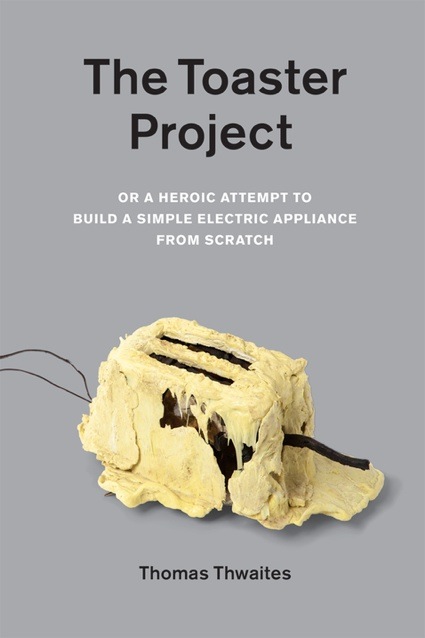
The Toaster Project by Thomas Thwaites

The book that held my attention during idle moments this week was Thomas Thwaites brilliant (!) book, The Toaster Project, the documentation of his MA project  at the Design Interactions program in the Royal College of Art. In it, he chronicles his misadventures of creating a toaster from scratch, showing how he obtained materials such as steel, mica, plastic, copper, and nickel. Apart from being a modern quixotic tale of a seemingly impossible and foolish task, it is also a poetic reflection of sustainability and global capitalism.

Thwaites' toaster. Image via the designer's website. Photo credit: Daniel Alexander

As a designer of a more speculative and conceptual kind, and one who is sometimes weary of seeing only apps, websites, and flowcharts, I feel encouraged at seeing projects like this. I think my favorite part was when Thwaites was writing his thank-yous:

“…for making the Design Interactions MA a place where toasters can be made from scratch, and saving me from a life as a bad web designer.”

Spot on.

***

I am not embarrassed to admit that when I see things like Chapman’s puzzles or Thwaites’ toaster, I jump up and down with glee and spread the joy by telling everyone in my path. I love being humbled and reminded that wonder can go beyond our digital devices and can actually reside in simple materials and objects such as wood and toasters. Wood isn’t just wood; it can stoke the fires of human imagination and hide delightful secrets. Toasters aren’t just toasters; they contain histories of our technology and consumption.

There is always the potential of poetry in everyday things.

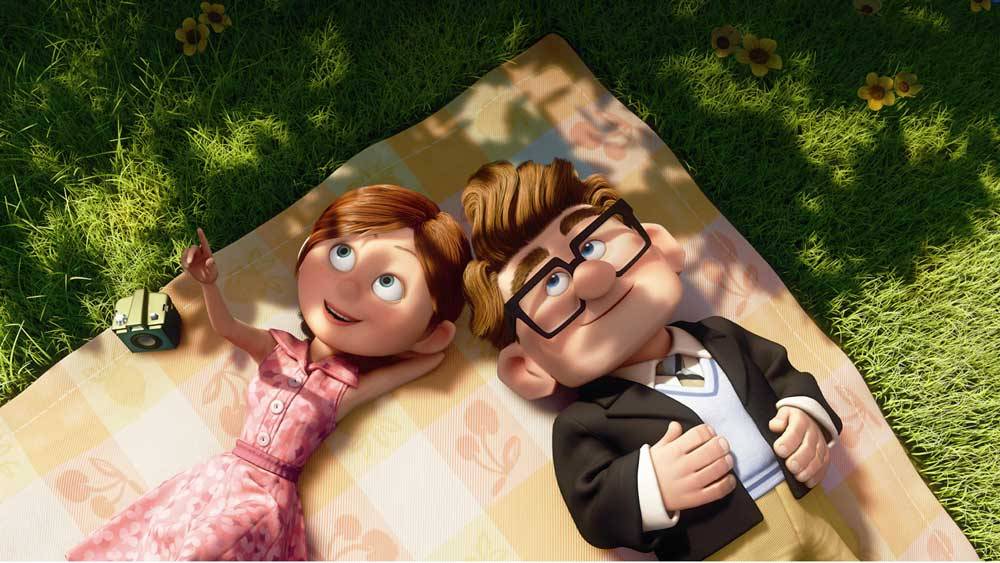
In the Pixar movie, Up, one of my favorite scenes is the one you see below. Before Carl became the grumpy old widower whose house was lifted by balloons, he was a young man whose wife, Ellie, liked to watch clouds with him and point out what they looked like.
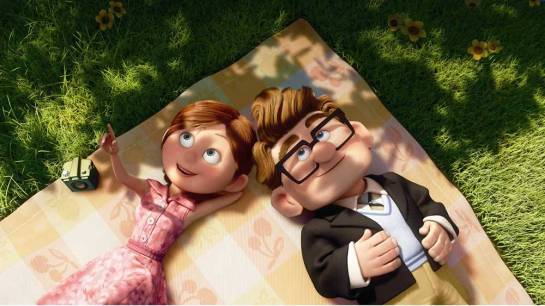
Carl and Ellie, from Up (Pixar, 2009), image courtesy of Pixar

“To see is to forget the name of the thing one sees,” was once stated by the French writer and philosopher Paul Valery (1871-1945). When Carl and Ellie were watching clouds, they didn’t just see an amorphous mass of water vapor; they went beyond the form of these objects, drawing shapes from memory and making them fit within the constraints of the cloud’s form.

In Proust was a Neuroscientist, Jonah Lehrer wrote about how the painter Cézanne showed the difference between seeing and interpreting. During his time, critics who derided his work said that his paintings were unfinished. Indeed, when you look closely at his work, he focused on form and color without objects being outlined. For Cézanne, our impressions required interpretation―to look is to create what you see. The way he painted was the way our eyes really saw the world. Our brains added the details after.

Like Carl and Ellie, I also look at clouds in different ways. Some of you may know that this has been keeping me happily occupied:
Rorsketch

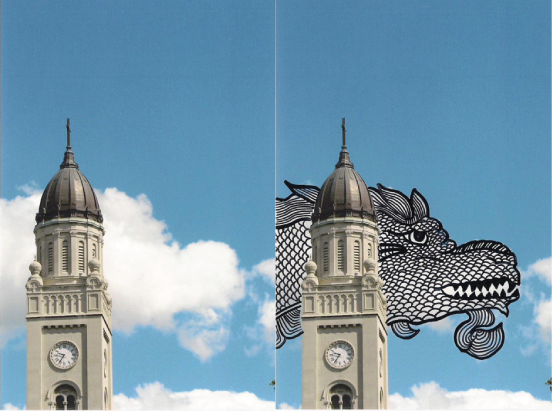
An example:
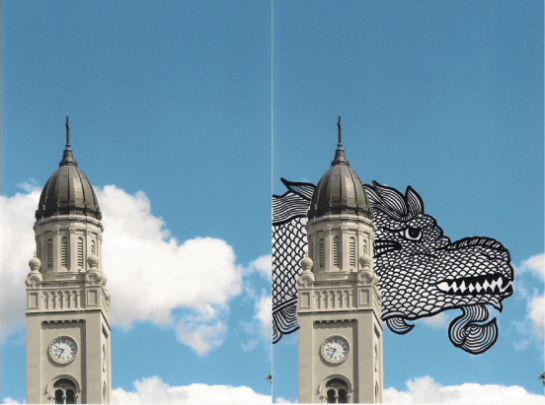
Rorsketch, Cloud #17, A dragon obliviously glides past a church.

In the middle of doing a hundred of these, I began to see the multiplicity of interpretations people can have from one simple object. I realized that their perceptions are affected by things such as age, profession, and culture. Also, too many strangers have stopped me as I took yet another photo of the sky while jumping up and down with baffling excitement. Why was I so happy? Because I’m seeing a dinosaur! Aren’t you? I wanted the project to be more accessible to people by designing a public interface.

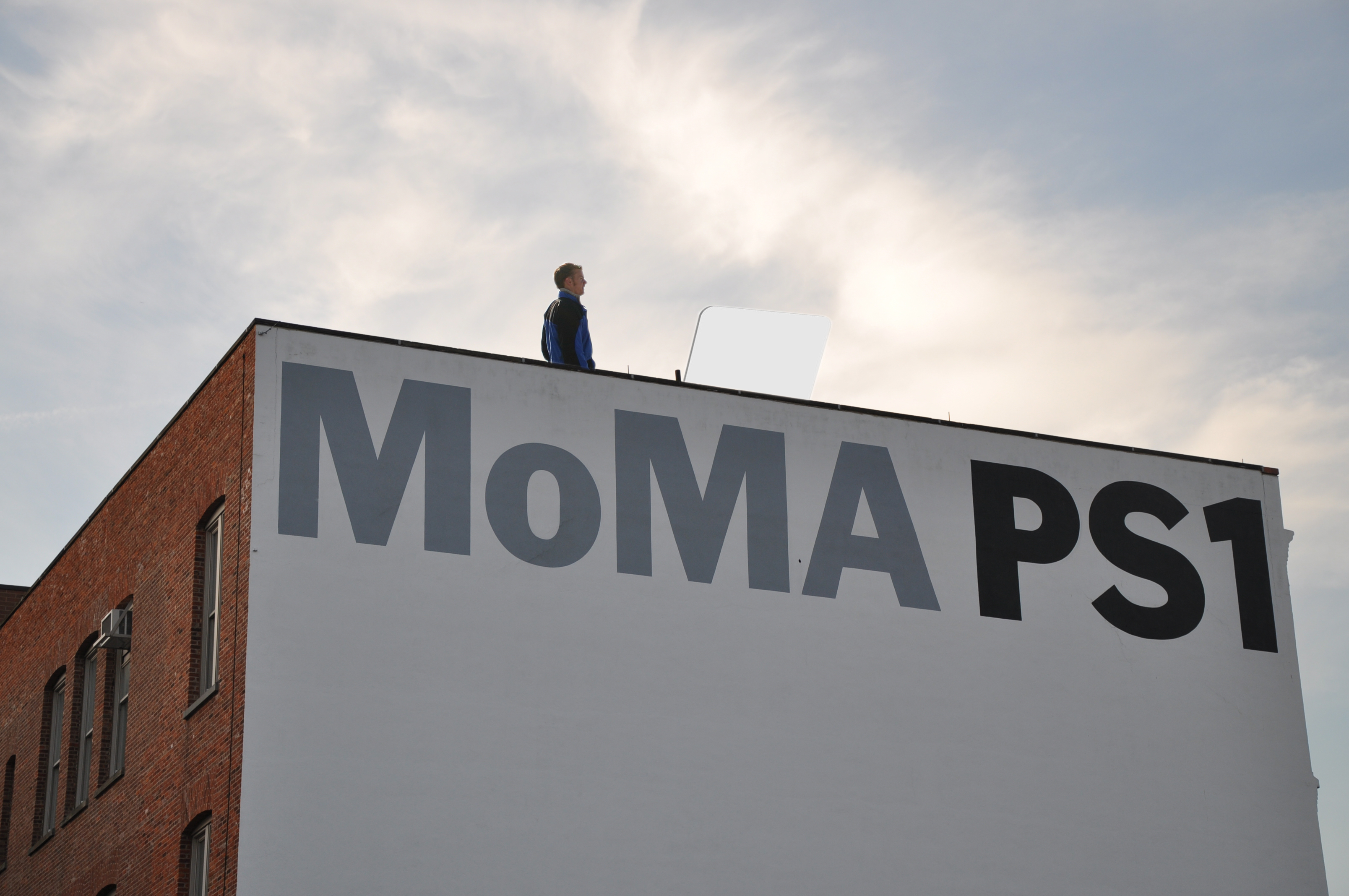
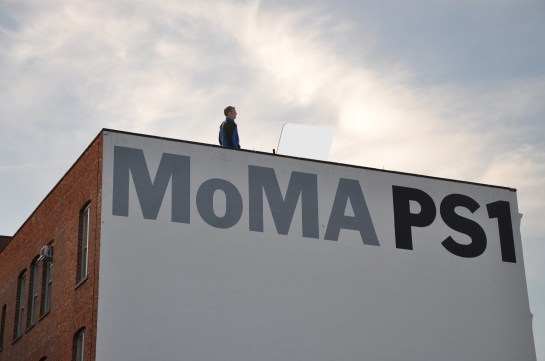
While parks would be the ideal place, I wanted something that would be secure and make the interface safe from vandalism. I decided to place it in MoMA PS1, which had an open area, a rooftop and two alcoves across the courtyard. Aside from parks, rooftops are a great way to see the sky; they lend a meditative, reflective state that is not unlike being on top of a mountain.

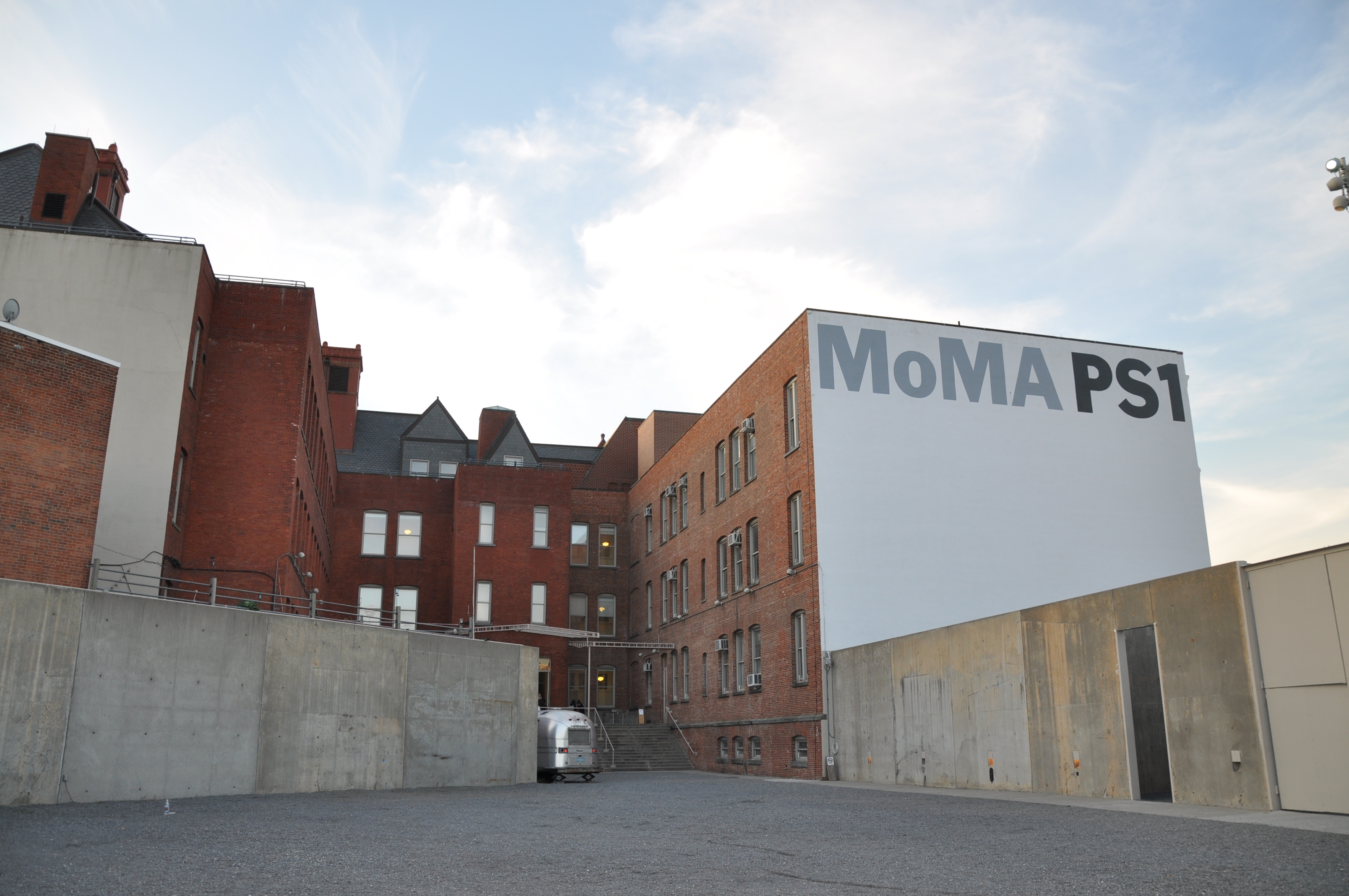
Although PS1 looks bare, it’s a popular place for certain events, especially their summer parties and the Young Architects Program. I wanted to transform it from this:

MoMA PS1

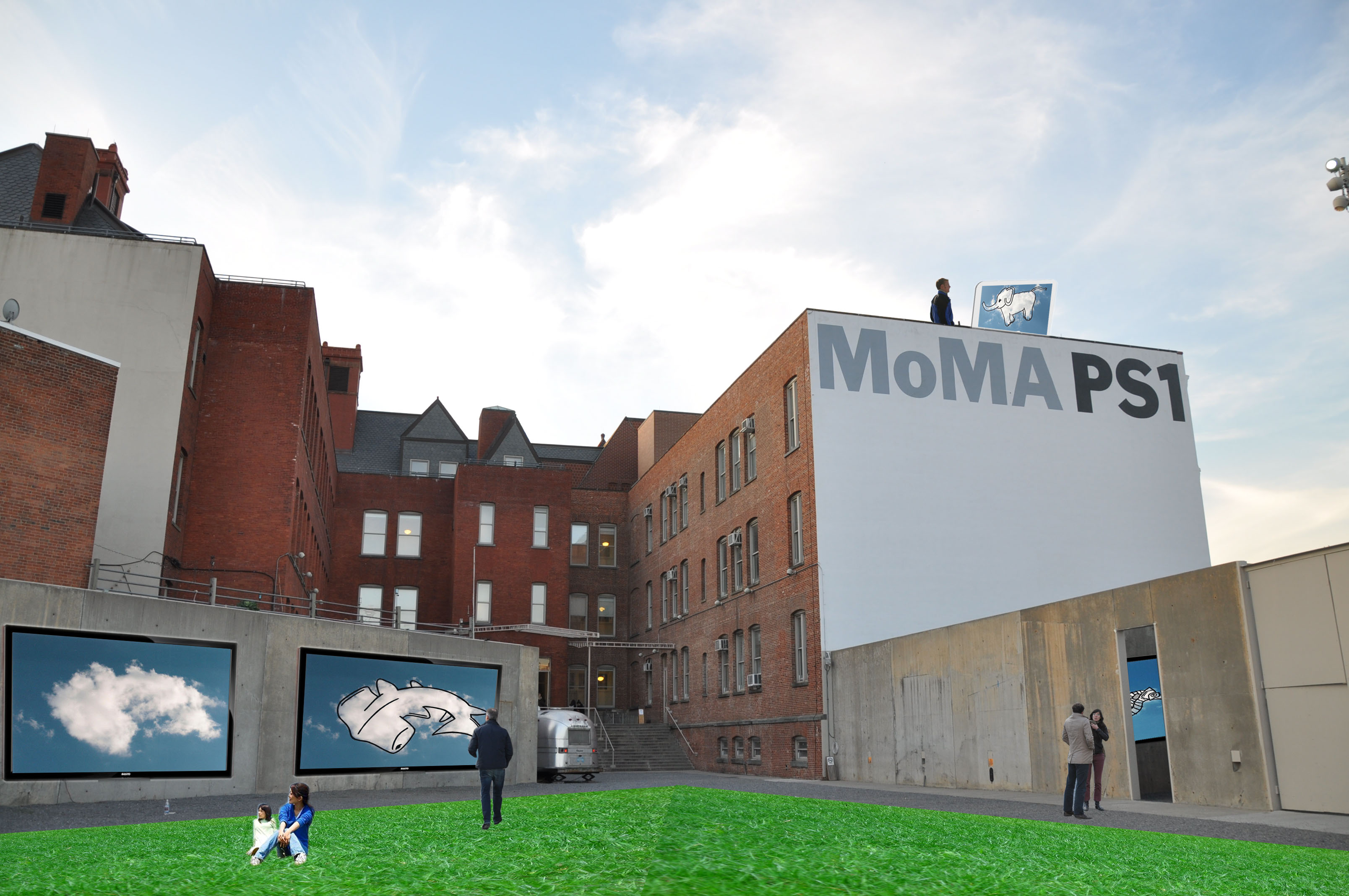
To this:
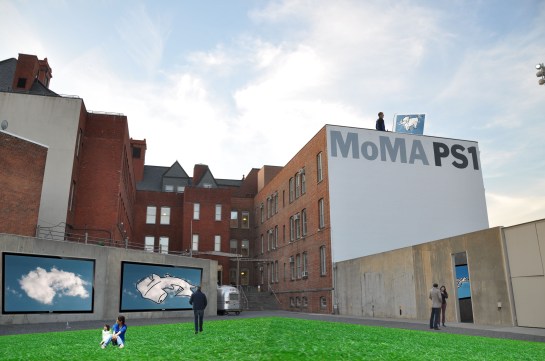
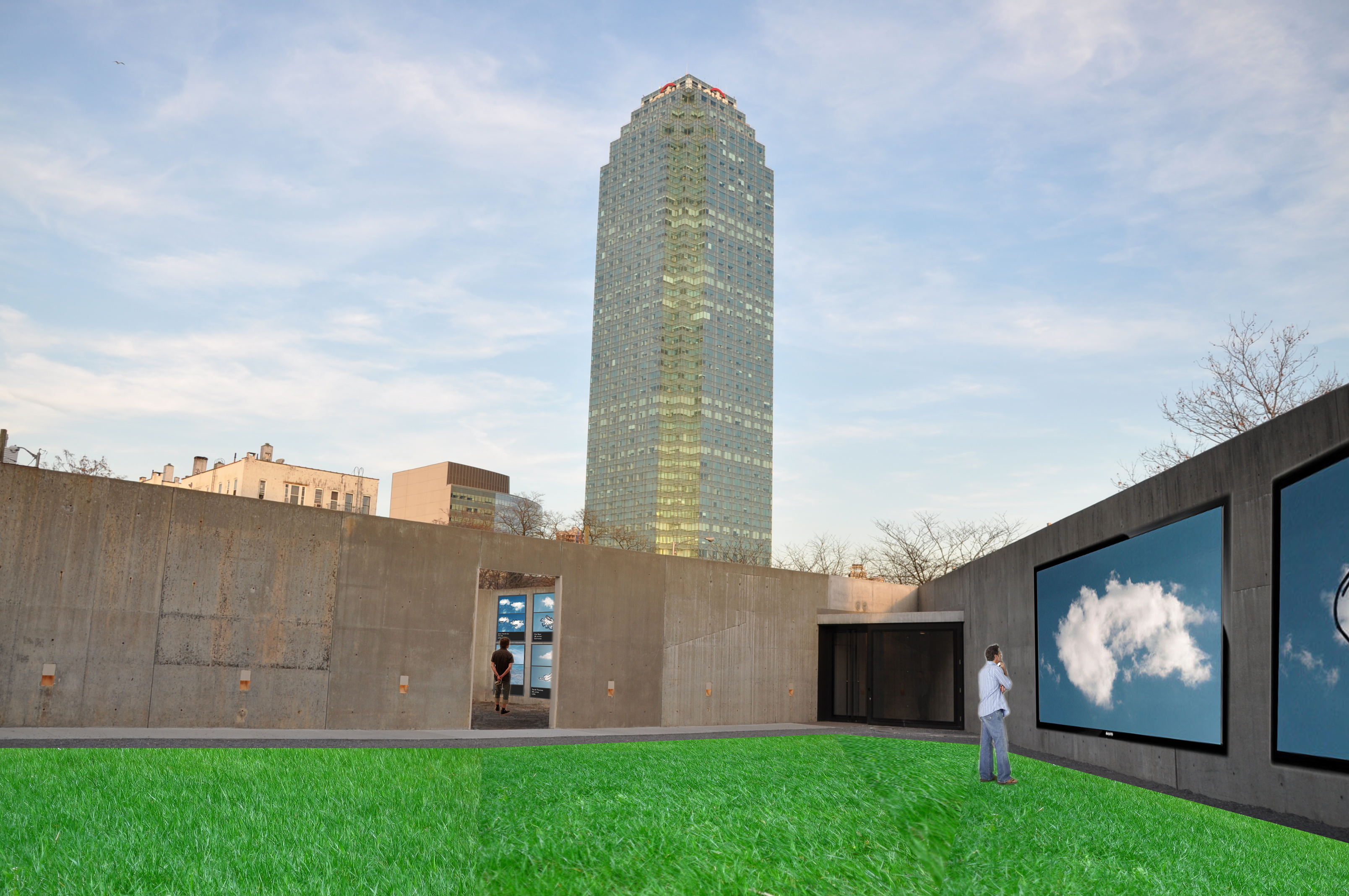
Rorsketch at MoMA PS1

An overview of the project:

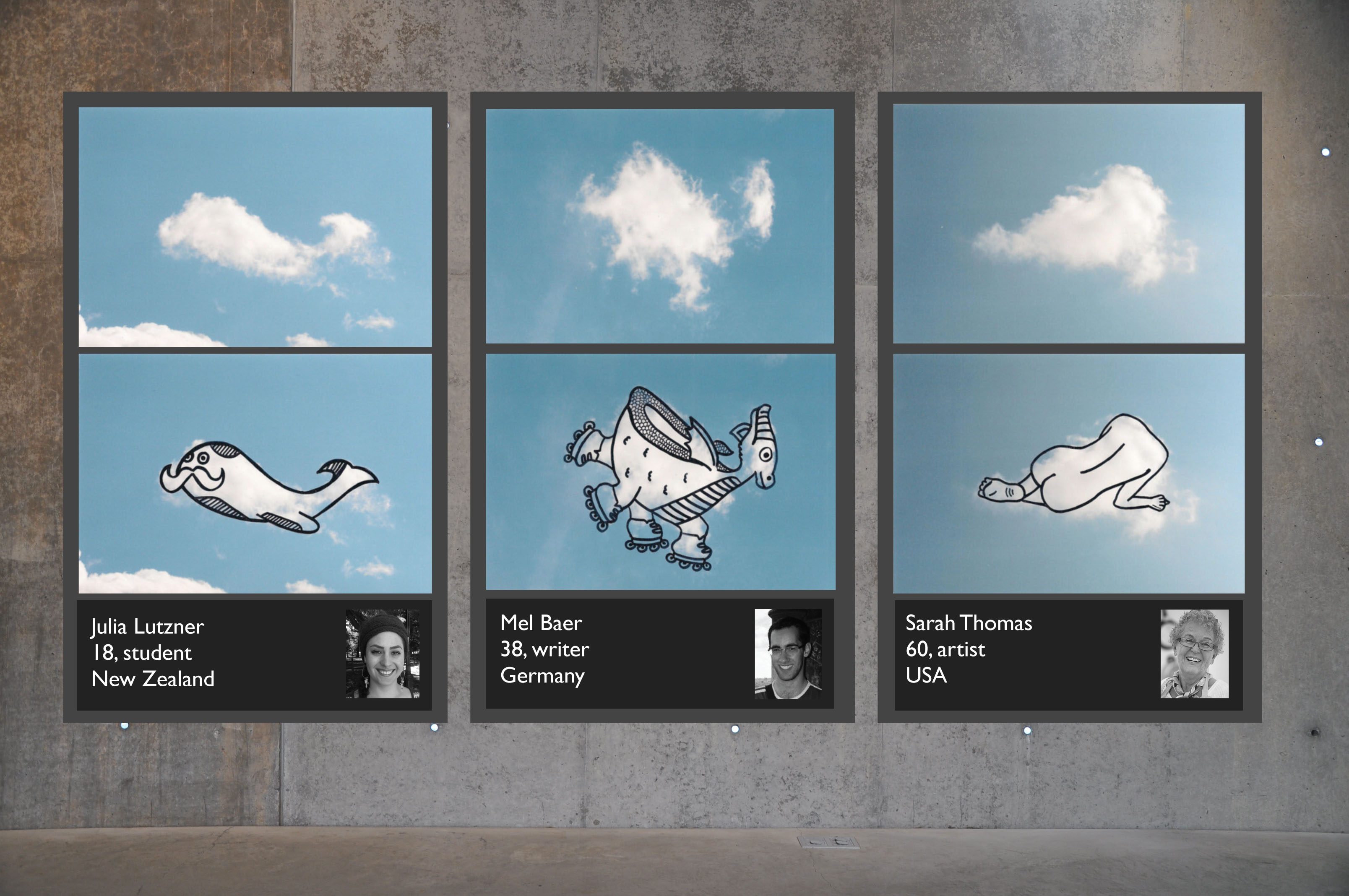
Rorsketch is a public collaborative art project that allows MoMA PS1 visitors to draw their interpretations of clouds on a digital interface on the rooftop. Using data gathered from visitors’ smartphones, the drawings will be automatically tagged with the sketcher’s name, age, profession, and country of origin. People can view the most recent interpretations in the courtyard. A gallery of these drawings with their metadata will be displayed in the two adjacent alcoves. These drawings will be documented online.

To gain admission to MoMA PS1 and to let the digital interface recognize the person creating the drawing, visitors will download an app on their smartphones:
Rorsketch, the mobile app

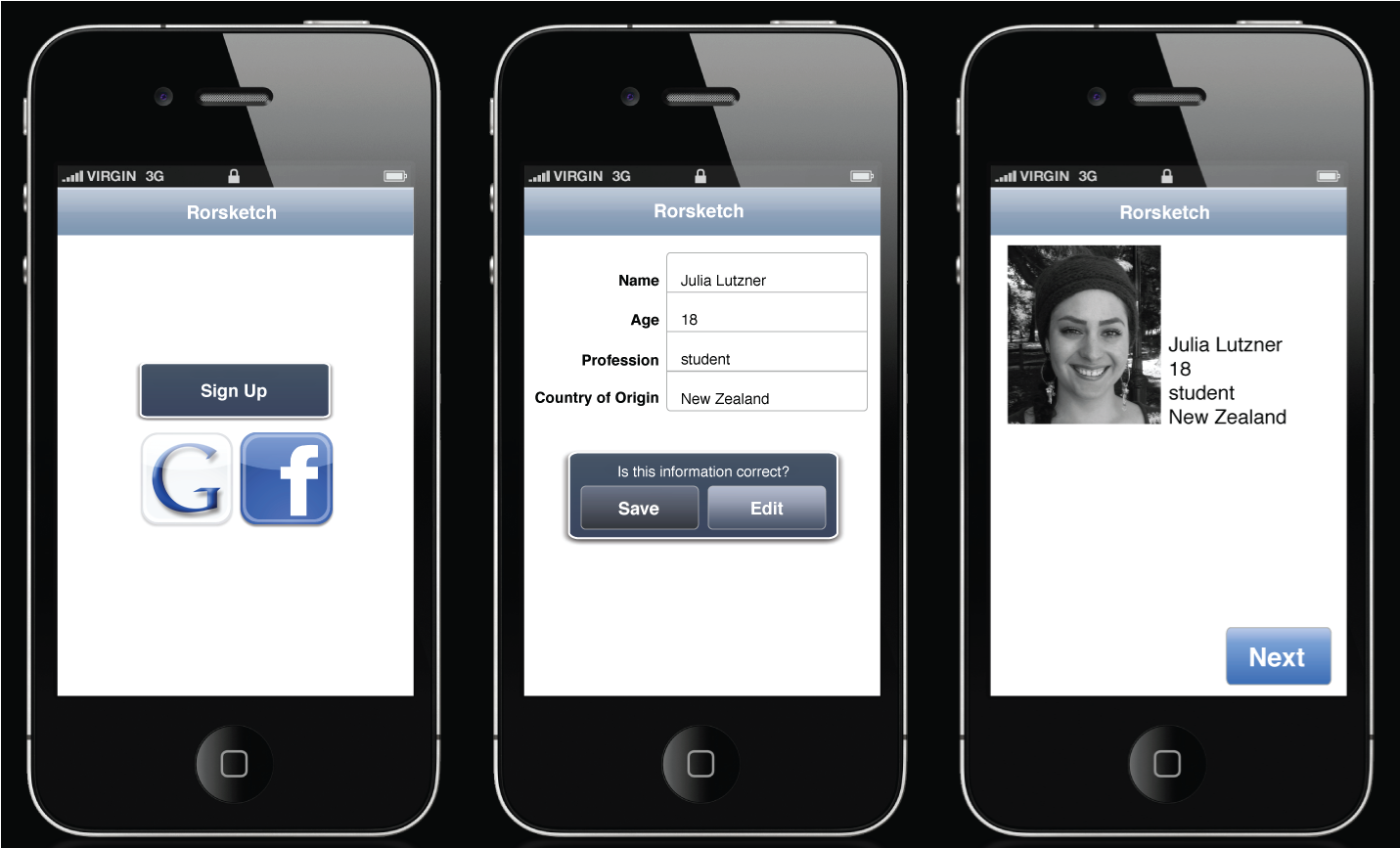
The mobile app will allow them to enter their information; namely, their name, age, profession, and country of origin. Alternatively, they can also sign in using their social networks:
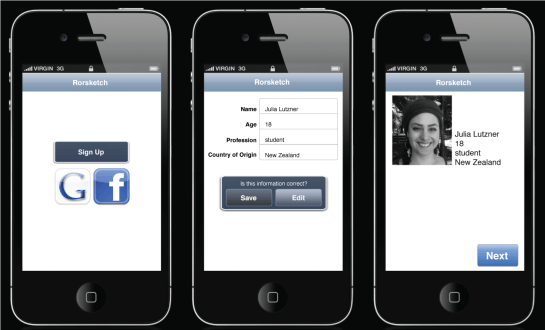
The app will ask for some information that will be used to tag the visitors' drawings.

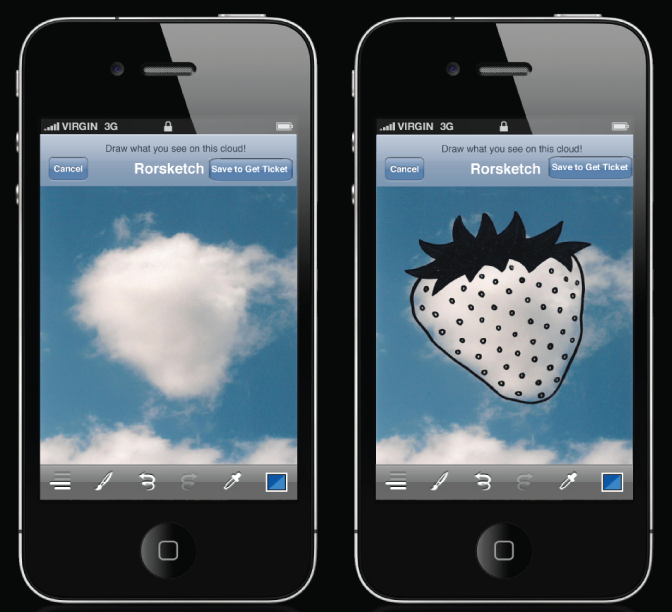
Next, visitors will also get a taste of what the project is about by requiring them to draw on a cloud:
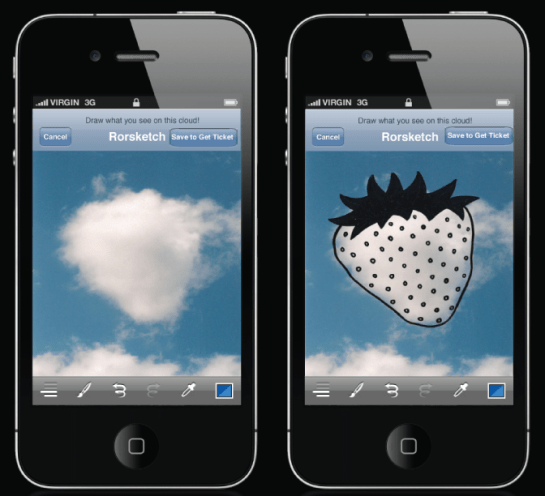
The Rorsketch app requires you to draw on a cloud before you get your QR code.

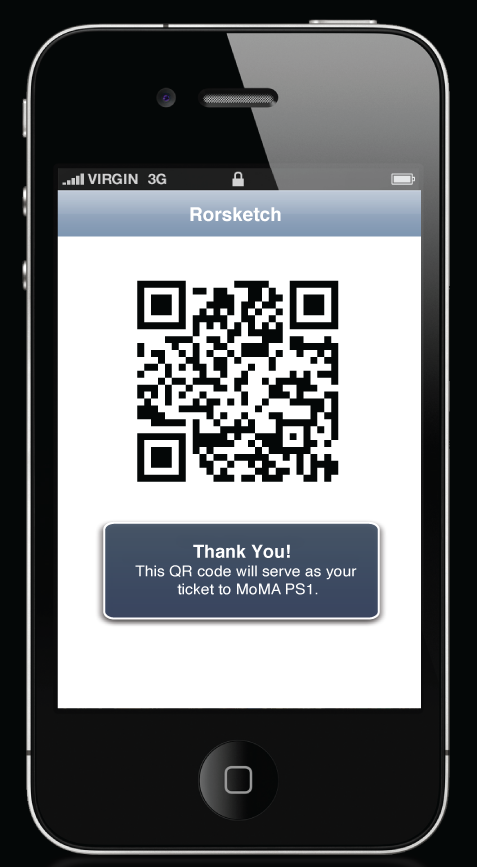
When you submit your drawing, you get a unique QR code that will allow you access to PS1 as well as the digital interface.

The Rorsketch mobile app gives you a unique QR code that serves as your ticket.

When visitors are at the rooftop, they will encounter a 22-inch transparent LCD screen that will show a live video feed of clouds. On days where there are no clouds, a pre-recorded video will be shown.
Visitors will encounter the Rorsketch digital interface on the rooftop.

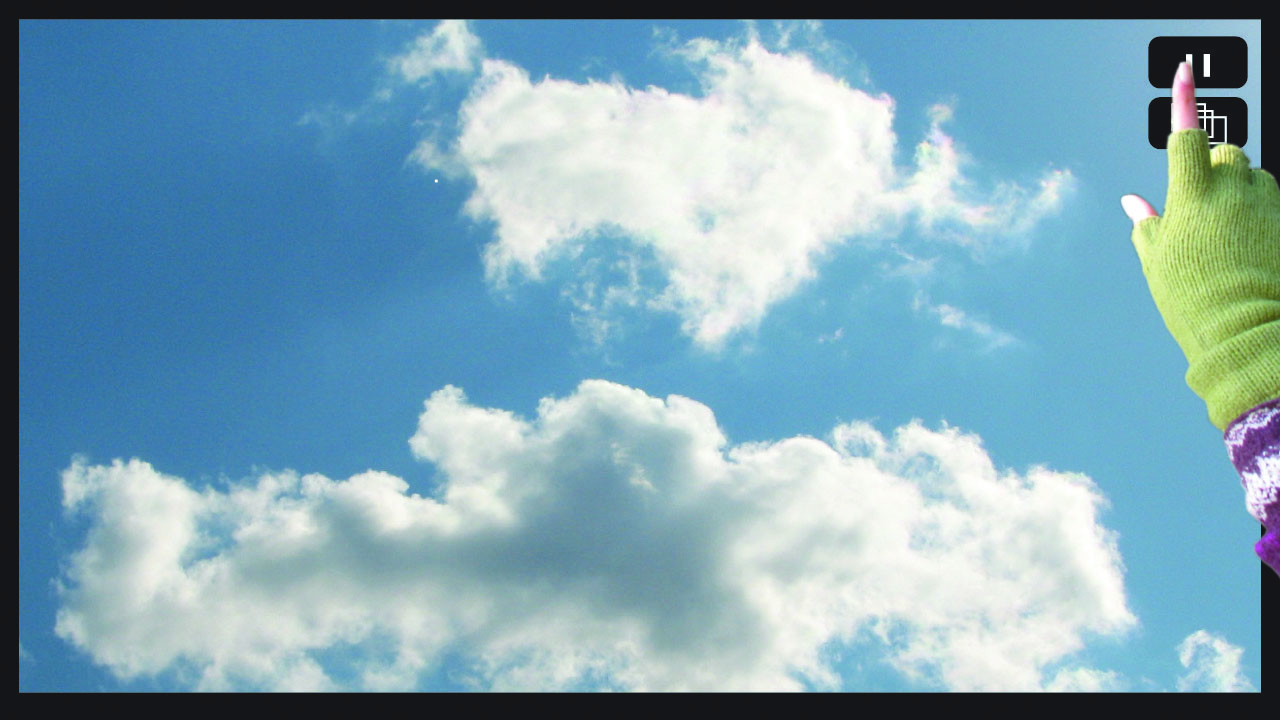
A visitor who wants to draw will have his QR code scanned to be identified. The visitor can pause the feed if he or she sees a cloud to be drawn.
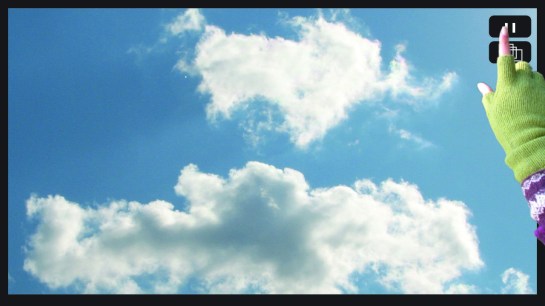
A visitor who wants to draw on a cloud can pause the video feed.

After pausing, the visitor will see that a palette of brushes appears, as well as the option to save or delete:
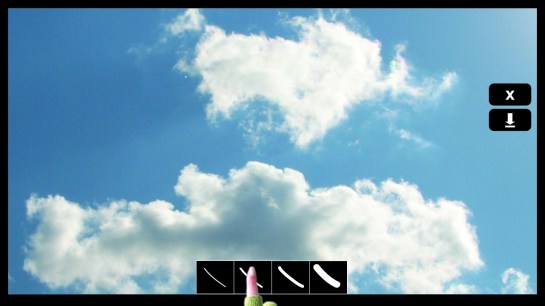
A visitor can choose from a palette of brushes with which to draw.

In this case, she sees an elephant:
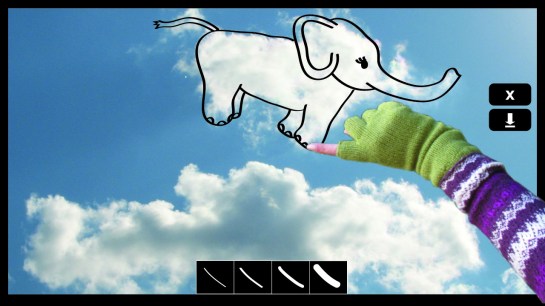
The Rorsketch Digital Interface allows you to freeze a live video feed of clouds, and draw on it.

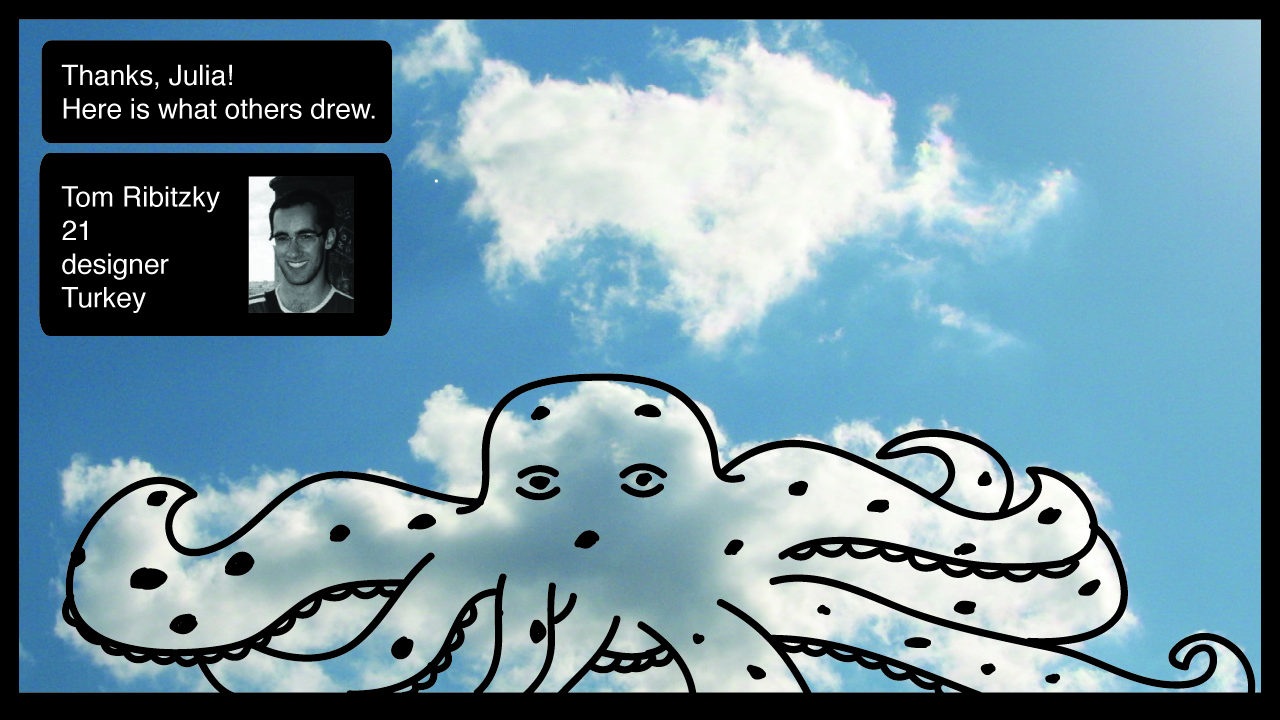
When the visitor saves the drawing, which is automatically tagged with his or her metadata, the interface may show a drawing by another person who may have interpreted it in another way:
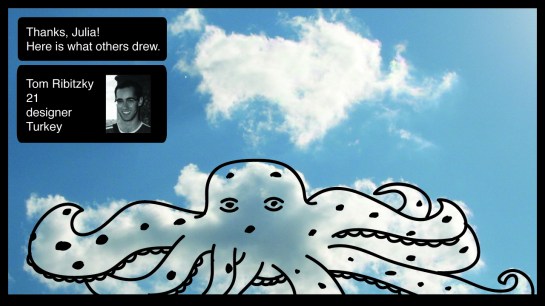
After a visitor submitted a drawing, the interface can show another drawing on the same cloud, if it so happens that another person interpreted it in another way.

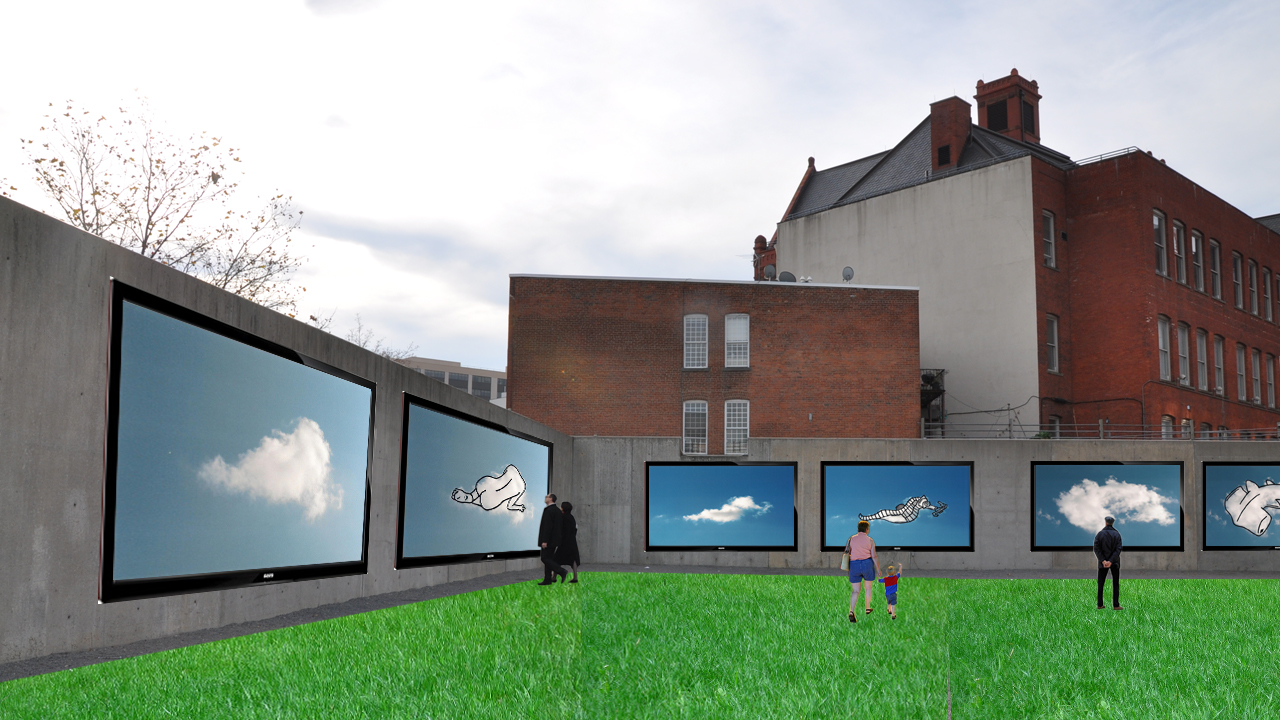
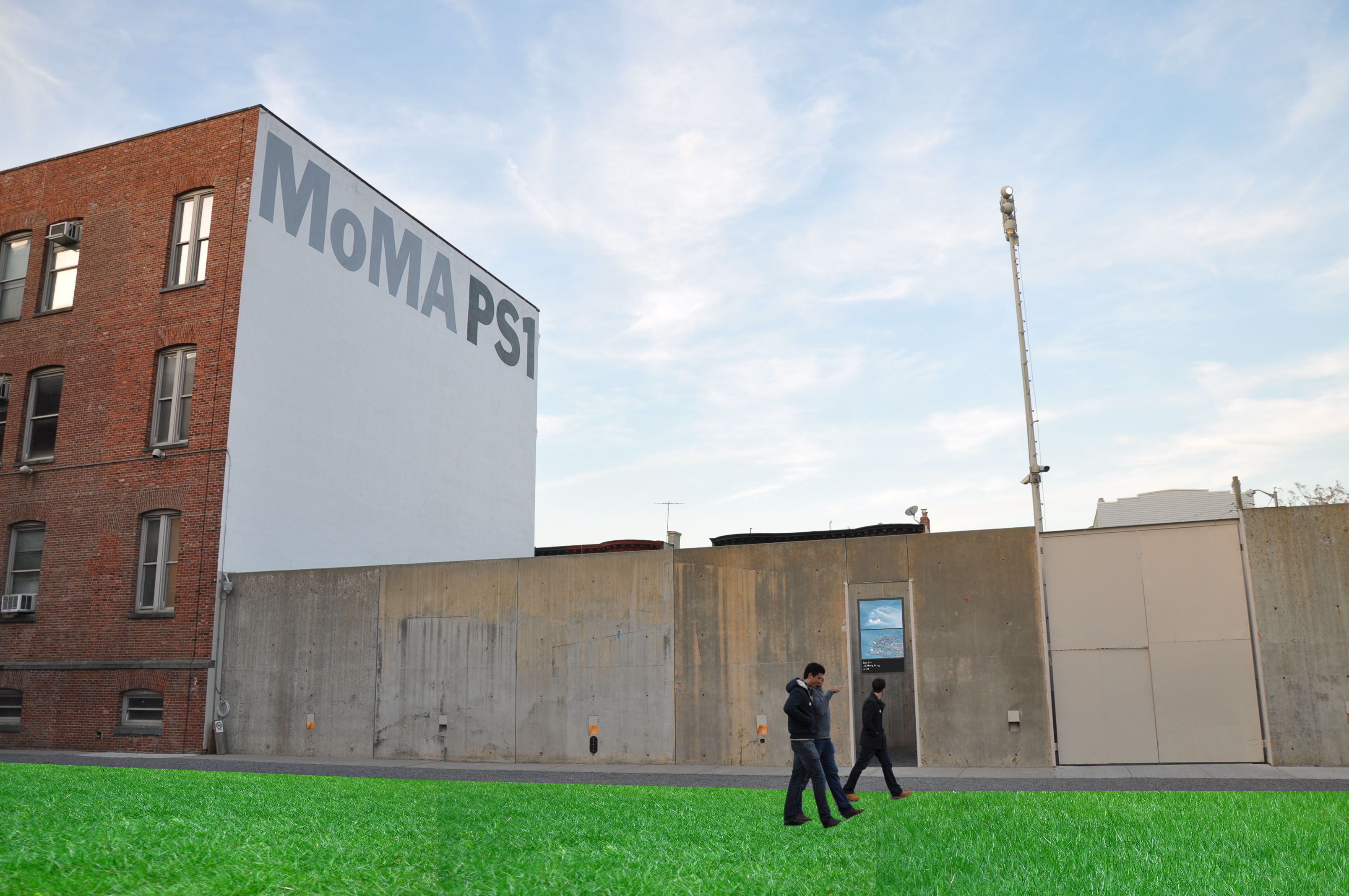
Meanwhile, down in the courtyard, visitors can view the most recent drawings through large LCD screens:
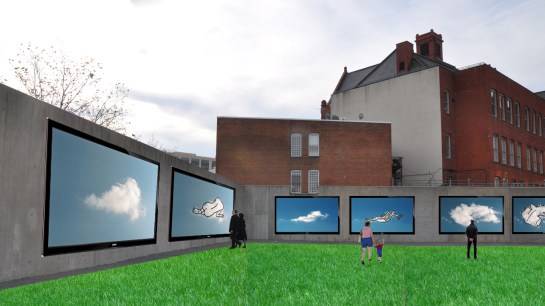
In the PS1 courtyard, visitors can view recent drawings with paired LCD screens, one showing the cloud and another showing the cloud with the drawing.
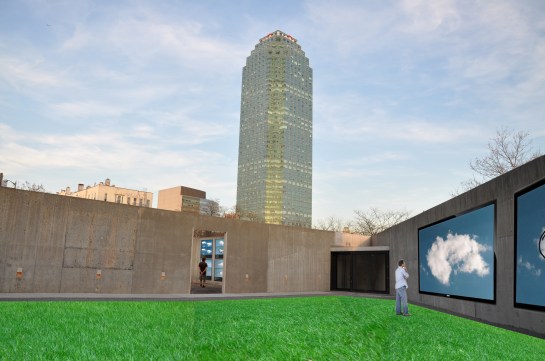
Rorsketch in the MoMA PS1 courtyard and adjacent alcoves

For the two small alcoves just across the courtyard, visitors will encounter a gallery of clouds and their drawings, together with the metadata of the people who drew them:

Rorsketch gallery in the MoMA PS1 alcoves
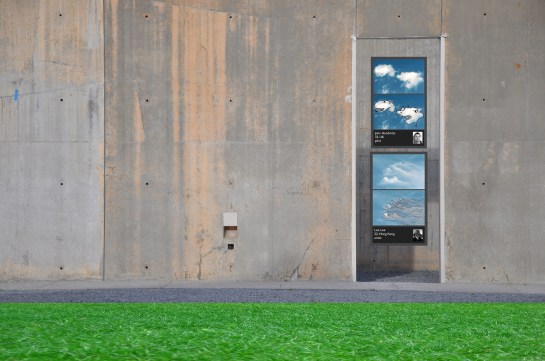
The Rorsketch gallery in the PS1 alcoves
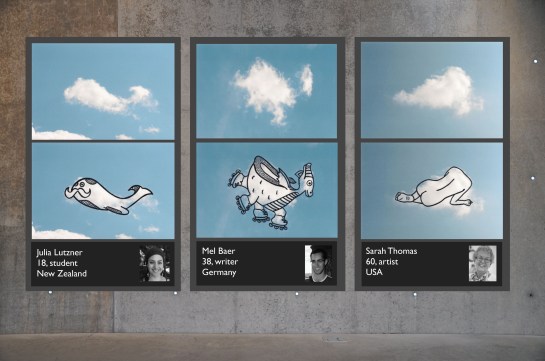
In the alcoves, the clouds and their drawings will be tagged with the sketcher's information.

Reflecting on this project, I wondered about this idea of recording humanity’s perception, similar to cave paintings made thousands of years ago, such as this one from the Chauvet cave, recently the subject of Werner Herzog’s documentary, Cave of Forgotten Dreams:
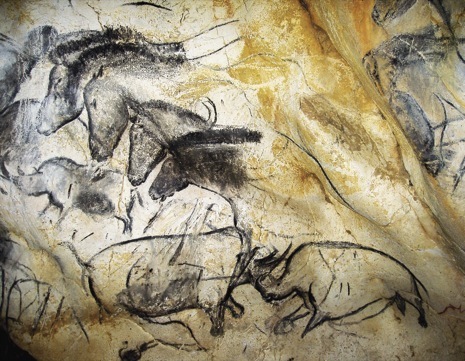
cave paintings at Chauvet, France (Image courtesy of the New Yorker)

I am fascinated by cave paintings because they are literally fragments of why our ancestors were the way they were; a record of what they saw. According to Michael Hofreiter, an evolutionary biologist at the University of York in England, whose team conducted research on cave paintings:
“It’s an enigma, but it’s also nice to see that if we go back 25,000 years, people didn’t have much technology and life was probably hard, but nevertheless they already endeavored in producing art. It tells us a lot about ourselves as a species.” (from an article in the NYTimes)

What if we had a way to record humanity’s perception over time? What will it say about the way we see?

Visit the project’s site here.

A postcript:

This was created as a final project for my class in Design for Public Interfaces at SVA’s Interaction Design program. Thanks to my instructors, Jake Barton and Ian Curry of Local Projects, as well as our guest panel for their valuable feedback.